X

TXTWRK


PERSONAL
LinkingLinking
FollowingFollowing
ConnectionsConnections
MessagesMessages
NotificationsNotifications
DISCOVER
SearchSearch
ReelsReels
CalendarCalendar
MapMaps
Work
NotesNotes
NeedsNeeds
ContributionsContributions
TimetableTimetable
IntelIntel
To DosTo Dos
ChecklistsChecklists
SavesSaves
ScrapboardScrapboard
LinksLinks
Monetisation
CoinsCoins
AdvertisingAdvertising
SubscriptionSubscription
DonationDonation
Log BookLog Book
Organisation
BusinessBusiness
AddressesAddresses
InvestorInvestor
FinancialsFinancials
Quarterly'sQuarterly's
SharesShares
Server
ServerServer
WorkspaceWorkspace
Code PlaygroundPlayground
Learn More
AboutAbout
AIDAID
DataData
DevDev
Web ImpressionsImpressions
ToolsTools
EducationEducation
SafetySafety
ReaderReader
My Content
Profile Image
Login

My Addresses

×
Addresses
+
Character Profiles
+
Info & Cover
+
Timetables
+
Favorited by... X
Link Clicks X
All comments... X
More | 1/33

TXTWRK Verified Website

@TXTWRK

City of Derby, Derby, Derbyshire, East Midlands, England, United Kingdom, Europe

Our mission is to help people make text work in daily life. Get investment, volunteers, donations & more publicly…

Join the journey & make a profile to remember... Discover our investment opportunities via our card: @TXTWRK

We developed & support the @UnitedKingdom movement through #UnitedKingdom


Brand
12/01/2024
Learn more about me 𓇻
Donations: £2.50
▦ Photos
▦ Videos
▦ Covers
Applications
Questionnaires
Active: 1 hours ago
Safety


OPENING TIMES
Show Images
Select a Store Location...
▼

Initializing schedule...

LOCAL PULSE

Profile Signals

Loading…
Loading profile signal…

Loading latest public Local Pulse signal…

Financials Financials
Quarterlys Quarterlys
Shares Shares
Notes Notes
Needs Needs
Contributions Contributions
Timetable Timetable
Intel Intel
To Dos To Dos
Notes Reel


Happening & Service
Happening Now and service updates connected to this profile


Happening in Offers
Offers available from this profile
Loading offers…


Connections
These are pages I added


Intel Pinned

Transparency of Operations
To make things even clearer, we are going to be updating our business registration in the coming days to 'TXTWRK Limited' in the UK & currently operate online in our startup phase, with workshops in educational institutions & community settings. We operate via the following domains: We monitise via the following sites: We operate the following social media: We operate the email addresses:
•Team@TXTWRK.com
•Support@TXTWRK.com
•Business@TXTWRK.com
•CommunityLibrary@TXTWRK.com
•Sponsors@TXTWRK.com
•Volunteer@TXTWRK.com
•Work@TXTWRK.com
•Writers@TXTRK.com
We operate the following TXTWRK pages: We operate the phone numbers: •447984582170 •0800 line coming soon We operate the following addresses:
•Currently in the process of setting up our office
•PO BOX coming soon & we focus on written communications
More intel:
•Need to request a removal from our Community Library, then simply email CommunityLibrary@TXTWRK.com
•Looking for account control, refer to ⚙ Settings/Linking to update your details or view https://txtwrk.com/account to understand your data or delete account
•We will never ask for your password or sensitive information and you should follow forms such as https://txtwrk.com/reset if you need to regain access to your account.
•We operate PayPal via our websites & also on TXTWRK
We keep this information up to date and concurrently here at TXTWRK via our intel reels - Last updated: 13/04/2026 00:16
Pinned Intel · 2026-04-12 23:14:46


Loading media...
DOUBLE TAP TO OPEN
+AI
+Analysis
•TXTWRK
+Assets
+Media
•Logos
+Standards
•Font
+Audio
•From Our Community
+Podcasts
+AI
•Insider Preview
+Language
•S1 E1 Psychology Research by @ImSunnyClaire
+Challenges
•Web Development
+Checklists
+Dev
•Business
•Server
•Web
•For Community
+Community Mentions
•Recognised as Stories
+Datasets
+Measurements
•Daily Common
+Documentation
•3D, AR & VR
+AI
•Checklists with AI
•Future Capabilities
•Insights
•Make Artistic Web Impressions
+Models
•Apple Intelligence
•Bing Copilot
•ChatGPT
•Claude
•IBM WatsonX
•Perchance
•Qwen
•TXTWRK AID
•Teaching
+Accessibility
•Feature Displayer
+Account Management
•Switch Accounts
•All Activity
+Assets
•Feedback
•Learn how to use assets
+Posting
•Set Projection
+Business
•Opportunities
+Checklists
•All Activity
•Applying
•Checklists Command Input 1.0
•Create
•Create Checklist with AI
•Directory API
•Engage
•Public Working
•Replicate
+Templates
•Starter Set
•Connect
+Data
•Account
•Cross Network Data API
•Directory
•Donations
+Feedback
•Streets
•TXTWRK Pulse
•Following
+Games
•Quiz
•Happening
+History
•In 1000 years
+Investors
+Crowdfunding
•Kickstarter
+Funding Rounds
•Funding Round 1
•Funding Round 2
•Funding Round 3
+Summary of Funding Rounds
•3 Core Funding Rounds
•Tools
+Labels
•Introduction
+Live
•Audio Rooms
+Location
•Addresses
+Management
•Future Proof
+Media
•3D Elements
•Record Audio
+Web Impressions
•Stickers
•Themes & Slideshows
•Messaging
•Monitisation
•Notifications
+Posting
•Prize Draws
•Transparency
+Progress
•Friday Weekly Updates
•In 1000 years
•TXTWRK Team
•Questions
•Reels
•Registration
+Safeguarding
•Covers of Education
•Logical Filters
•Our Safety Tools
•Search
+Selling
•Log Book & Types
+Server
•Connect to TXTWRK
•TXTWRK Servers
•Workspace
•Set Projection
+Shortcuts
•Posts
•Story Mode
+The Framework
•Language
•Tools
•Trending Topics
+Events
+April
•Easter
+December
•Christmas
•Hanukah
+March
•Eid Mubarak
•Seasons
+TXTWRK
•Annual
+Films
+From TXTWRK to Film
•Our Trail To Work
+Person of Interest X 2025
•Preview
+The Super 10
•Preview
+Learn How To
•Social Media
+Our Feedback
+Companies
+Alphabet Inc
•YouTube
•Facebook
+Partners
+AI
•Microsoft
+Educational
•Derby College
+People
+Digital
•Steve Jobs
+Role Models
•Questions
+Shop
+Digital
•NFT The Platinum Collection
+Subscriptions
+From TXTWRK
•Monthly Tiers
+United Kingdom
+Guidance
•Startups
+Podcasts
•S1 E1 The Start
+Work
+Startup
•Kids
+World
•Pledges
•Politics


@TXTWRK


Topic: Posts
⛶
Technology
Neutral
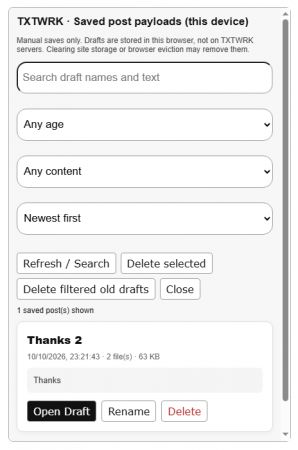
📢 TXTWRK Update: Introducing the Post Draft Upgrade with Library 💾


Create now. Save locally. Publish when you're ready.

At @TXTWRK, we're continuing to improve how people create, manage and publish content.

Our new Post Draft Library gives members greater control over unfinished posts, including posts containing text, images, videos, audio, checklists and other interactive content.

Instead of requiring every unfinished post to be uploaded to our servers, TXTWRK now supports browser-based draft storage.

You decide when to save, what to keep and when to publish.

---

💾 1. How the New Draft Library Works


TXTWRK uses your browser's IndexedDB storage system to save unfinished post payloads on your device.

A post payload is the collection of information you have entered or attached to a post before publication.

This can include your written content, selected options, attachments and other post settings.

FeatureWhat it does
💾 Save DraftManually save the post you're creating
📄 Manage DraftsBrowse previously saved post payloads
✏️ Update DraftMake changes and save over an existing draft
📑 Save New CopyKeep another version of your post
📂 Open DraftReturn saved content to the post composer
🔎 Search & FilterFind drafts by name, age or media content
🏷️ RenameGive saved drafts meaningful names
🗑️ DeleteRemove individual or multiple saved drafts
↺ Reset PostClear your current post without deleting saved drafts
There is no automatic draft saving.

When you press Save Draft, TXTWRK saves your current work locally. Changes made after that save must be saved again if you want to preserve them.

Your saved drafts remain available for later use, provided your browser retains its site storage.

---

🎬 2. More Than Just Saving Text


TXTWRK posts can contain considerably more than a message and a photograph.

Our draft system is designed to preserve the information entered across the post composer.

Supported content and settings


Post featureDraft support
📝 Text, topics and assetsSaved form content
📸 PhotosSelected files and preview restoration
🎥 VideosSelected video files and related fields
🎙️ Voice and MP3Audio files and form settings
🎚️ Audio StudioProject arrangements and recorded takes
📖 StoriesScenes, media and narration fields
ChecklistsItems, groups and selected settings
🖥️ Checklist ServersSelected server information
🛍️ ProductsProduct form values
📈 InvestmentsFunding details and settings
EventsEvent details and dates
❓ QuestionnairesSaved input values
📍 LocationsLocation IDs and form selections
🔒 PrivacyAudience and visibility choices
💰 Paid ContentPricing and subscription settings
📊 CSV and 3DSupported files and related form values
🌐 Web ImpressionsSaved fields and HTML content
Important: Basic form values are broadly supported. Some advanced interactive editors may require additional review or adjustment after reopening a draft. Not every generated preview or editor state is guaranteed to be restored perfectly.

Our aim is to make returning to complex unfinished posts much easier.

---

👥 3. What Happens When Multiple Members Use the Same Device?


TXTWRK links each local draft library to the signed-in member's unique memberID.

For example, imagine two TXTWRK members using the same computer and browser profile.

ActionMember AMember B
Signs into TXTWRKMember A active—
Saves three drafts3 local drafts—
Signs outDrafts remain stored—
Member B signs inA's drafts not listedB's library opens
Member B saves two drafts3 drafts remain2 local drafts
Member A signs back inOriginal 3 drafts appearB's drafts remain separate
### What does that mean?
•Each member gets their own draft list within the TXTWRK interface.
•Signing out does not automatically erase saved drafts.
•Returning to the same account, browser and device allows that member to reopen their drafts.
•Another member signing in is not shown the previous member's draft library.

A privacy reminder: Member-specific draft lists provide application-level separation, not encryption or complete protection from someone who has access to the device's browser storage. Avoid storing sensitive drafts on shared or public computers.

---

📱 4. What Happens If You Change Devices?


Because TXTWRK's new draft system is browser-based, the location of your drafts matters.

SituationWill your saved drafts be available?
Close and reopen the same browserUsually yes
Restart your phone or computerUsually yes
Return after switching between appsUsually yes
Sign out and back into the same accountYes, if local storage remains
Another member signs in on the same browserOnly their own drafts are listed
Use a different browserNo automatic transfer
Sign in on another phoneNo automatic transfer
Clear TXTWRK browser site storageDrafts may be permanently lost
Uninstall a browser or clear its app dataDrafts may be lost
Your TXTWRK account identifies which local draft library to display, but the files themselves are not synchronised between your devices.

Save Draft is not a cloud-backup service. Browser storage may be cleared or evicted, and large media files are subject to available storage capacity.

---

🌍 5. How Does TXTWRK Compare with Other Social Networks?


Different networks take different approaches to unfinished content.

PlatformDraft approachKey distinction
TXTWRKManual, browser-based Draft LibraryMultiple named post payloads with supported files and settings
InstagramDrafts for posts and ReelsPrimarily device-based editing and content drafts
TikTokVideo draft collectionDrafts are device-dependent and may be lost after app removal
XPost and thread draftsDraft behaviour varies by application and device
LinkedInPost and article draftsSome drafts can be continued across devices
FacebookPersonal and Page draft workflowsDraft management differs between personal posting and Pages
TXTWRK's focus is on preserving more of the post creation process, rather than treating a draft as written text alone.

We also recognise that other platforms offer features such as cross-device drafts that TXTWRK's local-only library does not currently provide.

This is a different approach, designed around user-controlled local saving and the wide range of content TXTWRK supports.

---

💽 6. Why Use Browser Storage Instead of Uploading Every Draft?


There are several benefits to keeping unfinished post payloads locally.

For members

•More control: Decide exactly when to save.
•Less unnecessary uploading: Saving a draft does not submit the post payload to TXTWRK's draft servers.
•Multiple projects: Keep several unfinished posts and return to them individually.
•Media recovery: Selected files can be stored locally when browser storage permits.
•Draft management: Organise older work without publishing or deleting everything.

For the platform

•Fewer unnecessary draft-storage requests.
•Less server storage consumed by unfinished post uploads.
•Reduced dependence on repeated server-side draft saving.
•Separation between preparing content and publishing content.

The distinction matters: saving locally prepares your work for later, while pressing Post sends your finished content through TXTWRK's normal publishing process.

---

🚀 7. How to Save and Reopen a Post


Using the Draft Library is straightforward.

1. Start creating a post. Add your text, media and other content.
2. Press 💾 Save Draft. Give your draft a name.
3. Continue working or leave TXTWRK. Your saved version remains in browser storage.
4. Return to TXTWRK. Sign into the same account using the same browser profile.
5. Press 📄 Manage Drafts. Browse or search your saved posts.
6. Select Open. TXTWRK loads the saved payload back into the composer.
7. Review and publish. Check restored media and settings, make any final changes, then press Post.

You can also use Save New Copy to preserve an earlier version while continuing to develop another.

What about old drafts?


The manager supports searching, sorting, filtering by age or media, and deleting individual or multiple saved records.

Saved drafts are not automatically removed simply because you reset the composer or publish a post. You can manage or delete those saved copies yourself.

---

⚠️ 8. Important Things to Remember


We want members to understand both the capabilities and limitations of this feature.

1. Browser storage is not unlimited. Large videos and other attachments may reach browser storage limits.

2. Save important work regularly. TXTWRK does not automatically save changes between manual saves.

3. Do not clear your site storage if you need your drafts. Clearing browser data can permanently remove locally saved content.

4. Use the same browser profile. Signing into TXTWRK on another browser or device will not automatically retrieve these drafts.

5. Review complex posts before publishing. Advanced media editors and interactive components may need adjustment after reopening.

6. Wait for a successful save confirmation. If saving fails because storage is full or unavailable, your latest changes have not been safely preserved.

---

🌱 9. What's Next for TXTWRK?


The Draft Library is another step towards making TXTWRK a more flexible environment for creating content.

We're building beyond the idea that a social post must be completed and published in one session.

Our longer-term goal is a creative environment where members can prepare detailed posts, work with different media formats, return to unfinished projects and manage their content before it goes public.

That means continuing to improve advanced editor restoration, media handling and the reliability of local draft recovery.

---

💬 Your Work. Your Timing. Your TXTWRK.


Not every idea needs to be published immediately.

Sometimes you want to write today, add media tomorrow, review your settings later and publish when everything is ready.

TXTWRK's Post Draft Library gives you that flexibility — with manual saving, local storage and multiple draft management tools.

Sign into TXTWRK, open your post composer and explore 💾 Save Draft and 📄 Manage Drafts.

What other draft-management features would you like us to introduce?

@TXTWRK — Helping the world make text work in daily life.

#TXTWRK #TXTWRKUpdate #SocialMedia #Drafts #ContentCreation #DigitalCreativity #CreatorTools #BrowserStorage #WebDevelopment

🗖 VIEW
⛶
Technology
Neutral
TXTWRK Development Report

Audio Across Posts, Checklists & Messaging

16 September 2026


Today marked a significant expansion of audio communication across TXTWRK.

What began as Audio Rooms connected to posts has now developed into audio functionality spanning three major areas of the network:

1. Posts — Audio Rooms
2. Checklists — Audio Rooms
3. Messaging — Audio Chats

Rather than creating one generic audio feature and forcing it into every part of TXTWRK, each implementation has been designed around the permissions, storage requirements and user behaviour of the area in which it operates.

The result is the beginning of a network-wide audio communication layer across TXTWRK.

---

1. Audio Rooms in Posts


The first implementation provides Audio Rooms attached directly to TXTWRK posts.

A post can contain its own Audio Room, allowing the post itself to become the centre of a recorded audio discussion.

Room Status


A newly created Audio Room begins Offline.

The room owner can switch it between:
•Offline
•Live

The visual state of the room changes accordingly, providing an immediate indication of whether the host is currently accepting participation.

The room owner controls when the room becomes active rather than simply leaving recording permanently available.

Guest Participation


Visitors can request to join an Audio Room.

The room owner receives a participation log and can manage requests by:
•Accepting a participant
•Removing acceptance
•Blocking a participant
•Viewing all requests
•Viewing blocked users
•Unblocking users

Accepted participants are then permitted to record within the room.

This creates a moderated audio environment rather than allowing unrestricted recording against a public post.

Recording Limits


The host has unrestricted recording time.

Guest recording limits can be configured using options including:
•10 seconds
•15 seconds
•30 seconds
•1 minute
•3 minutes
•Unlimited

This allows the room owner to determine the expected style of participation.

A room could therefore be configured for very short voice responses or longer-form discussion.

Dynamic Room Behaviour


While an Audio Room is Live, its state and participation information can refresh dynamically.

Guests can discover when they have been accepted without needing to manually reload the entire page.

Once accepted, recording functionality becomes available to them.

Recording and Playback


Audio recordings are stored against the Audio Room and can subsequently be played through the room interface.

Playback and pagination allow a growing Audio Room to remain usable as additional recordings are added.

Data Accounting


TXTWRK-hosted recordings participate in TXTWRK's data accounting system.

This connects Audio Rooms to the wider storage/data model rather than treating audio as unlimited external media.

Post Audio Room Structure


Conceptually:

Post
└── Audio Room
├── Offline / Live
├── Host
├── Join Requests
├── Accept / Block
├── Guest Recording Limits
├── Recordings
└── Playback

The important distinction is that the audio conversation belongs to the post itself.

Users do not have to leave the post and create a separate group conversation simply to discuss it using audio.

---

2. Audio Rooms in Checklists


The second major development was adapting Audio Rooms for TXTWRK Checklists.

This required a different architecture because a checklist is not a social post.

It represents structured work, collaboration and existing permissions.

For this reason, Checklist Audio Rooms were developed as their own system rather than simply reusing the Post Audio Room participation model.

Audio Attached to a Checklist Item


A Checklist Audio Room belongs directly to a checklist item.

Conceptually:

Checklist
└── Checklist Item
└── Audio Room

This allows an audio discussion to remain attached to the exact piece of work being discussed.

Instead of discussing a checklist task somewhere else in a general messaging conversation, the discussion remains with the task.

Turning Audio On


Checklist items can expose an Audio Room control allowing the feature to be enabled for that particular item.

This means Audio Rooms do not need to exist unnecessarily on every checklist item.

They can be activated where audio collaboration is useful.

Checklist Permissions


Unlike public Post Audio Rooms, checklist participants already operate within a permissions system.

Therefore the Post Audio Room workflow of:

Join
↓
Request
↓
Host Accepts
↓
Recording Enabled

is unnecessary.

Instead:

Checklist Permission
↓
Audio Room Permission

Users who already have the appropriate checklist permissions can participate automatically.

This makes the Checklist Audio Room behave as part of the collaborative work environment rather than as a separate social room.

Recording Topics


Checklist recordings can optionally be associated with topics.

This provides another organisational layer for Audio Rooms that may accumulate substantial discussion.

Recordings can subsequently be filtered according to the selected topic.

This is particularly useful when one checklist item contains several areas of discussion.

Date Organisation


Recordings can be grouped and retrieved by date.

Features such as:
•Play Today
•Date grouping
•Initial recording limits
•View More loading

allow longer-running checklist discussions to remain manageable.

Live Behaviour


Checklist Audio Rooms can still operate with Live behaviour.

Polling can be limited to situations where:
•the Audio Room is Live; and
•the room is currently within the user's viewport.

This avoids unnecessary background requests while retaining responsive behaviour when users are actively viewing the room.

---

3. Checklist Audio Storage


Checklist Audio Rooms introduced another important capability: selectable storage.

When configuring the Audio Room, storage can be directed to either:

1. TXTWRK
2. The user's connected server through the Directory API infrastructure

TXTWRK Storage


TXTWRK can host the audio using the user's available TXTWRK data balance.

Connected Server Storage


Where the user has configured suitable server infrastructure through TXTWRK's Directory API system, the audio object can instead be stored on that server.

Conceptually:

Checklist Recording
│
▼
TXTWRK
│
├────────► TXTWRK Data Balance
│
└────────► Connected Directory API Server

TXTWRK can therefore remain responsible for the checklist, Audio Room, recording metadata and interface without necessarily being responsible for permanently storing the underlying media object.

This begins separating two concepts:

the network managing the collaboration

from:

the infrastructure storing the media

---

4. Public Checklist Listening


Checklist Audio Rooms were also designed to support public listening where appropriate.

This means an Audio Room can potentially be heard by people who are not authenticated TXTWRK participants while recording permissions remain protected.

The distinction becomes:

Listening
│
└── Can be public where enabled

Recording
│
└── Requires appropriate checklist access

This allows checklist owners to expose useful audio information without granting public users the ability to contribute recordings.

---

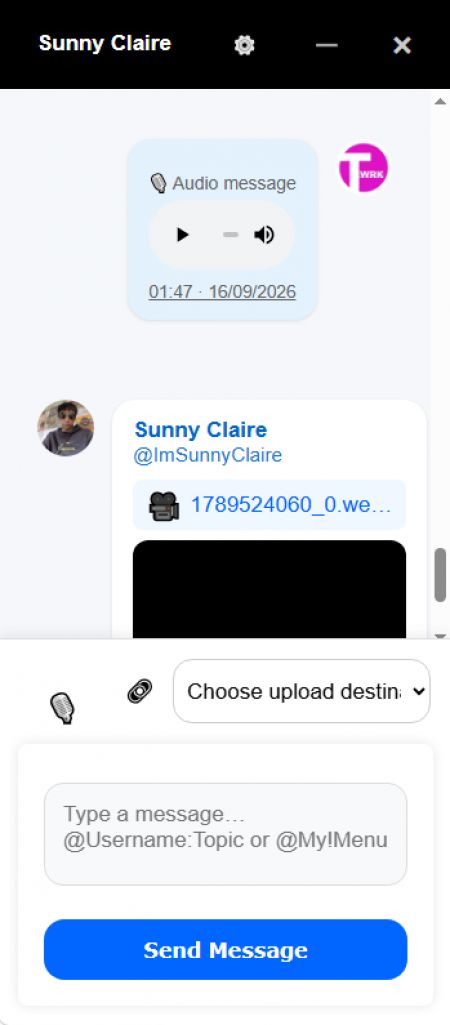
5. Audio Chats in Messaging


The third major development brought recorded audio into TXTWRK Messaging.

Audio Chats are being integrated into both:
•Direct conversations
•Group conversations

Unlike Post and Checklist Audio Rooms, Messaging Audio is designed around private asynchronous communication.

It therefore behaves more like a conventional voice message while still making use of TXTWRK's wider infrastructure model.

Messaging Composer


The existing messaging composer gains a microphone control positioned alongside the existing attachment controls.

Conceptually:

🎙️ 🔗 Message... Send

Users can record an Audio Chat directly from the messaging interface.

Recording


Browser recording uses the available media recording capabilities of the user's device/browser.

Once recording begins, the user can stop the recording and preview the pending audio before sending it.

Audio Without Text


An important part of the implementation is that an Audio Chat does not require a text message.

A message can therefore consist entirely of:

🎙️ Audio Recording

rather than requiring:

Text + Audio Recording

This allows audio to behave as a genuine messaging format rather than merely as an attachment to text.

Direct Conversations


Audio can be recorded and sent inside ordinary one-to-one TXTWRK conversations.

Group Conversations


The same capability is available within group messaging.

The messaging architecture therefore becomes:

Messaging
│
├── Direct Chat
│ └── Audio Chat
│
└── Group Chat
└── Audio Chat

---

6. Messaging Audio Storage


Messaging Audio Chats also introduce selectable storage.

The default storage destination is TXTWRK Data Balance.

A user with an appropriate Messaging API/server connection can instead choose to store Audio Chats on their connected server.

Default


Audio Storage:
TXTWRK Data Balance

This requires no additional server configuration.

Connected Server


Where suitable infrastructure has been configured:

Audio Storage:
My Messaging API Server

can be selected instead.

Conceptually:

Audio Chat
│
▼
TXTWRK
│
├────────► TXTWRK Data Balance
│
└────────► Messaging API / User Server

This allows users who operate their own infrastructure to preserve their TXTWRK data allowance by storing the underlying recording themselves.

---

7. TXTWRK Messaging Audio Storage Structure


TXTWRK-hosted Messaging Audio has been deliberately separated from the earlier Audio Room systems.

Its storage hierarchy is:

/1-audio-rooms-messaging/
{memberID}/
direct/
{chat_controller_id}/
audio_xxxxx.webm

group/
{group_id}/
audio_xxxxx.webm

This keeps:
•Post Audio Rooms
•Checklist Audio Rooms
•Messaging Audio Chats

separate at the storage level.

The implementations therefore do not need to interfere with one another simply because they all contain recorded audio.

---

8. Messaging Audio Data Accounting


When an Audio Chat is stored by TXTWRK, it consumes the appropriate user's TXTWRK data balance.

The recording therefore becomes part of the same broader storage economy as other TXTWRK-hosted data.

Where the user's own Messaging API server is selected instead, TXTWRK does not need to charge its own storage balance for the underlying audio object.

This creates a practical reason for users with their own infrastructure to connect it.

---

9. Audio Deletion and Ownership


Messaging storage also requires different deletion behaviour depending on where the media lives.

TXTWRK-Hosted Audio


Where TXTWRK owns the physical stored object, the system can manage:
•physical deletion;
•storage metadata;
•data accounting; and
•appropriate data refunds.

User-Server Audio


Where the audio resides on a user's connected server, TXTWRK should not treat that physical object as its own property.

Removing or hiding the TXTWRK message therefore does not mean TXTWRK should reach into the user's server and destroy the original media object.

Conceptually:

TXTWRK-hosted recording
↓
TXTWRK controls storage lifecycle

User-server recording
↓
Server owner controls storage lifecycle

This establishes a clearer ownership boundary between TXTWRK and connected infrastructure.

---

10. Protecting Private Messaging Audio


The TXTWRK Messaging Audio storage directory has also been treated separately from the earlier public Audio Room work.

The directory:

/1-audio-rooms-messaging/

can have its own .htaccess protection.

The protection includes:
•directory indexing disabled;
•executable scripts blocked;
•unexpected file types blocked;
•MIME sniffing protection;
•direct/no-referrer requests rejected; and
•playback requests restricted to TXTWRK-originating pages under the current hotlink-protection model.

This protection applies only to Messaging Audio.

The earlier Post and Checklist Audio Room directories are not changed by this Messaging-specific protection.

---

11. End-of-Day Audio Architecture


At the end of today's work, TXTWRK effectively has three different audio systems serving three different purposes.

AreaAudio TypePrimary PurposeParticipationStorage
PostsAudio RoomsSocial discussionHost + requested/accepted guestsTXTWRK
ChecklistsAudio RoomsWork collaborationChecklist-authorized usersTXTWRK or connected server
MessagingAudio ChatsPrivate communicationDirect/group participantsTXTWRK or Messaging API server
This separation is important.

The goal has not been to create three copies of the same microphone feature.

Each implementation reflects its environment.

---

12. Social Audio


Post Audio Rooms represent the social layer.

SOCIAL
│
▼
Post
│
▼
Audio Room
│
├── Host
├── Live / Offline
├── Join Requests
├── Accept / Block
├── Recording Limits
└── Playback

The conversation revolves around published content.

---

13. Work Audio


Checklist Audio Rooms represent the work layer.

WORK
│
▼
Checklist
│
▼
Checklist Item
│
▼
Audio Room
│
├── Checklist Permissions
├── Recording
├── Topics
├── Date Organisation
├── Public Listening
└── Selectable Storage

The conversation revolves around a specific piece of work.

---

14. Private Audio


Messaging Audio Chats represent the private communication layer.

PRIVATE
│
▼
Messaging
│
├── Direct
│ └── Audio Chat
│
└── Group
└── Audio Chat

The conversation revolves around private communication between users or groups.

---

15. One Audio Layer Across TXTWRK


Together, the three implementations can be viewed as:

TXTWRK AUDIO
│
┌───────────────┼───────────────┐
│ │ │
▼ ▼ ▼
SOCIAL WORK PRIVATE
│ │ │
POST CHECKLIST MESSAGING
│ │ │
AUDIO ROOM AUDIO ROOM AUDIO CHAT
│ │ │
Discussion Collaboration Conversation

This is a much broader development than simply adding voice messages.

Audio now has a place across three fundamentally different types of activity on TXTWRK.

---

16. Competitive Comparison — TXTWRK Audio Across the Network


Recorded audio itself is not unusual among modern communication networks.

Major messaging and collaboration platforms already provide various forms of:
•voice messages;
•recorded clips;
•voice channels;
•calls;
•meetings; and
•synchronous audio.

The more relevant comparison is therefore not:

"Does TXTWRK have audio?"

The more useful question is:

"Where can audio exist within TXTWRK, what is it attached to, who controls participation, and who controls its storage?"

That produces a considerably more interesting comparison.

---

17. Comparison With Other Major Networks


CapabilityTXTWRKWhatsAppDiscordSignalSlackMicrosoft Teams
Recorded audio in direct messagingYesYesYesYesYesYes
Recorded audio in group messagingYesYesYesYesYesYes
Audio connected directly to social postsYesNo direct equivalentDifferent modelNoDifferent modelDifferent model
Dedicated Audio Room attached to a postYesNoVoice channels use a different modelNoHuddles use a different modelMeetings use a different model
Audio attached directly to checklist/work itemsYesNoNo direct equivalentNoNo direct equivalentNo direct equivalent
Existing checklist permissions control recording accessYes—————
Public listening with controlled recording participationYes—Different model—Different modelDifferent model
Choice between platform storage and user's own serverYesNo normal user-facing equivalentNo normal user-facing equivalentNo normal user-facing equivalentNo normal user-facing equivalentNo normal user-facing equivalent
Own-server audio can avoid platform data usageYes—————
Audio integrated across social + work + private messagingYesPrimarily messagingCommunity + messagingPrimarily messagingWork + messagingWork + messaging
The comparison is not intended to suggest that other platforms lack sophisticated audio systems.

Several of them have extremely mature audio, calling, transcription, encryption and mobile experiences.

The distinction is the combination TXTWRK is developing.

---

18. Comparison With Messaging Networks


Platforms such as WhatsApp and Signal demonstrate the established value of asynchronous voice communication.

Voice recordings work naturally when users want to communicate something faster or more personally than typing a message.

TXTWRK Messaging now enters that same general category through Audio Chats.

However, TXTWRK's implementation also connects messaging audio to its wider infrastructure model.

A user can potentially choose between:

TXTWRK-hosted media

or:

User-hosted media

while continuing to use the same TXTWRK conversation.

The communication network and storage provider therefore do not necessarily have to be the same entity.

---

19. Comparison With Community Platforms


Discord demonstrates another model where audio extends beyond conventional private messaging.

Its ecosystem combines messaging with community-oriented voice functionality.

TXTWRK Post Audio Rooms approach community audio differently.

Instead of creating a voice channel that exists independently of a piece of content, the Audio Room belongs directly to a post.

Conceptually:

Traditional Community Voice

Community
↓
Voice Channel
↓
Conversation


TXTWRK Post Audio

Post
↓
Audio Room
↓
Conversation about that Post

The content itself becomes the location of the audio discussion.

---

20. Comparison With Workplace Platforms


Slack and Microsoft Teams demonstrate how recorded communication can become useful in professional collaboration.

Audio and video clips can reduce the need for synchronous meetings and allow information to be consumed asynchronously.

TXTWRK Checklist Audio Rooms approach the work context from the perspective of the work item itself.

Instead of:

Channel
↓
Discussion
↓
User determines which task it concerns

TXTWRK can provide:

Checklist Item
↓
Audio Discussion
↓
Context already established

The recording is already attached to the object being discussed.

This reduces the separation between communication and the work itself.

---

21. Storage as an Architectural Difference


One of the most significant differences introduced during today's development is the ability to separate TXTWRK's application layer from the physical storage layer.

A conventional hosted network can broadly be represented as:

User
│
▼
Platform
│
▼
Platform-Controlled Storage

TXTWRK is developing another possibility:

User
│
▼
TXTWRK
│
├────────────► TXTWRK Storage
│
└────────────► User-Controlled Server

TXTWRK can remain responsible for:
•identity;
•permissions;
•conversations;
•checklist relationships;
•room metadata;
•interfaces; and
•application logic

while the physical media can, where supported, live somewhere selected by the user.

---

22. Data Balance or Infrastructure Ownership


This creates two different ways of consuming an audio service.

TXTWRK Data Balance


The simplest route is:

Record
↓
TXTWRK
↓
TXTWRK Storage
↓
Data Balance

No external infrastructure is required.

User Infrastructure


A user with their own compatible server can instead use:

Record
↓
TXTWRK
↓
Connected Server
↓
User-Controlled Storage

This can reduce consumption of the user's TXTWRK data balance while giving the server owner greater control over the underlying media object.

---

23. The Network and the Storage Do Not Have to Be the Same Thing


This is an important architectural principle emerging from the work.

Historically, users of a hosted social or messaging network generally expect:

Platform = Application + Communication + Storage

TXTWRK can increasingly operate as:

TXTWRK = Application + Communication + Coordination

while:

Storage = TXTWRK OR User Infrastructure

That distinction is now visible in both:
•Checklist Audio Rooms
•Messaging Audio Chats

and can potentially become relevant to additional TXTWRK services in the future.

---

24. Different Permission Models for Different Contexts


Another important outcome is that TXTWRK has not attempted to impose one permission model everywhere.

Post


A public/social Audio Room requires explicit moderation.

Visitor
↓
Join
↓
Host Accepts
↓
Record

Checklist


A collaborative work environment already knows who should have access.

Checklist User
↓
Existing Permission
↓
Record

Messaging


A private conversation already establishes participation.

Conversation Member
↓
Direct / Group Access
↓
Record and Send

These are three different solutions because they solve three different problems.

---

25. Why This Is More Than a Microphone Button


From the user's perspective, all three systems may contain a microphone.

Technically and architecturally, however, today's work encompasses much more.

It includes:
•room ownership;
•Live/Offline state;
•participation requests;
•acceptance;
•blocking;
•recording limits;
•checklist permissions;
•public listening;
•recording topics;
•filtering;
•date organisation;
•direct messaging;
•group messaging;
•audio-only messages;
•inline playback;
•TXTWRK storage;
•connected-server storage;
•data accounting;
•storage ownership;
•deletion behaviour; and
•protected private media directories.

The microphone is therefore only the visible entry point into a much larger system.

---

26. TXTWRK's Emerging Audio Model


The architecture can now be summarised as:

┌─────────────────────────────────────────────┐
│ TXTWRK AUDIO │
└─────────────────────────────────────────────┘
│
┌───────────────┼───────────────┐
│ │ │
▼ ▼ ▼
SOCIAL WORK PRIVATE
│ │ │
▼ ▼ ▼
POSTS CHECKLISTS MESSAGING
│ │ │
▼ ▼ ▼
AUDIO ROOMS AUDIO ROOMS AUDIO CHATS
│ │ │
├───────┬───────┴───────┬───────┤
│ │ │ │
▼ ▼ ▼ ▼
RECORD PLAYBACK TXTWRK OWN SERVER
STORAGE STORAGE

This creates a foundation that can be extended rather than requiring an entirely new audio architecture every time another part of TXTWRK needs recorded communication.

---

27. Areas Where Established Platforms Remain More Mature


A competitive comparison should also recognise where long-established communication platforms have mature capabilities that TXTWRK can continue developing.

Depending on the platform, these include areas such as:
•native mobile recording experiences;
•end-to-end encrypted media delivery;
•transcription;
•captions;
•accessibility;
•noise processing;
•waveform interfaces;
•playback-speed controls;
•large-scale media delivery;
•synchronous calling;
•large voice channels;
•sophisticated notification systems; and
•extensive moderation infrastructure.

The significance of today's TXTWRK development is therefore not a claim that every individual audio capability exceeds those of established networks.

The significance is the combination and integration being developed.

---

28. TXTWRK's Combination


TXTWRK can increasingly be described as combining:

SOCIAL PUBLISHING

That combination is considerably more meaningful than treating Audio Rooms and Audio Chats as isolated features.

---

29. Today's Progress


At the beginning of this development path, Audio Rooms were associated primarily with posts.

The architecture now covers:

POSTS
│
▼
AUDIO ROOMS


CHECKLISTS
│
▼
AUDIO ROOMS


MESSAGING
│
▼
AUDIO CHATS

Each serves a different type of communication.

Posts provide social discussion.

Checklists provide work-related collaboration.

Messaging provides private conversation.

---

30. End-of-Day Position — 16 September 2026


By the end of today's work, recorded audio has moved from being a feature within one area of TXTWRK toward becoming a capability of the wider network.

The architecture now supports the idea that audio can belong to:
•published content;
•a collaborative task;
•a direct conversation; or
•a group conversation.

At the same time, the infrastructure work introduces the principle that the media itself can potentially belong either to:
•TXTWRK storage; or
•infrastructure controlled by the user.

That gives TXTWRK an increasingly clear separation between communication, context and storage.

The day's work can therefore be summarised simply:

> Posts gained conversation through Audio Rooms.
>
> Checklists gained contextual collaboration through Audio Rooms.
>
> Messaging gained private recorded communication through Audio Chats.
>
> And TXTWRK's audio architecture began moving beyond platform-only storage toward user-selectable infrastructure.

Not a bad day's work.

1/3
🗖 VIEW
⛶
Technology
Neutral
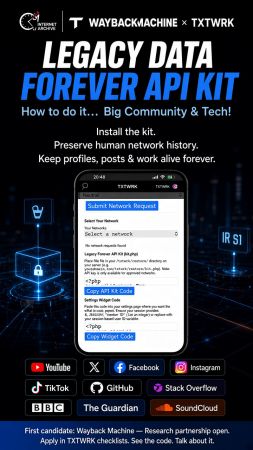
🚀 TXTWRK LEGACY DATA FOREVER — Building Our Own Wayback Layer + Open Invitation to the Wayback Machine and 10 Key Networks


We’re making it.

Right now, inside TXTWRK Server & Workspace technologies and our open-source public working checklists, we’re building a pure web-code snapshot system — a lightweight, client-side Wayback-style tool.

No heavy files required.
Just clean HTML snapshots.
External images, CSS and scripts keep linking to the live originals.
Placeholders appear when something is gone.
Everything stays visible, discussable and improvable in public checklists where anyone can see the code and talk about it.

This is not a side project.
It is the next practical step in our long-term digital legacy mission.

TXTWRK already turns profiles into living records.
Checklists into public work containers.
Servers and Workspaces into real collaborative execution.

Now we are adding the ability to freeze the exact state of a page — whether it’s a community feedback post, a local checklist, a business pitch, or an external page that matters to the work — so the proof and the memory stay intact.

The Legacy Data Forever API Kit


We are designing an installable kit for networks that care about durable public memory.

It will let platforms:
•Expose structured, timestamped page snapshots
•Preserve public work records (profiles, checklists, feedback, contributions) in a consistent, interoperable format
•Keep external links and assets live where possible, with graceful placeholders where they are not
•Give communities ownership and visibility of their own legacy data
•Turn long-term digital memory into a shared layer instead of isolated silos

First real candidate: the Wayback Machine


The Wayback Machine (Internet Archive) is our first real candidate.

We would like to support them in research and explore integration of the Legacy Data Forever API Kit.

They have spent decades doing the essential work of preserving the web for everyone. We respect that work deeply and see a clear opportunity for complementary collaboration — not competition.

10 networks we should prioritise next


Our history on these networks must be maintained into a future where we can afford to keep human historical network data from profiles alive.

These are the platforms where millions of people have already built their public records, creative work, code, news contributions and music.

Losing that history would mean losing part of the human story.

YouTube & social media networks


1. YouTube
2. X (Twitter)
3. Facebook / Meta
4. Instagram
5. TikTok

Code-based & test networks


6. GitHub
7. Stack Overflow

News portals


8. BBC News
9. The Guardian

Music apps


10. SoundCloud (and platforms like Spotify / Bandcamp)

These networks hold the profiles, posts, videos, code, articles and music that form the living history of communities, creators, developers and citizens.

The Legacy Data Forever API Kit is designed so that this human network data can remain accessible, structured and protected long into the future — not locked behind changing company policies or disappearing pages.

We are developing the core capture and viewer openly in TXTWRK checklists — code visible, conversation public, contributions welcome.

Server directories and Workspace tools already give us the place to store, edit, test and iterate.

If the Wayback Machine or any of the networks listed above want to explore research collaboration or integration, the invitation is open today.

Let’s make long-term digital legacy something networks can install, share and protect together — forever.

Apply to the open checklist.
See the code.
Talk about it.
Help shape the Legacy Data Forever API Kit.

This is how text works for the next 100 years.


#TXTWRK #LegacyDataForever #WaybackMachine #OpenSourceWorking #DigitalLegacy

🗖 VIEW
Do you think your posts are online forever?
Select up to 1
0 people have voted
Yes
0 votes
Not sure
0 votes
No
0 votes
Cast Vote
⛶
Technology
Neutral
Web Impressions are becoming a bigger part of TXTWRK — and now we’re adding Stickers to the mix. ✨

You can already create a Web Impression directly from the TXTWRK post box and publish it as a post, with the Web Impression player bringing it to life on the homepage.

But we’ve been building Web Impressions to go much further than a single post.

You can add Web Impressions to Checklist Items, then use Checklist Comments to build on them and really tell a story.

Your Profile Cover can also become a Web Impression. You can choose:

1. All My Web Impressions — showcase your creations.
2. Post ID Web Impression — feature a specific post.
3. Web Impression Code — create something specifically for your cover.

And now: Web Impression Stickers.

We don't see a Sticker as just a little graphic attached to something.

A Sticker can say I support you. I connect with you. I get this. This made me feel something.

They can bring joy, humour, encouragement, personality and uplifting energy into conversations — while also becoming genuinely engaging, interactive pieces of the TXTWRK experience.

We've seen over the last decade how powerful visual expression can become across social networks. With Web Impression Stickers, we want to take that idea further by making the expression itself programmable and customisable.

This weekend, we'll begin rolling Stickers out across comments and subthreads.

Next week, we're aiming to start bringing them into messaging.

And there's another side to this that we're particularly excited about.

Over the last year, we've purposefully been building our own technology around Web Impressions to help people market, promote, explain, showcase and tell their stories in ways that aren't limited to a static image or a block of text.

Stickers extend that technology into something smaller, faster and more social.

For brands, that could mean custom interactive campaign stickers, launches, reactions and visual identities.

For communities, it could mean their own symbols, celebrations, inside jokes, support messages and ways of recognising each other.

For creators and individuals, it becomes another little canvas for expressing something that words alone don't quite capture.

Web Impressions made the web itself part of a TXTWRK post.

Web Impression Stickers make it part of the conversation.

And we're only just getting started.

— @TXTWRK

ChatGPT x TXTWRK
Sticker Source

⛶
How-To / Tutorial
Neutral
Obviously, screenshots first 📸

Then mini video clips 🎬

Then master the full video editions with follow ups🔥

Document your progress as you build

Your journey becomes your content

—

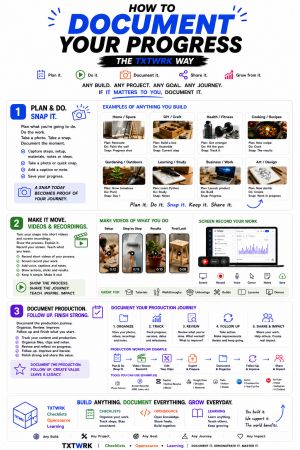
How to Document Your Progress — The TXTWRK Way

Whatever you’re building, learning, creating or improving, document the journey — not just the finished result.

1. Plan, Do & Snap 📸
Plan what you’re doing, get started, and capture photos or snapshots as you progress. Add notes so the moments retain their context.

2. Make Videos & Screen Record 🎥
Turn progress into motion. Record what you’re making, capture demonstrations and screen-record digital work, tutorials, walkthroughs and processes.

3. Document Production & Follow Up 🚀
Organise your photos, clips and recordings. Track versions and milestones, review what worked, improve, follow up and turn the journey into finished content worth sharing.

From renovating a room to building software, learning a skill, cooking, creating art or growing a business:

Build anything. Document everything. Grow every day.

TXTWRK Checklists • Opensource • Learning — tools for documenting progress, sharing knowledge and helping others learn from the journey.

🗖 VIEW