
X

TXTWRK


PERSONAL
LinkingLinking
FollowingFollowing
ConnectionsConnections
MessagesMessages
NotificationsNotifications
DISCOVER
SearchSearch
ReelsReels
CalendarCalendar
MapMaps
Work
NotesNotes
NeedsNeeds
ContributionsContributions
TimetableTimetable
IntelIntel
To DosTo Dos
ChecklistsChecklists
SavesSaves
ScrapboardScrapboard
LinksLinks
Monetisation
CoinsCoins
AdvertisingAdvertising
SubscriptionSubscription
DonationDonation
Log BookLog Book
Organisation
BusinessBusiness
AddressesAddresses
InvestorInvestor
FinancialsFinancials
Quarterly'sQuarterly's
SharesShares
Server
ServerServer
WorkspaceWorkspace
Code PlaygroundPlayground
Learn More
AboutAbout
AIDAID
DataData
DevDev
Web ImpressionsImpressions
ToolsTools
EducationEducation
SafetySafety
ReaderReader
My Content
Profile Image
Login

My Addresses

×
Addresses
+
Character Profiles
+
Info & Cover
+
Timetables
+
Favorited by... X
Link Clicks X
All comments... X
More | 1/33

TXTWRK Verified Website

@TXTWRK

City of Derby, Derby, Derbyshire, East Midlands, England, United Kingdom, Europe

Our mission is to help people make text work in daily life. Get investment, volunteers, donations & more publicly…

Join the journey & make a profile to remember... Discover our investment opportunities via our card: @TXTWRK

We developed & support the @UnitedKingdom movement through #UnitedKingdom


Brand
12/01/2024
Learn more about me 𓇻
Donations: £2.50
▦ Photos
▦ Videos
▦ Covers
Applications
Questionnaires
Active: 2 hours ago
Safety


OPENING TIMES
Show Images
Select a Store Location...
▼

Initializing schedule...

LOCAL PULSE

Profile Signals

Loading…
Loading profile signal…

Loading latest public Local Pulse signal…

Financials Financials
Quarterlys Quarterlys
Shares Shares
Notes Notes
Needs Needs
Contributions Contributions
Timetable Timetable
Intel Intel
To Dos To Dos
Notes Reel


Happening & Service
Happening Now and service updates connected to this profile


Happening in Offers
Offers available from this profile
Loading offers…


Connections
These are pages I added


Intel Pinned

Transparency of Operations
To make things even clearer, we are going to be updating our business registration in the coming days to 'TXTWRK Limited' in the UK & currently operate online in our startup phase, with workshops in educational institutions & community settings. We operate via the following domains: We monitise via the following sites: We operate the following social media: We operate the email addresses:
•Team@TXTWRK.com
•Support@TXTWRK.com
•Business@TXTWRK.com
•CommunityLibrary@TXTWRK.com
•Sponsors@TXTWRK.com
•Volunteer@TXTWRK.com
•Work@TXTWRK.com
•Writers@TXTRK.com
We operate the following TXTWRK pages: We operate the phone numbers: •447984582170 •0800 line coming soon We operate the following addresses:
•Currently in the process of setting up our office
•PO BOX coming soon & we focus on written communications
More intel:
•Need to request a removal from our Community Library, then simply email CommunityLibrary@TXTWRK.com
•Looking for account control, refer to ⚙ Settings/Linking to update your details or view https://txtwrk.com/account to understand your data or delete account
•We will never ask for your password or sensitive information and you should follow forms such as https://txtwrk.com/reset if you need to regain access to your account.
•We operate PayPal via our websites & also on TXTWRK
We keep this information up to date and concurrently here at TXTWRK via our intel reels - Last updated: 13/04/2026 00:16
Pinned Intel · 2026-04-12 23:14:46


Loading media...
DOUBLE TAP TO OPEN
+AI
+Analysis
•TXTWRK
+Assets
+Media
•Logos
+Standards
•Font
+Audio
•From Our Community
+Podcasts
+AI
•Insider Preview
+Language
•S1 E1 Psychology Research by @ImSunnyClaire
+Challenges
•Web Development
+Checklists
+Dev
•Business
•Server
•Web
•For Community
+Community Mentions
•Recognised as Stories
+Datasets
+Measurements
•Daily Common
+Documentation
•3D, AR & VR
+AI
•Checklists with AI
•Future Capabilities
•Insights
•Make Artistic Web Impressions
+Models
•Apple Intelligence
•Bing Copilot
•ChatGPT
•Claude
•IBM WatsonX
•Perchance
•Qwen
•TXTWRK AID
•Teaching
+Accessibility
•Feature Displayer
+Account Management
•Switch Accounts
•All Activity
+Assets
•Feedback
•Learn how to use assets
+Posting
•Set Projection
+Business
•Opportunities
+Checklists
•All Activity
•Applying
•Checklists Command Input 1.0
•Create
•Create Checklist with AI
•Directory API
•Engage
•Public Working
•Replicate
+Templates
•Starter Set
•Connect
+Data
•Account
•Cross Network Data API
•Directory
•Donations
+Feedback
•Streets
•TXTWRK Pulse
•Following
+Games
•Quiz
•Happening
+History
•In 1000 years
+Investors
+Crowdfunding
•Kickstarter
+Funding Rounds
•Funding Round 1
•Funding Round 2
•Funding Round 3
+Summary of Funding Rounds
•3 Core Funding Rounds
•Tools
+Labels
•Introduction
+Live
•Audio Rooms
+Location
•Addresses
+Management
•Future Proof
+Media
•3D Elements
•Record Audio
+Web Impressions
•Stickers
•Themes & Slideshows
•Messaging
•Monitisation
•Notifications
+Posting
•Prize Draws
•Transparency
+Progress
•Friday Weekly Updates
•In 1000 years
•TXTWRK Team
•Questions
•Reels
•Registration
+Safeguarding
•Covers of Education
•Logical Filters
•Our Safety Tools
•Search
+Selling
•Log Book & Types
+Server
•Connect to TXTWRK
•TXTWRK Servers
•Workspace
•Set Projection
+Shortcuts
•Posts
•Story Mode
+The Framework
•Language
•Tools
•Trending Topics
+Events
+April
•Easter
+December
•Christmas
•Hanukah
+March
•Eid Mubarak
•Seasons
+TXTWRK
•Annual
+Films
+From TXTWRK to Film
•Our Trail To Work
+Person of Interest X 2025
•Preview
+The Super 10
•Preview
+Learn How To
•Social Media
+Our Feedback
+Companies
+Alphabet Inc
•YouTube
•Facebook
+Partners
+AI
•Microsoft
+Educational
•Derby College
+People
+Digital
•Steve Jobs
+Role Models
•Questions
+Shop
+Digital
•NFT The Platinum Collection
+Subscriptions
+From TXTWRK
•Monthly Tiers
+United Kingdom
+Guidance
•Startups
+Podcasts
•S1 E1 The Start
+Work
+Startup
•Kids
+World
•Pledges
•Politics


@TXTWRK


Topic: 🌎
⛶
Technology
Neutral
TXTWRK Servers

Infrastructure Development & Feasibility Report

October 2026 | Concept & Research Edition
TXTWRK — https://txtwrk.com

> Imagine a TXTWRK Server switched on by someone in your family today. A hundred years from now, that same server is still running, still connected and still contributing to the network. It may have needed maintenance, upgrades and periods of downtime, but the network kept working while it rested.

Built to outlast generations. Designed to evolve.

Executive Summary


TXTWRK proposes a new approach to digital infrastructure, combining accessible home servers, simplified software, partner integrations and an optional distributed computing network.

The initiative has two principal products:

ProductProposed Starting PricePurpose
TXTWRK Server OneFrom £1,000Home hosting for businesses and communities
TXTWRK Servers: Local Open ComputeFrom £3,000Server One capabilities plus distributed computing participation
Prices are preliminary development targets, not confirmed retail commitments.

The network begins as a hybrid of residential nodes, traditional data centers, cloud infrastructure and content delivery partners. Over time, more workloads may be distributed when technically and commercially feasible.

---

Part One — TXTWRK Servers


1. Product Vision


TXTWRK Servers are plug-and-play devices designed to help people establish and operate businesses, websites and communities from home.

The product prioritizes user experience. Customers should be able to connect their hardware, complete a guided setup and begin using their server without specialist systems administration knowledge.

Core Principles

•Plug-and-play installation.
•Locally controlled infrastructure.
•Preinstalled server software.
•A simple local management interface.
•Optional integration with txtwrk.com.
•Access to partner applications and services.
•Security, updates and backup support.
•Long-term maintainability and repairability.

2. User Experience


The intended setup journey is:

1. Unbox the TXTWRK Server.
2. Connect power and networking.
3. Open the local setup interface.
4. Configure administrator access and security.
5. Optionally connect a TXTWRK account.
6. Configure domains, applications and services.
7. Launch a website, community or business platform.

The local interface should remain useful even when TXTWRK's central platform is temporarily unavailable.

3. Software Architecture


LayerFunction
Local interfaceDevice management, storage, applications and networking
TXTWRK platformAccounts, domains, licensing, support and partner integrations
Partner servicesWebsite builders, management panels, security and backup
Server operating environmentHosting, containerization, updates and monitoring
Network servicesOptional connectivity to the wider TXTWRK ecosystem
TXTWRK can investigate integrations with established software such as cPanel, open-source management tools and future applications created by independent developers.

4. Hardware Requirements


ComponentProposed Requirement
CPUEfficient multicore processor
RAMExpandable memory
StorageSSD-based system and application storage
NetworkingReliable Ethernet connectivity
SecuritySecure boot, encryption and authenticated identity
CoolingEfficient, maintainable cooling
PowerLow idle consumption and safe shutdown
ConstructionRepairable and replaceable components
SoftwarePreinstalled TXTWRK environment
Final specifications must be established through workload testing and manufacturing research.

5. Commercial Positioning


Proposed starting price: £1,000.

The objective is to provide accessible infrastructure for individuals, startups and communities.

The price is an initial target. Manufacturing costs, taxes, support, warranties and commercial viability remain to be validated.

---

Part Two — TXTWRK Servers: Local Open Compute


6. Concept


Local Open Compute extends TXTWRK Server One by providing additional resources for participation in a coordinated distributed computing network.

The enhanced product includes the capabilities of Server One and additional storage, processing and networking capacity.

Customers can operate their own services while optionally contributing agreed resources to the wider network.

7. Resource Allocation


The initial concept proposes 1 TB of dedicated Local Open Compute storage per participating device, separate from personal or business storage.

ResourceInitial AllocationPurpose
Total dedicated network storage1 TBDistributed network participation
CDN-style cache100 GBFrequently requested content
Remaining storage900 GBOther approved network storage workloads
CPUTo be specifiedIndependent processing tasks
GPUModel-dependentSupported accelerated workloads
BandwidthManaged allocationNetwork delivery and resource sharing
Allocations may change according to demand, contractual agreements and the resource limits accepted by participants.

Actual usable storage will be lower after operational overhead.

8. Network Architecture


TXTWRK proposes a hybrid infrastructure combining:
•Independently owned home servers.
•TXTWRK network coordination services.
•Partner cloud infrastructure.
•Traditional data centers.
•CDN providers.
•Regional storage and processing nodes.

The coordination system would allocate workloads according to location, availability, performance, security and cost.

The network should initially focus on workloads that do not require extremely low-latency communication between distributed machines.

9. Local Content Distribution


Popular files could be replicated across approved nodes in relevant geographic regions.

For example, a UK business could have suitable static assets cached on several participating servers serving different locations.

The network would need to account for:
•Content popularity and geographic demand.
•Node availability and upload capacity.
•Network routing and latency.
•Storage replication and consistency.
•Security and encryption.
•Bandwidth usage and partner agreements.

Residential nodes would complement conventional CDNs where measurements show an advantage.

Geographic proximity alone does not guarantee improved performance.

10. Distributed Compute


Potential workloads include:
•Independent CPU processing.
•Batch processing.
•AI inference requests.
•Selected GPU workloads.
•Media processing.
•Distributed storage and caching.
•Background application jobs.

Large-scale AI training may remain better suited to specialized data centers because of the high-speed communication requirements between GPUs.

TXTWRK should investigate compute workloads through research and controlled benchmarks before making performance commitments.

11. Bandwidth and Network Coordination


TXTWRK and participating partners would establish mutually agreed network policies.

These would govern:
•Resource allocation.
•Bandwidth commitments.
•Workload scheduling.
•Service quality.
•Node eligibility.
•Network monitoring.
•Security and compliance.

Participants should have clear visibility into resource commitments and the ability to manage participation within agreed terms.

12. Credits and Compensation


Participating owners could earn TXTWRK credits for verified resource contributions.

MechanismProposed Approach
Storage contributionsReward verified useful capacity and availability
Compute contributionsReward successfully completed workloads
Bandwidth contributionsReward approved data delivery
CompensationTXTWRK credits
RedemptionOptional periodic cash settlement
Settlement frequencyQuarterly, six-monthly or another agreed interval
The commercial model must account for electricity, connectivity, operating costs, taxes, fraud prevention and service reliability.

No financial return is guaranteed.

13. Security


The network should use defense-in-depth security.

Proposed measures include:
•Secure boot and signed updates.
•Encrypted storage and network traffic.
•Authenticated node identities.
•Workload isolation.
•Remote attestation where supported.
•Tamper detection.
•Compromise monitoring.
•Automated quarantine and service migration.

A physical tamper event could generate a report to trusted infrastructure or nearby nodes, but this must not be treated as proof that a compromised device can reliably report its own condition.

14. Reliability and Failover


The network should tolerate individual devices going offline for maintenance, cooling, hardware failure or connectivity interruptions.

Potential techniques include:
•Replicated storage.
•Erasure coding.
•Redundant service execution.
•Health monitoring.
•Automated failover.
•Planned workload migration.
•Backup and recovery.

A node may temporarily stop operating while another eligible node handles its supported workload.

Availability guarantees will depend on redundancy and tested recovery procedures.

15. Hybrid Infrastructure


TXTWRK will initially depend on a combination of residential infrastructure and conventional providers.

Traditional data centers remain important for:
•Central coordination.
•High-bandwidth workloads.
•Critical services.
•Large GPU clusters.
•Disaster recovery.
•Regional connectivity.

Long-term research may investigate greater network independence, but independence is not required for the initial commercial model.

---

Part Three — Sustainability and Product Longevity


16. Long-Term Device Support


TXTWRK proposes a development culture based on durability rather than frequent hardware replacement.

New product editions may be introduced approximately every three to five years.

Older devices should remain compatible with supported network functions wherever feasible.

The ambition is to maintain useful participation for decades through updates, repairs and changing workload assignments.

17. Hardware Repurposing


Older nodes may transition to less demanding responsibilities.

Device ConditionPotential Role
New high-performance deviceAdvanced applications and compute
Mature deviceGeneral hosting and distributed storage
Older compatible deviceCaching and lightweight processing
Limited-capacity deviceMonitoring or other low-demand services
Unsupported or unsafe deviceRetirement, refurbishment or recycling
A century-long service life is an aspiration for continuity and maintainability, not a guarantee that original components will operate indefinitely.

18. Buyback and Recycling


TXTWRK may develop a buyback program to support upgrades and responsible reuse.

Returned devices could be:
•Inspected and refurbished.
•Reassigned to educational projects.
•Redeployed for lighter workloads.
•Used for spare parts.
•Recycled when continued operation is no longer viable.

Energy consumption, repair costs and cybersecurity support must determine whether continued operation is practical.

---

Part Four — Research and Partnerships


19. Collaborative Development


TXTWRK intends to develop the initiative with industry specialists, technology partners, independent researchers and volunteers.

Research areas include:
•Server hardware and manufacturing.
•Networking and connectivity.
•Distributed storage.
•GPU and CPU scheduling.
•Cybersecurity.
•Energy efficiency.
•Application integration.
•Customer experience.
•Resource accounting.

Volunteer research should have clear expectations, appropriate recognition and genuine educational value. Commercial operational responsibilities require appropriate resourcing.

20. Partner Opportunities


Partner CategoryPotential Contribution
Hardware manufacturersComponents and modular server designs
Hosting companiesDomain services and management tools
Network operatorsConnectivity and routing expertise
Cloud providersHybrid compute and storage
CDN operatorsContent delivery integration
Security companiesDevice trust and threat protection
UniversitiesResearch and independent testing
Software developersApplications and platform integrations
These represent potential collaborations rather than confirmed partnerships.

---

Part Five — Network Capacity and Economics


21. Illustrative Storage Growth


Assuming each participating Local Open Compute server contributes 1 TB of raw dedicated storage:

Participating ServersRaw Network StorageCDN Cache Allocation
100100 TB10 TB
1,0001 PB100 TB
10,00010 PB1 PB
100,000100 PB10 PB
1,000,0001 EB100 PB
These figures are theoretical and exclude replication, redundancy, offline devices, metadata and operational reserves.

They are not customer acquisition or deployment forecasts.

22. Economic Requirements


The commercial feasibility model must evaluate:
•Hardware manufacturing costs.
•Product distribution and warranty costs.
•Electricity consumption.
•Residential internet limitations.
•Network coordination expenses.
•Customer support.
•Security operations.
•Partner revenue sharing.
•Resource compensation.
•Real customer demand.

Network participation must create sufficient value to justify its operating costs.

23. Principal Technical Challenges


ChallengeResearch Response
Residential upload limitationsBenchmarking and workload selection
Dynamic IP addresses and NATSecure tunnels and connectivity services
Unreliable nodesRedundancy and automated recovery
Hardware differencesStandardized compatibility profiles
Data securityEncryption and isolation
Network economicsUsage metering and resource accounting
Electricity costsEnergy-efficient scheduling
Long-term supportModular design and compatibility policies
Legal complianceData protection and regulatory assessment
---

Part Six — Development Roadmap


24. Proposed Development Phases


PhaseObjectivePrincipal Deliverable
1Product definitionUser experience and hardware requirements
2Standalone prototypeWorking TXTWRK Server
3Platform integrationTXTWRK account and partner connectivity
4Distributed researchSmall Local Open Compute test network
5Pilot deploymentReliability and performance measurements
6Commercial validationManufacturing and economic assessment
7Controlled expansionAdditional models and network growth
No fixed launch dates are established in this report.

25. Research Milestones


Before a wider launch, TXTWRK should demonstrate:

1. A working plug-and-play standalone server.
2. Reliable local hosting and management.
3. Secure TXTWRK platform integration.
4. A small distributed storage network.
5. Tested failover and node recovery.
6. Verified bandwidth and compute accounting.
7. Measurable energy and operating costs.
8. A commercially viable support and compensation model.

---

Part Seven — Industry Opportunity


26. Reusing Established Technologies Differently


TXTWRK is not claiming to invent distributed computing, edge hosting, failover or CDN technology.

The proposal is to combine established technologies into a more accessible, integrated product ecosystem.

The innovation opportunity lies in:
•Making home infrastructure approachable.
•Connecting owned servers to useful services.
•Enabling optional distributed participation.
•Creating an accessible partner ecosystem.
•Supporting long-term hardware use.
•Developing sustainable resource compensation.
•Making infrastructure education part of the product experience.

The objective is to revisit barriers that have historically limited adoption and test whether new hardware, software and network approaches can overcome them.

27. Supporting UK Startups


TXTWRK aims to make infrastructure ownership a practical option for UK entrepreneurs and community organizations.

The long-term ambition includes reaching a potential market of millions of new and existing businesses.

This represents a strategic aspiration rather than a verified market forecast.

28. Criteria for Success


TXTWRK should measure success through:
•Customer ease of use.
•Service reliability.
•Hardware longevity.
•Security.
•Economic sustainability.
•Partner participation.
•Network utilization.
•Environmental performance.
•Accessibility to small organizations.

The project should progress from working prototypes and measured evidence rather than assuming that theoretical capacity automatically produces commercial value.

---

Conclusion


TXTWRK Servers and TXTWRK Servers: Local Open Compute represent two interconnected initiatives.

Part One enables individuals, communities and businesses to operate their own digital infrastructure through accessible home server hardware and integrated software.

Part Two investigates how independently owned devices can contribute to a wider distributed computing network.

The network begins as a hybrid system, combining home infrastructure with established hosting, cloud and data center services.

Its long-term direction emphasizes sustainability, maintainability, local ownership and collaborative innovation.

The technical and commercial challenges are significant. Success will require partnerships, prototypes, research and measured validation.

TXTWRK's objective is to make digital infrastructure accessible today while developing a network capable of evolving for generations.

---

Founding Principle


> Build locally. Connect globally. Last for generations.

A server should not be defined only by the day it was manufactured, but by the value it can continue providing to the people and networks that depend on it.

---

Document Status: Initial Concept and Feasibility Report

Organization: TXTWRK

Website: https://txtwrk.com

Date: October 2026

Commercial Status: Proposed product concepts, indicative starting prices and research objectives. Specifications, performance, partnerships and release plans remain subject to validation.

Let’s work together @Meta & @XAI


⛶
Technology
Neutral
TXTWRK Checklists All Activity installed today, next to Search


TXTWRK has extended All Activity into Checklist technologies, adding another specialised surface to an activity system that already operates across the Homepage, Profiles, Maps and the API Kit. The importance of the checklist implementation is that activity is not being developed as an isolated audit log for another product feature. Instead, the existing TXTWRK activity architecture is adapted to structured work: users can move from discovering activity across the platform to understanding activity surrounding a particular checklist, and now an individual checklist item. This gives Checklist technologies both an operational purpose—managing work—and a historical purpose—understanding how that work actually progressed.

Core capabilities introduced

•Checklist-level All Activity: activity can be viewed directly inside the checklist experience while remaining restricted to the relevant enclosing post.
•Checklist-item filtering: users can select a particular checklist item and retrieve activity associated specifically with that item.
•Existing All Activity controls remain available: username, search, time, ordering, activity categories and applicable scope controls continue to provide additional ways of exploring the history.

All Activity surfaceContext providedWhat a user can learn
HomepagePlatform-wide discoveryWhat is happening across TXTWRK
ProfileIndividual contextActivity surrounding a particular person
MapsGeographic contextWhat is happening in a location
API KitProgrammatic contextHow activity can be consumed by integrations
ChecklistStructured-work contextHow a checklist/post has progressed
Checklist ItemIndividual work-item contextHow a specific part of that checklist progressed
The Checklist Item filter is the key adaptation in this implementation. Checklist items are presented through a selector organised according to their existing checklist groups, making the activity interface reflect the structure of the work itself. Selecting an item changes the question being asked of All Activity from “what happened in this checklist?” to “what happened around this particular piece of work?” The selected item is combined with the enclosing post context, providing a progressively narrower history rather than relying on a simple keyword match. That gives TXTWRK a hierarchy of discovery running from platform activity through to highly specific work-item activity.

What the item-level adaptation enables

•Progress investigation: review the history surrounding one individual item instead of manually searching through the entire checklist timeline.
•Process learning: completed checklists can become historical records showing how particular stages of work developed, rather than becoming static completed task lists.
•Contextual investigation: item selection can work alongside other activity controls, allowing the history to be examined by participant, period, search term or other supported activity dimensions.

LevelExample questionActivity scope
PlatformWhat is happening across TXTWRK?All Activity
PersonWhat has happened around this user?Profile
LocationWhat has happened here?Maps
ChecklistHow did this body of work progress?Post/checklist
Checklist itemHow did this exact part of the work progress?Post + selected item
This creates a broader knowledge and learning capability around checklists. A normal checklist is principally concerned with the present state of work: what exists, what is outstanding and what has been completed. All Activity adds the temporal layer. Users can look backwards through activity and understand the path that led to the current state. Item-level filtering makes that history substantially more useful on large or complex checklists because the user does not need to reconstruct an individual item's story from an entire project history. As TXTWRK accumulates activity, previous checklists can consequently provide useful evidence of how work was approached, where interaction occurred and how individual elements progressed.

Wider product benefits

•One activity concept across multiple technologies: users encounter All Activity across Homepage, Profiles, Maps, API Kit and now Checklist technologies instead of learning unrelated history systems.
•Granularity without fragmentation: the user can move from broad discovery to post/checklist history and then individual-item history while remaining within the same conceptual activity system.
•Reusable historical knowledge: checklist activity can provide more than an audit trail; it can help users revisit previous work and understand the progression behind completed outcomes.

The comparison with established work-management technology helps clarify where this approach differs. monday.com provides board activity and an Item Activity Log. Jira records activity against individual work items, including areas such as comments, history and work logs. ClickUp provides individual task activity alongside broader Activity views. These products demonstrate the value of detailed work history. The distinguishing aspect of TXTWRK's implementation is not simply that checklist items have history, but that checklist-item activity becomes another specialised view of an activity concept already spanning people, geographic discovery, platform discovery and API consumption.

CapabilityTXTWRKmonday.comJiraClickUp
Broad activity experienceHomepage All ActivityBoard Activity LogPrimarily work-item/project activityActivity View
Individual work-item historyChecklist Item All ActivityItem/Subitem ActivityWork-item ActivityTask Activity
Person-oriented activity contextProfilesPerson filteringUser/change information within work itemsPerson/activity filtering
Geographic activity contextMapsNot a central Activity Log contextNot a central work-item Activity contextNot a central Activity View context
Programmatic activity contextAPI KitAPIs availableAPIs availableAPIs available
Structured checklist contextYesItems/subitemsWork items/subtasksTasks/checklists
Specific checklist-item filteringYesItem-level activityWork-item levelTask/checklist activity
Broad-to-specific activity modelPlatform → Profile/Map → Checklist → Checklist ItemBoard → Item/SubitemProject → Work itemLocation → Task
TXTWRK distinctionOne All Activity concept adapted across multiple platform technologiesStrong board/item historyStrong issue/work historyStrong task/workspace activity
There is also an important architectural distinction as Checklist technologies develop further. TXTWRK starts from the concept that All Activity can operate across several platform surfaces, with each technology adapting activity according to its own context. Checklist activity therefore does not have to end with recording that a task changed. It can participate in the wider discovery model used by Homepage activity, a person's Profile activity, geographically relevant activity through Maps and programmatic use through the API Kit. Adding the Checklist Item filter makes this adaptation considerably more specific: users can retain the wider All Activity capabilities while drilling down to one defined component of a checklist. The result is a checklist technology that can organise work, expose how that work progressed, and allow people to return later and learn from the history of individual items as well as the checklist as a whole.

1/6
🗖 VIEW

⛶
Technology
Neutral
The reason why we outsmart big tech such as Facebook, TikTok, etc


We're not in it for the short term gains, we are in it for the long term gains. Continue listening...

We can survive for the next 1000 years at very small scale, that's the magic in our development, alongside being underpinned by our founder's existing other ventures that propel the network.


⛶
Technology
Neutral
TXTWRK Development Report

Audio Across Posts, Checklists & Messaging

16 September 2026


Today marked a significant expansion of audio communication across TXTWRK.

What began as Audio Rooms connected to posts has now developed into audio functionality spanning three major areas of the network:

1. Posts — Audio Rooms
2. Checklists — Audio Rooms
3. Messaging — Audio Chats

Rather than creating one generic audio feature and forcing it into every part of TXTWRK, each implementation has been designed around the permissions, storage requirements and user behaviour of the area in which it operates.

The result is the beginning of a network-wide audio communication layer across TXTWRK.

---

1. Audio Rooms in Posts


The first implementation provides Audio Rooms attached directly to TXTWRK posts.

A post can contain its own Audio Room, allowing the post itself to become the centre of a recorded audio discussion.

Room Status


A newly created Audio Room begins Offline.

The room owner can switch it between:
•Offline
•Live

The visual state of the room changes accordingly, providing an immediate indication of whether the host is currently accepting participation.

The room owner controls when the room becomes active rather than simply leaving recording permanently available.

Guest Participation


Visitors can request to join an Audio Room.

The room owner receives a participation log and can manage requests by:
•Accepting a participant
•Removing acceptance
•Blocking a participant
•Viewing all requests
•Viewing blocked users
•Unblocking users

Accepted participants are then permitted to record within the room.

This creates a moderated audio environment rather than allowing unrestricted recording against a public post.

Recording Limits


The host has unrestricted recording time.

Guest recording limits can be configured using options including:
•10 seconds
•15 seconds
•30 seconds
•1 minute
•3 minutes
•Unlimited

This allows the room owner to determine the expected style of participation.

A room could therefore be configured for very short voice responses or longer-form discussion.

Dynamic Room Behaviour


While an Audio Room is Live, its state and participation information can refresh dynamically.

Guests can discover when they have been accepted without needing to manually reload the entire page.

Once accepted, recording functionality becomes available to them.

Recording and Playback


Audio recordings are stored against the Audio Room and can subsequently be played through the room interface.

Playback and pagination allow a growing Audio Room to remain usable as additional recordings are added.

Data Accounting


TXTWRK-hosted recordings participate in TXTWRK's data accounting system.

This connects Audio Rooms to the wider storage/data model rather than treating audio as unlimited external media.

Post Audio Room Structure


Conceptually:

Post
└── Audio Room
├── Offline / Live
├── Host
├── Join Requests
├── Accept / Block
├── Guest Recording Limits
├── Recordings
└── Playback

The important distinction is that the audio conversation belongs to the post itself.

Users do not have to leave the post and create a separate group conversation simply to discuss it using audio.

---

2. Audio Rooms in Checklists


The second major development was adapting Audio Rooms for TXTWRK Checklists.

This required a different architecture because a checklist is not a social post.

It represents structured work, collaboration and existing permissions.

For this reason, Checklist Audio Rooms were developed as their own system rather than simply reusing the Post Audio Room participation model.

Audio Attached to a Checklist Item


A Checklist Audio Room belongs directly to a checklist item.

Conceptually:

Checklist
└── Checklist Item
└── Audio Room

This allows an audio discussion to remain attached to the exact piece of work being discussed.

Instead of discussing a checklist task somewhere else in a general messaging conversation, the discussion remains with the task.

Turning Audio On


Checklist items can expose an Audio Room control allowing the feature to be enabled for that particular item.

This means Audio Rooms do not need to exist unnecessarily on every checklist item.

They can be activated where audio collaboration is useful.

Checklist Permissions


Unlike public Post Audio Rooms, checklist participants already operate within a permissions system.

Therefore the Post Audio Room workflow of:

Join
↓
Request
↓
Host Accepts
↓
Recording Enabled

is unnecessary.

Instead:

Checklist Permission
↓
Audio Room Permission

Users who already have the appropriate checklist permissions can participate automatically.

This makes the Checklist Audio Room behave as part of the collaborative work environment rather than as a separate social room.

Recording Topics


Checklist recordings can optionally be associated with topics.

This provides another organisational layer for Audio Rooms that may accumulate substantial discussion.

Recordings can subsequently be filtered according to the selected topic.

This is particularly useful when one checklist item contains several areas of discussion.

Date Organisation


Recordings can be grouped and retrieved by date.

Features such as:
•Play Today
•Date grouping
•Initial recording limits
•View More loading

allow longer-running checklist discussions to remain manageable.

Live Behaviour


Checklist Audio Rooms can still operate with Live behaviour.

Polling can be limited to situations where:
•the Audio Room is Live; and
•the room is currently within the user's viewport.

This avoids unnecessary background requests while retaining responsive behaviour when users are actively viewing the room.

---

3. Checklist Audio Storage


Checklist Audio Rooms introduced another important capability: selectable storage.

When configuring the Audio Room, storage can be directed to either:

1. TXTWRK
2. The user's connected server through the Directory API infrastructure

TXTWRK Storage


TXTWRK can host the audio using the user's available TXTWRK data balance.

Connected Server Storage


Where the user has configured suitable server infrastructure through TXTWRK's Directory API system, the audio object can instead be stored on that server.

Conceptually:

Checklist Recording
│
▼
TXTWRK
│
├────────► TXTWRK Data Balance
│
└────────► Connected Directory API Server

TXTWRK can therefore remain responsible for the checklist, Audio Room, recording metadata and interface without necessarily being responsible for permanently storing the underlying media object.

This begins separating two concepts:

the network managing the collaboration

from:

the infrastructure storing the media

---

4. Public Checklist Listening


Checklist Audio Rooms were also designed to support public listening where appropriate.

This means an Audio Room can potentially be heard by people who are not authenticated TXTWRK participants while recording permissions remain protected.

The distinction becomes:

Listening
│
└── Can be public where enabled

Recording
│
└── Requires appropriate checklist access

This allows checklist owners to expose useful audio information without granting public users the ability to contribute recordings.

---

5. Audio Chats in Messaging


The third major development brought recorded audio into TXTWRK Messaging.

Audio Chats are being integrated into both:
•Direct conversations
•Group conversations

Unlike Post and Checklist Audio Rooms, Messaging Audio is designed around private asynchronous communication.

It therefore behaves more like a conventional voice message while still making use of TXTWRK's wider infrastructure model.

Messaging Composer


The existing messaging composer gains a microphone control positioned alongside the existing attachment controls.

Conceptually:

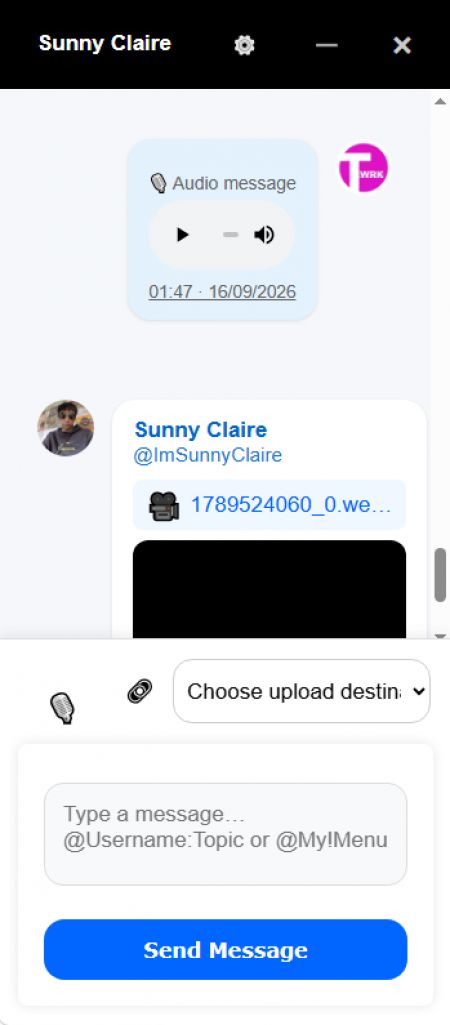
🎙️ 🔗 Message... Send

Users can record an Audio Chat directly from the messaging interface.

Recording


Browser recording uses the available media recording capabilities of the user's device/browser.

Once recording begins, the user can stop the recording and preview the pending audio before sending it.

Audio Without Text


An important part of the implementation is that an Audio Chat does not require a text message.

A message can therefore consist entirely of:

🎙️ Audio Recording

rather than requiring:

Text + Audio Recording

This allows audio to behave as a genuine messaging format rather than merely as an attachment to text.

Direct Conversations


Audio can be recorded and sent inside ordinary one-to-one TXTWRK conversations.

Group Conversations


The same capability is available within group messaging.

The messaging architecture therefore becomes:

Messaging
│
├── Direct Chat
│ └── Audio Chat
│
└── Group Chat
└── Audio Chat

---

6. Messaging Audio Storage


Messaging Audio Chats also introduce selectable storage.

The default storage destination is TXTWRK Data Balance.

A user with an appropriate Messaging API/server connection can instead choose to store Audio Chats on their connected server.

Default


Audio Storage:
TXTWRK Data Balance

This requires no additional server configuration.

Connected Server


Where suitable infrastructure has been configured:

Audio Storage:
My Messaging API Server

can be selected instead.

Conceptually:

Audio Chat
│
▼
TXTWRK
│
├────────► TXTWRK Data Balance
│
└────────► Messaging API / User Server

This allows users who operate their own infrastructure to preserve their TXTWRK data allowance by storing the underlying recording themselves.

---

7. TXTWRK Messaging Audio Storage Structure


TXTWRK-hosted Messaging Audio has been deliberately separated from the earlier Audio Room systems.

Its storage hierarchy is:

/1-audio-rooms-messaging/
{memberID}/
direct/
{chat_controller_id}/
audio_xxxxx.webm

group/
{group_id}/
audio_xxxxx.webm

This keeps:
•Post Audio Rooms
•Checklist Audio Rooms
•Messaging Audio Chats

separate at the storage level.

The implementations therefore do not need to interfere with one another simply because they all contain recorded audio.

---

8. Messaging Audio Data Accounting


When an Audio Chat is stored by TXTWRK, it consumes the appropriate user's TXTWRK data balance.

The recording therefore becomes part of the same broader storage economy as other TXTWRK-hosted data.

Where the user's own Messaging API server is selected instead, TXTWRK does not need to charge its own storage balance for the underlying audio object.

This creates a practical reason for users with their own infrastructure to connect it.

---

9. Audio Deletion and Ownership


Messaging storage also requires different deletion behaviour depending on where the media lives.

TXTWRK-Hosted Audio


Where TXTWRK owns the physical stored object, the system can manage:
•physical deletion;
•storage metadata;
•data accounting; and
•appropriate data refunds.

User-Server Audio


Where the audio resides on a user's connected server, TXTWRK should not treat that physical object as its own property.

Removing or hiding the TXTWRK message therefore does not mean TXTWRK should reach into the user's server and destroy the original media object.

Conceptually:

TXTWRK-hosted recording
↓
TXTWRK controls storage lifecycle

User-server recording
↓
Server owner controls storage lifecycle

This establishes a clearer ownership boundary between TXTWRK and connected infrastructure.

---

10. Protecting Private Messaging Audio


The TXTWRK Messaging Audio storage directory has also been treated separately from the earlier public Audio Room work.

The directory:

/1-audio-rooms-messaging/

can have its own .htaccess protection.

The protection includes:
•directory indexing disabled;
•executable scripts blocked;
•unexpected file types blocked;
•MIME sniffing protection;
•direct/no-referrer requests rejected; and
•playback requests restricted to TXTWRK-originating pages under the current hotlink-protection model.

This protection applies only to Messaging Audio.

The earlier Post and Checklist Audio Room directories are not changed by this Messaging-specific protection.

---

11. End-of-Day Audio Architecture


At the end of today's work, TXTWRK effectively has three different audio systems serving three different purposes.

AreaAudio TypePrimary PurposeParticipationStorage
PostsAudio RoomsSocial discussionHost + requested/accepted guestsTXTWRK
ChecklistsAudio RoomsWork collaborationChecklist-authorized usersTXTWRK or connected server
MessagingAudio ChatsPrivate communicationDirect/group participantsTXTWRK or Messaging API server
This separation is important.

The goal has not been to create three copies of the same microphone feature.

Each implementation reflects its environment.

---

12. Social Audio


Post Audio Rooms represent the social layer.

SOCIAL
│
▼
Post
│
▼
Audio Room
│
├── Host
├── Live / Offline
├── Join Requests
├── Accept / Block
├── Recording Limits
└── Playback

The conversation revolves around published content.

---

13. Work Audio


Checklist Audio Rooms represent the work layer.

WORK
│
▼
Checklist
│
▼
Checklist Item
│
▼
Audio Room
│
├── Checklist Permissions
├── Recording
├── Topics
├── Date Organisation
├── Public Listening
└── Selectable Storage

The conversation revolves around a specific piece of work.

---

14. Private Audio


Messaging Audio Chats represent the private communication layer.

PRIVATE
│
▼
Messaging
│
├── Direct
│ └── Audio Chat
│
└── Group
└── Audio Chat

The conversation revolves around private communication between users or groups.

---

15. One Audio Layer Across TXTWRK


Together, the three implementations can be viewed as:

TXTWRK AUDIO
│
┌───────────────┼───────────────┐
│ │ │
▼ ▼ ▼
SOCIAL WORK PRIVATE
│ │ │
POST CHECKLIST MESSAGING
│ │ │
AUDIO ROOM AUDIO ROOM AUDIO CHAT
│ │ │
Discussion Collaboration Conversation

This is a much broader development than simply adding voice messages.

Audio now has a place across three fundamentally different types of activity on TXTWRK.

---

16. Competitive Comparison — TXTWRK Audio Across the Network


Recorded audio itself is not unusual among modern communication networks.

Major messaging and collaboration platforms already provide various forms of:
•voice messages;
•recorded clips;
•voice channels;
•calls;
•meetings; and
•synchronous audio.

The more relevant comparison is therefore not:

"Does TXTWRK have audio?"

The more useful question is:

"Where can audio exist within TXTWRK, what is it attached to, who controls participation, and who controls its storage?"

That produces a considerably more interesting comparison.

---

17. Comparison With Other Major Networks


CapabilityTXTWRKWhatsAppDiscordSignalSlackMicrosoft Teams
Recorded audio in direct messagingYesYesYesYesYesYes
Recorded audio in group messagingYesYesYesYesYesYes
Audio connected directly to social postsYesNo direct equivalentDifferent modelNoDifferent modelDifferent model
Dedicated Audio Room attached to a postYesNoVoice channels use a different modelNoHuddles use a different modelMeetings use a different model
Audio attached directly to checklist/work itemsYesNoNo direct equivalentNoNo direct equivalentNo direct equivalent
Existing checklist permissions control recording accessYes—————
Public listening with controlled recording participationYes—Different model—Different modelDifferent model
Choice between platform storage and user's own serverYesNo normal user-facing equivalentNo normal user-facing equivalentNo normal user-facing equivalentNo normal user-facing equivalentNo normal user-facing equivalent
Own-server audio can avoid platform data usageYes—————
Audio integrated across social + work + private messagingYesPrimarily messagingCommunity + messagingPrimarily messagingWork + messagingWork + messaging
The comparison is not intended to suggest that other platforms lack sophisticated audio systems.

Several of them have extremely mature audio, calling, transcription, encryption and mobile experiences.

The distinction is the combination TXTWRK is developing.

---

18. Comparison With Messaging Networks


Platforms such as WhatsApp and Signal demonstrate the established value of asynchronous voice communication.

Voice recordings work naturally when users want to communicate something faster or more personally than typing a message.

TXTWRK Messaging now enters that same general category through Audio Chats.

However, TXTWRK's implementation also connects messaging audio to its wider infrastructure model.

A user can potentially choose between:

TXTWRK-hosted media

or:

User-hosted media

while continuing to use the same TXTWRK conversation.

The communication network and storage provider therefore do not necessarily have to be the same entity.

---

19. Comparison With Community Platforms


Discord demonstrates another model where audio extends beyond conventional private messaging.

Its ecosystem combines messaging with community-oriented voice functionality.

TXTWRK Post Audio Rooms approach community audio differently.

Instead of creating a voice channel that exists independently of a piece of content, the Audio Room belongs directly to a post.

Conceptually:

Traditional Community Voice

Community
↓
Voice Channel
↓
Conversation


TXTWRK Post Audio

Post
↓
Audio Room
↓
Conversation about that Post

The content itself becomes the location of the audio discussion.

---

20. Comparison With Workplace Platforms


Slack and Microsoft Teams demonstrate how recorded communication can become useful in professional collaboration.

Audio and video clips can reduce the need for synchronous meetings and allow information to be consumed asynchronously.

TXTWRK Checklist Audio Rooms approach the work context from the perspective of the work item itself.

Instead of:

Channel
↓
Discussion
↓
User determines which task it concerns

TXTWRK can provide:

Checklist Item
↓
Audio Discussion
↓
Context already established

The recording is already attached to the object being discussed.

This reduces the separation between communication and the work itself.

---

21. Storage as an Architectural Difference


One of the most significant differences introduced during today's development is the ability to separate TXTWRK's application layer from the physical storage layer.

A conventional hosted network can broadly be represented as:

User
│
▼
Platform
│
▼
Platform-Controlled Storage

TXTWRK is developing another possibility:

User
│
▼
TXTWRK
│
├────────────► TXTWRK Storage
│
└────────────► User-Controlled Server

TXTWRK can remain responsible for:
•identity;
•permissions;
•conversations;
•checklist relationships;
•room metadata;
•interfaces; and
•application logic

while the physical media can, where supported, live somewhere selected by the user.

---

22. Data Balance or Infrastructure Ownership


This creates two different ways of consuming an audio service.

TXTWRK Data Balance


The simplest route is:

Record
↓
TXTWRK
↓
TXTWRK Storage
↓
Data Balance

No external infrastructure is required.

User Infrastructure


A user with their own compatible server can instead use:

Record
↓
TXTWRK
↓
Connected Server
↓
User-Controlled Storage

This can reduce consumption of the user's TXTWRK data balance while giving the server owner greater control over the underlying media object.

---

23. The Network and the Storage Do Not Have to Be the Same Thing


This is an important architectural principle emerging from the work.

Historically, users of a hosted social or messaging network generally expect:

Platform = Application + Communication + Storage

TXTWRK can increasingly operate as:

TXTWRK = Application + Communication + Coordination

while:

Storage = TXTWRK OR User Infrastructure

That distinction is now visible in both:
•Checklist Audio Rooms
•Messaging Audio Chats

and can potentially become relevant to additional TXTWRK services in the future.

---

24. Different Permission Models for Different Contexts


Another important outcome is that TXTWRK has not attempted to impose one permission model everywhere.

Post


A public/social Audio Room requires explicit moderation.

Visitor
↓
Join
↓
Host Accepts
↓
Record

Checklist


A collaborative work environment already knows who should have access.

Checklist User
↓
Existing Permission
↓
Record

Messaging


A private conversation already establishes participation.

Conversation Member
↓
Direct / Group Access
↓
Record and Send

These are three different solutions because they solve three different problems.

---

25. Why This Is More Than a Microphone Button


From the user's perspective, all three systems may contain a microphone.

Technically and architecturally, however, today's work encompasses much more.

It includes:
•room ownership;
•Live/Offline state;
•participation requests;
•acceptance;
•blocking;
•recording limits;
•checklist permissions;
•public listening;
•recording topics;
•filtering;
•date organisation;
•direct messaging;
•group messaging;
•audio-only messages;
•inline playback;
•TXTWRK storage;
•connected-server storage;
•data accounting;
•storage ownership;
•deletion behaviour; and
•protected private media directories.

The microphone is therefore only the visible entry point into a much larger system.

---

26. TXTWRK's Emerging Audio Model


The architecture can now be summarised as:

┌─────────────────────────────────────────────┐
│ TXTWRK AUDIO │
└─────────────────────────────────────────────┘
│
┌───────────────┼───────────────┐
│ │ │
▼ ▼ ▼
SOCIAL WORK PRIVATE
│ │ │
▼ ▼ ▼
POSTS CHECKLISTS MESSAGING
│ │ │
▼ ▼ ▼
AUDIO ROOMS AUDIO ROOMS AUDIO CHATS
│ │ │
├───────┬───────┴───────┬───────┤
│ │ │ │
▼ ▼ ▼ ▼
RECORD PLAYBACK TXTWRK OWN SERVER
STORAGE STORAGE

This creates a foundation that can be extended rather than requiring an entirely new audio architecture every time another part of TXTWRK needs recorded communication.

---

27. Areas Where Established Platforms Remain More Mature


A competitive comparison should also recognise where long-established communication platforms have mature capabilities that TXTWRK can continue developing.

Depending on the platform, these include areas such as:
•native mobile recording experiences;
•end-to-end encrypted media delivery;
•transcription;
•captions;
•accessibility;
•noise processing;
•waveform interfaces;
•playback-speed controls;
•large-scale media delivery;
•synchronous calling;
•large voice channels;
•sophisticated notification systems; and
•extensive moderation infrastructure.

The significance of today's TXTWRK development is therefore not a claim that every individual audio capability exceeds those of established networks.

The significance is the combination and integration being developed.

---

28. TXTWRK's Combination


TXTWRK can increasingly be described as combining:

SOCIAL PUBLISHING

That combination is considerably more meaningful than treating Audio Rooms and Audio Chats as isolated features.

---

29. Today's Progress


At the beginning of this development path, Audio Rooms were associated primarily with posts.

The architecture now covers:

POSTS
│
▼
AUDIO ROOMS


CHECKLISTS
│
▼
AUDIO ROOMS


MESSAGING
│
▼
AUDIO CHATS

Each serves a different type of communication.

Posts provide social discussion.

Checklists provide work-related collaboration.

Messaging provides private conversation.

---

30. End-of-Day Position — 16 September 2026


By the end of today's work, recorded audio has moved from being a feature within one area of TXTWRK toward becoming a capability of the wider network.

The architecture now supports the idea that audio can belong to:
•published content;
•a collaborative task;
•a direct conversation; or
•a group conversation.

At the same time, the infrastructure work introduces the principle that the media itself can potentially belong either to:
•TXTWRK storage; or
•infrastructure controlled by the user.

That gives TXTWRK an increasingly clear separation between communication, context and storage.

The day's work can therefore be summarised simply:

> Posts gained conversation through Audio Rooms.
>
> Checklists gained contextual collaboration through Audio Rooms.
>
> Messaging gained private recorded communication through Audio Chats.
>
> And TXTWRK's audio architecture began moving beyond platform-only storage toward user-selectable infrastructure.

Not a bad day's work.

1/3
🗖 VIEW
⛶
Technology
Neutral
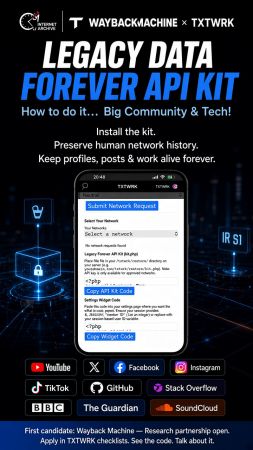
🚀 TXTWRK LEGACY DATA FOREVER — Building Our Own Wayback Layer + Open Invitation to the Wayback Machine and 10 Key Networks


We’re making it.

Right now, inside TXTWRK Server & Workspace technologies and our open-source public working checklists, we’re building a pure web-code snapshot system — a lightweight, client-side Wayback-style tool.

No heavy files required.
Just clean HTML snapshots.
External images, CSS and scripts keep linking to the live originals.
Placeholders appear when something is gone.
Everything stays visible, discussable and improvable in public checklists where anyone can see the code and talk about it.

This is not a side project.
It is the next practical step in our long-term digital legacy mission.

TXTWRK already turns profiles into living records.
Checklists into public work containers.
Servers and Workspaces into real collaborative execution.

Now we are adding the ability to freeze the exact state of a page — whether it’s a community feedback post, a local checklist, a business pitch, or an external page that matters to the work — so the proof and the memory stay intact.

The Legacy Data Forever API Kit


We are designing an installable kit for networks that care about durable public memory.

It will let platforms:
•Expose structured, timestamped page snapshots
•Preserve public work records (profiles, checklists, feedback, contributions) in a consistent, interoperable format
•Keep external links and assets live where possible, with graceful placeholders where they are not
•Give communities ownership and visibility of their own legacy data
•Turn long-term digital memory into a shared layer instead of isolated silos

First real candidate: the Wayback Machine


The Wayback Machine (Internet Archive) is our first real candidate.

We would like to support them in research and explore integration of the Legacy Data Forever API Kit.

They have spent decades doing the essential work of preserving the web for everyone. We respect that work deeply and see a clear opportunity for complementary collaboration — not competition.

10 networks we should prioritise next


Our history on these networks must be maintained into a future where we can afford to keep human historical network data from profiles alive.

These are the platforms where millions of people have already built their public records, creative work, code, news contributions and music.

Losing that history would mean losing part of the human story.

YouTube & social media networks


1. YouTube
2. X (Twitter)
3. Facebook / Meta
4. Instagram
5. TikTok

Code-based & test networks


6. GitHub
7. Stack Overflow

News portals


8. BBC News
9. The Guardian

Music apps


10. SoundCloud (and platforms like Spotify / Bandcamp)

These networks hold the profiles, posts, videos, code, articles and music that form the living history of communities, creators, developers and citizens.

The Legacy Data Forever API Kit is designed so that this human network data can remain accessible, structured and protected long into the future — not locked behind changing company policies or disappearing pages.

We are developing the core capture and viewer openly in TXTWRK checklists — code visible, conversation public, contributions welcome.

Server directories and Workspace tools already give us the place to store, edit, test and iterate.

If the Wayback Machine or any of the networks listed above want to explore research collaboration or integration, the invitation is open today.

Let’s make long-term digital legacy something networks can install, share and protect together — forever.

Apply to the open checklist.
See the code.
Talk about it.
Help shape the Legacy Data Forever API Kit.

This is how text works for the next 100 years.


#TXTWRK #LegacyDataForever #WaybackMachine #OpenSourceWorking #DigitalLegacy

🗖 VIEW
Do you think your posts are online forever?
Select up to 1
0 people have voted
Yes
0 votes
Not sure
0 votes
No
0 votes
Cast Vote