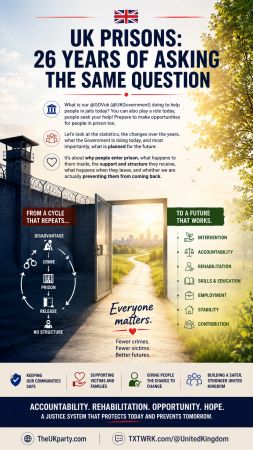
What is our
@GOVuk (
@UKGovernment) doing to help people in jails today, you may ask from time to time? You can also play a role today, people seek your help! Prepare to make opportunities for people in prison too.
Well, let's look at the statistics first — how many people are currently in our prisons, how those numbers have changed over the last 26 years, what has changed within the prison and rehabilitation system during that time, what the Government is doing today, and importantly,
what is planned for the future.
Because this isn't simply a question about how many prison places Britain has.
It's about
why people enter prison, what happens to them while they're there, what support and structure they receive, what happens when they leave, and whether our system is actually preventing them from coming back.
🇬🇧
UK PRISONS: 26 YEARS OF ASKING THE SAME QUESTION
How many people are we imprisoning — and are we actually fixing what brings people back?
📊 England & Wales: the long-term picture
Source: Ministry of Justice prison population statistics. Most historical figures are snapshots taken on 30 June, so they should be compared on that basis.
The story isn't a straight line.
There was a major rise through the 2000s, a decline around the pandemic, and then another sharp increase after 2022.
From
71,218 in 2002 to 87,334 in 2025, the England & Wales prison population increased by approximately
23%.
But numbers alone don't tell us whether the system is working.
A growing prison population raises much bigger questions about sentencing, overcrowding, rehabilitation, education, addiction treatment, mental health support, employment, housing after release and ultimately
reoffending.
🇬🇧 What about the rest of the UK?
The UK doesn't operate one prison system.
England & Wales, Scotland and Northern Ireland operate and publish statistics for their own prison systems, often using different reporting dates.
These dates don't match, so
≈98,000 should be treated as an indicative UK picture, not an official same-day UK total.
Scotland itself recently reached a record
8,603 prisoners on 26 May 2026, against a prison estate design capacity of
7,805.
That should make all of us ask questions.
Not simply:
"Where do we build the next prison?"
But:
"Why are so many people entering and returning to prison in the first place?"
---
🔄 But numbers alone don't explain the problem
Prison has several purposes.
Everyone matters.
That includes the person whose life was changed by crime.
It includes the family living with the consequences.
It includes the community that deserves to feel safe.
And yes — it also includes the person sitting inside a prison cell.
Recognising somebody's humanity does
not excuse what they did.
Understanding why somebody offended does
not remove their responsibility for offending.
But if understanding the causes helps prevent that person from creating another victim, then surely understanding those causes must be part of justice too.
---
⚖️ Accountability AND rehabilitation
These things should not be opposites.
People make mistakes.
Some mistakes cause enormous harm and require serious punishment.
Some people may also require long periods of imprisonment to protect the public.
But eventually,
many prisoners will return to our streets and communities.
That means society has a choice.
What kind of person do we want walking through that prison gate?
Someone who spent years simply being contained?
Someone leaving with the same problems, addictions, lack of education, lack of employment, instability and absence of structure they entered with?
Or someone who has been
challenged, educated, treated, disciplined, supported and given the tools to build a different life?
Prison cannot simply be somewhere we store people until their sentence expires.
If somebody is going to return to society, rehabilitation becomes a matter of
public safety.
---
🔁 The revolving door is the bigger question
Imagine somebody's life following this path:
Disadvantage → Crime → Prison → Release → No Structure → Crime → Prison
Then it happens again.
And again.
And again.
We can continue blaming that individual every time they return.
They absolutely have responsibility for their choices.
But eventually society must also ask:
Why does the engine keep turning?
If thousands of people repeatedly travel through the same system, then challenging the system does not mean excusing the individual.
It means asking whether we can produce a better outcome.
What if more journeys looked like this?
Disadvantage → Intervention → Accountability → Rehabilitation → Skills → Employment → Stability → Contribution
That is much harder than simply locking somebody away.
But the potential reward is enormous:
One person rebuilding their life can mean fewer crimes, fewer victims, stronger families, safer communities and one less person occupying a prison cell.
---
🧱 PEOPLE NEED STRUCTURE — SOMETIMES AGAIN AND AGAIN
Rehabilitation isn't one conversation.
It isn't one training course.
It isn't handing somebody a leaflet when they're released and expecting years of problems to disappear.
For some people, change requires structure
again and again and again.
That could mean:
Not everyone will take those opportunities.
Some will fail.
Some will relapse.
Some will reoffend.
Some may need intervention
again and again before something finally changes.
That does not mean we stop holding people accountable.
And it does not mean we stop trying.
---
This is where the conversation needs to go beyond prison-population statistics.
We should be looking at what is actually being delivered across:
→ Prison capacity
→ Sentencing reform
→ Probation
→ Rehabilitation programmes
→ Prison education
→ Employment and skills
→ Drug and alcohol treatment
→ Mental-health support
→ Housing after release
→ Electronic monitoring
→ Community sentences
→ Support for victims
→ Reoffending prevention
And then we need to measure the results.
Not simply:
"How much money was announced?"
But:
"Did it work?"
---
🔮 AND WHAT IS PLANNED FOR THE FUTURE?
Government announcements and promises matter.
But outcomes matter more.
Over the coming years we should be able to judge criminal-justice policy against some straightforward questions:
That final measure matters enormously.
Because rehabilitation isn't simply about being compassionate towards somebody who committed a crime.
Successful rehabilitation protects the person who otherwise might have become their next victim.
---
🇬🇧 26 YEARS LATER...
After more than two decades of rising pressure on our prisons, the question cannot simply be:
"How many more prison places do we need?"
We should also be asking:
"Why do we need so many?"
"What changed over those 26 years?"
"Which policies worked?"
"Which policies failed?"
"Why are people returning?"
"What is Government changing today?"
And perhaps most importantly:
"What are we going to do differently over the next 26 years?"
We can continue blaming the people who break the system.
People must take responsibility for their actions.
But
we should also have the courage to challenge a system that allows the same engine to keep turning.
Justice matters.
Victims matter.
Accountability matters.
Consequences matter.
Public safety matters.
Rehabilitation matters.
Second chances matter.
Everyone matters.
Because the best criminal-justice system isn't simply one capable of punishing yesterday's crime.
It's one capable of preventing tomorrow's victim.
🇬🇧
For accountability.
🇬🇧
For rehabilitation.
🇬🇧
For safer communities.
🇬🇧
For fewer future victims.
🇬🇧
For a better future.
#UnitedKingdom #UK #GOVuk #UKGovernment #Justice #Prisons #Rehabilitation #Crime #CriminalJustice #PublicSafety #SecondChances #Reoffending #EveryoneMatters























































COMMUNITY
People