



















































































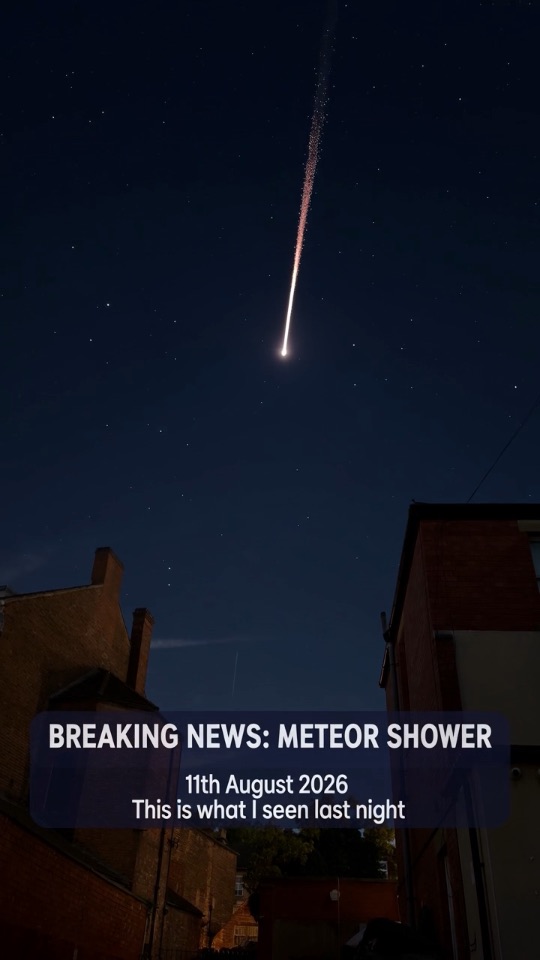
☄️ Perseid Meteor Shower Peaks Over the UK Tonight (video remade with Grok)
One of the year's biggest meteor showers is reaching its peak over the United Kingdom tonight, giving people across the country a chance to catch shooting stars and potentially spectacular fireballs crossing the night sky.
The Perseid meteor shower peaks overnight from Wednesday 12 August into Thursday 13 August 2026. The shower has been active since July, but tonight offers one of the best opportunities to watch it.
The Perseids are known for producing bright, extremely fast meteors and long visible trails. Under ideal dark-sky conditions, large numbers of meteors may be visible around the shower's peak, although the number actually seen will depend heavily on location, cloud cover and light pollution.
🌠 A spectacular sighting over Derby
The display may already have given Derby a taste of what's to come.
Late on Tuesday night, @ImSunnyClaire reported seeing an exceptionally bright object streak across a huge portion of the sky from Derby city centre.
The sighting was made from the DE1 area at roughly 23:00–00:00, with the object first appearing from approximately 223° south-west before streaking across the observer's field of view.
It happened so quickly that it was nearly — but not quite — caught on camera.
The timing places the sighting during the active Perseid period and immediately ahead of the shower's peak. However, the object has not been independently confirmed as a Perseid meteor, so for now it remains an eyewitness sighting consistent with bright meteor activity at this time of year.
👀 Look up tonight
You don't need a telescope to watch the Perseids.
Meteors can appear across a huge area of the sky, so a wide, unobstructed view is better than concentrating on one small point.
Find somewhere as dark as possible, move away from street lighting where you can, and give your eyes time to adjust to the darkness.
For photographers and anyone hoping to catch a meteor on video, consider setting up a wide-angle camera covering a large area of open sky and leaving it recording or taking repeated exposures.
Trying to grab your camera after seeing a fireball is usually too late.
☄️ What causes the Perseids?
The Perseids occur as Earth travels through a stream of debris associated with Comet Swift–Tuttle.
Tiny particles enter Earth's atmosphere at enormous speeds, heating up and producing the brilliant streaks of light we see as meteors.
Most are over almost instantly.
Occasionally, though, a particularly bright one can produce a spectacular streak or lingering trail across the night sky.
---
📅 Event: Perseid Meteor Shower 2026 — UK Peak
🗓️ Date: 12–13 August 2026
⏰ Starts: 23:00 BST
⏰ Ends: 05:30 BST
🌍 Location: United Kingdom
👀 Visibility: Nationwide where skies are sufficiently clear
🔭 Equipment: No telescope required
📷 Photography: Wide-angle camera and continuous/repeated shooting recommended
If you spot something spectacular, share your location, the approximate time, which direction it travelled and what it looked like.
Multiple sightings from different locations could help establish whether people witnessed the same fireball.
Read More



COMMUNITY
People