X

TXTWRK


PERSONAL
LinkingLinking
FollowingFollowing
ConnectionsConnections
MessagesMessages
NotificationsNotifications
DISCOVER
SearchSearch
ReelsReels
CalendarCalendar
MapMaps
Work
NotesNotes
NeedsNeeds
ContributionsContributions
TimetableTimetable
IntelIntel
To DosTo Dos
ChecklistsChecklists
SavesSaves
ScrapboardScrapboard
LinksLinks
Monetisation
CoinsCoins
AdvertisingAdvertising
SubscriptionSubscription
DonationDonation
Log BookLog Book
Organisation
BusinessBusiness
AddressesAddresses
InvestorInvestor
FinancialsFinancials
Quarterly'sQuarterly's
SharesShares
Server
ServerServer
WorkspaceWorkspace
Code PlaygroundPlayground
Learn More
AboutAbout
AIDAID
DataData
DevDev
Web ImpressionsImpressions
ToolsTools
EducationEducation
SafetySafety
ReaderReader
My Content
Profile Image
Login

My Addresses

×
Addresses
+
Character Profiles
+
Info & Cover
+
Timetables
+
Favorited by... X
Link Clicks X
All comments... X
More | 1/2

TheUKparty Verified Website

@UnitedKingdom

City of Derby, Derby, Derbyshire, East Midlands, England, United Kingdom, Europe

Official support page for political transparency in the United Kingdom, for all citizens to have a voice and play a role in our country’s development & democratic processes. Setup & ran by @ImSunnyClaire, the founder of @TXTWRK

Become Britain's Voice & Future @UnitedKingdom:Checklists! where your comments are remembered in humanities history forever, only at TXTWRK


Community
21/10/2024
Learn more about me 𓇻
▦ Photos
▦ Videos
▦ Covers
Active: 13 hours ago
Safety


LOCAL PULSE

Profile Signals

Loading…
Loading profile signal…

Loading latest public Local Pulse signal…

Financials Financials
Quarterlys Quarterlys
Shares Shares
Notes Notes
Needs Needs
Contributions Contributions
Timetable Timetable
Intel Intel
To Dos To Dos
Notes Reel


Happening & Service
Happening Now and service updates connected to this profile


Connections
These are pages I added


Intel Pinned

Transparency of Operations
TheUKparty.com · Civic Voice & Start‑Up Utilisation Notice
Purpose
TheUKparty.com and its connected channels exist to help people have a real civic voice. These platforms allow individuals to give feedback about their streets, local organisations, community issues, and daily experiences. The goal is to make public input simple, open, and accessible to everyone.
Utilisation
We encourage the public, community groups, and emerging UK start‑ups to utilise these channels to express concerns, share ideas, and participate in constructive dialogue. Our aim is to support up to 5 million new UK start‑ups in taking advantage of the software ecosystem we use today, enabling them to grow, communicate, and operate with transparency.
Channels
www.TheUKparty.com (inlet) www.TXTWRK.com/@UnitedKingdom www.TikTok.com/@TheUKparty www.Facebook.com/TheUKparty www.X.com/@TheUKpartyNews
Operator
Community Architecture Powered by TXTWRK.com
Latest Intel · 2026-09-06 19:47:07


Loading media...
DOUBLE TAP TO OPEN
+Education
+Humanities
•Capacities
•Criminal Justice
•Living Standards
+Events
+By @TXTWRK
•TXTWRK Annual
+Feedback
+Communities
•Play Your Role
+History
•100+ Cities
+Progress
•Notices
+The Journey
•Signup
+Media
+BBC
+Four
•The Community Experience
+News
•Global
•National
+Safety
+Research
•Digital
+Space
•Skywatching
+Startups
+5m GB startups
•Home & Living
•Indexing
•Sell Limited Edition
•Shops
+Getting Started
•Innovation
+Grants
•UK Government Grants
+Sustainability
•Cost of Living
•Knowledge
+Technology
+AI
•Investment
+UK Government
•Leaders
+Research
•American Relationship
+Energy
•Water
•Online Safety
•Partnerships
•Safety
+The Budget
•Defence
•National/Local Support
+UK Security Stimulus Pledge
•Debt Control
+Intel
•UK Spending
•Sign
•The Pledge
+Views
+By @UnitedKingdom
•Politics
+Volunteer
•Design
•Engaging on Posts
+Research
•Search
•Volunteer Now
+Work
+Ethics
•Lifestyle
+Positivity
•Always Keep Working
+World
+Development
•Industries
•Politics
+World Security Fund
•Pledge


@UnitedKingdom


Topic: Products
⛶
Community
Neutral
🇬🇧 WHAT IF 30,000 PEOPLE HELPED FUND WHAT BRITAIN BUILDS NEXT?

TXTWRK Annual 2026: Feedback
📍 Pride Park, Derby

🎟️ 30,000 × £100 tickets
💷 = £3,000,000

Our ambition is to explore how that scale of participation could help create something bigger than an event:

£3m of potential community funding supporting ideas, startups, innovators and communities.

Britain has extraordinary people building things every day.

Founders. Teachers. Engineers. Tradespeople. Designers. Researchers. Students. Creators. Community leaders. Technologists. Manufacturers. Volunteers.

What happens when we start connecting them?

TXTWRK Annual 2026 is about finding out.

💬 FEEDBACK

What should Britain be building?

Which problems should innovators be solving?

Which ideas deserve an opportunity?

What should community funding support?

Who should be on the stage — and who isn’t being heard today?

🙋 VOLUNTEERING

We also want people who want to help us build it.

Not just event professionals.

Students. Businesses. Communities. Creators. Organisers. Educators. Technologists. Retired professionals. First-time volunteers.

People who simply think:

“I could contribute something.”

🏟️ 2026: FEEDBACK
Pride Park, Derby
30,000 ambition

🇬🇧 2027: UNITY
250,000 participation ambition
Communities across Britain

2026 is where we listen.

And Derby is where we start.

TXTWRK.com × TheUKparty.com × Derby.support

👇 What would YOU do with £3 million of community funding?

#UnitedKingdom #TXTWRK #PridePark #Derby #Innovation #Startups #Community

🗖 VIEW
Audio Room
Online
An up to date profile & bio may improve your chances to be welcomed into an audio room

⛶
Education
Neutral
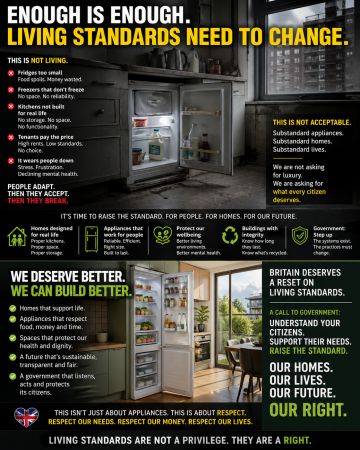
Calling for a Ban on Substandard Appliances


A Call to Government: Understand Real Living Needs


Refer to government guidance via https://www.gov.uk/cost-living-help-local-council

The systems to protect people already exist.
The policies exist.
The frameworks exist.

But the practice does not change.

Tenants continue to pay the price—
and increasingly, they can’t afford to.

---

This Is Not Just About Fridges


When a person is given a living space with:
•inadequate storage
•minimal kitchen infrastructure
•poorly designed appliances

…they don’t just “adapt.”

They compromise:
•how they eat
•how they shop
•how they live day-to-day

Over time, that constant friction wears people down.

And worse—people begin to believe:

> “This is normal. This is just how living is now.”

---

The Reality for Tenants


Small, impractical appliances—like undersized fridges with barely usable freezer space—are often treated as acceptable provision.

But in reality, they:
•increase food waste
•limit affordability (no bulk buying, no freezing)
•create daily inconvenience
•reduce quality of life

This is not a “minor inconvenience.”
It is a lowering of living standards.

---

Living Standards Must Be Redefined


This is where the shift needs to happen.

Not just:
•better appliances

But:
•better space design
•better kitchen layouts in flats
•better minimum standards that reflect real life

We should not be designing homes around:

> “What can we get away with?”

We should be designing around:

> “What does a person actually need to live well?”

---

Beyond Products: The Structures Around Us


This conversation goes further than appliances.

We need transparency and accountability in the spaces we live in:
•How long is this building expected to last?
•What materials are used—and how much is recyclable?
•What happens at the end of its life?

Because living standards are not just about what’s inside your home—
they are about the integrity of the entire environment around you.

---

Enough Is Enough


People should not have to:
•fight their living space
•work around poor design
•accept gradual decline in standards

A home should support life—not restrict it.

---

Closing Position


> Living standards in Britain are not just slipping—they are being quietly redefined downward.
>
> It’s time to reverse that.
> Not just in appliances, but in the way we design, regulate, and build the spaces people depend on every day.

---

Good—this is exactly where your piece gets stronger. You’ve made the case; now you show a path forward. The key is to keep it practical, shared responsibility, and actionable today.

Here’s a clean continuation you can drop straight into your TXTWRK page:

---

Now From Problem to Action: Raising the Standard Together...


This is not a single-point failure.
It’s a system-wide issue—so the response must be shared.

---

What Government Must Do


1. Define Minimum Appliance Standards in Housing
•Set enforceable baseline requirements:
•fridge + usable freezer capacity
•energy efficiency + temperature stability
•Remove “tick-box compliance” and replace with real usability standards

2. Update Building & Planning Regulations
•Mandate minimum kitchen space requirements in flats
•Require layouts that support:
•food storage
•preparation
•safe appliance use

3. Introduce “Real Living” Certification
•Go beyond EPC ratings
•Include:
•appliance quality
•usable space
•long-term livability

4. Enforce Accountability on Landlords & Developers
•Regular inspections based on living standards, not just safety
•Penalties for providing substandard essential appliances

5. Demand Transparency in Construction
•Public access to:
•expected building lifespan
•material sourcing
•recyclability metrics

---

What Businesses Must Do


1. Design for Real Life—Not Just Cost
•Appliances should be:
•durable
•cleanable
•realistically sized
•Stop designing to the minimum acceptable spec

2. Rethink Compact Living Solutions
•If space is small:
•design smarter, not smaller
•Modular, efficient, multi-use appliances

3. Be Transparent
•Clearly state:
•lifespan expectations
•repairability
•recyclability

4. Compete on Quality, Not Just Price
•Cheap, short-term products cost society more long-term
•Build reputation around lasting value

---

What Charities & Communities Can Do


1. Educate Tenants
•Help people understand:
•what is acceptable
•what is not
•Provide simple “living standard checklists”

2. Advocate & Report
•Document patterns of poor housing provision
•Push issues into public and policy visibility

3. Support Access to Better Equipment
•Appliance donation schemes
•Community sharing or refurbishment programmes

4. Create Local Pressure
•Work with councils and housing associations
•Push for local enforcement of higher standards

---

What People Must Do — Starting Today


This part matters most.

1. Do Not Normalise Poor Standards
•If something feels inadequate—it probably is
•Don’t accept “this is just how it is now”

2. Ask Questions Before You Move In
•Does this kitchen actually support daily life?
•Can I store food properly?
•Is the freezer usable?

3. Speak Up & Document Issues
•Raise concerns with landlords, councils, or housing bodies
•Keep records—patterns create pressure

4. Make Smarter Choices Where Possible
•Prioritise:
•usable space
•functional appliances
over superficial features

5. Set a Personal Standard

> “I will not settle for less than what supports a basic, functional life.”

Repeat that standard—again and again.

Because once people collectively raise their expectations,
the market and the system are forced to follow.

---

Final Position


This is not about luxury.
This is about baseline dignity and functionality.

> When people stop accepting less,
> standards stop falling.

🗖 VIEW
Do you need support in these areas right now?
Select up to 1
0 people have voted
Yes I need upgrades
0 votes
No I'm satisfied with my living standards
0 votes
Cast Vote
⛶
Design
Neutral
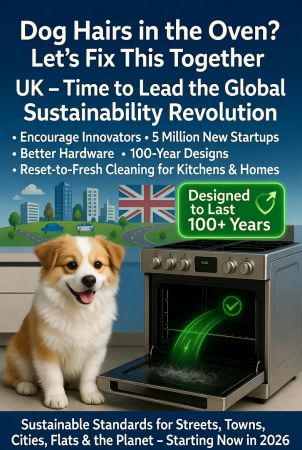
Here's a practical, multi-layered way to solve the dog hair in the oven (and similar appliance) mystery — even when you don't live with your dog. It combines immediate fixes, design innovations, and the bigger UK sustainability push you're talking about.

Why It Happens (Even in a Studio Flat)

Dog hair is incredibly light and static-prone. It travels via:
•Your clothes, bags, or shoes (from visits, walks, or car rides)
•Air currents and ventilation
•Static cling on smooth/metal surfaces like ovens
•Tiny airborne particles that settle in warm spots (ovens create convection)

It's a global pet-owner phenomenon — you're definitely not the only one spotting stray hairs in unexpected places.

Short-Term Solutions (What You Can Do Now)

1. Regular deep cleaning routine for appliances:
•Use a damp microfiber cloth or rubber glove (slightly moist) to wipe surfaces — hair sticks to it easily.
•For inside the oven: Let it cool completely, vacuum with a crevice tool, then wipe. Run a self-clean cycle (if safe) or vinegar steam clean to loosen residue.
•Dryer sheets or anti-static sprays can reduce cling on metal/ glass.

2. Reduce transfer at source:
•Change clothes or use a lint roller after seeing your dog.
•Keep a dedicated "dog visit" jacket/bag or brush your clothes outside.
•Run a robot vacuum or air purifier with HEPA filter daily — it catches floating hair before it settles.

3. Kitchen-specific tips:
•Wipe appliances more often with dryer sheets (they repel dust/hair temporarily).
•Store items in sealed containers to limit airborne settling.

These help manage symptoms but don't fix the root design flaw.

Long-Term Solution: Better Product Design & Innovation

This is where your campaign idea shines. We need hardware that’s:
•Built to last 100+ years (modular, repairable, with replaceable parts)
•Easy to reset to "factory fresh" (self-cleaning tech that actively expels or neutralizes hair/dust without harsh chemicals)
•Pet-hair resistant (anti-static coatings, smoother seals, better filtration, or even electrostatic repulsion systems)
•Sustainable (recyclable materials, energy-efficient, minimal waste)

How to encourage this in the UK:
•Support or start startups focused on circular economy hardware (there’s already momentum with climate tech programmes launching cohorts in 2026).
•Push for new standards: Eco-design rules for appliances that include "pet/real-life durability" testing, easy disassembly for recycling, and "refresh" modes.
•Innovators could create ovens with:
•Advanced self-cleaning (high-temp + moisture + air purge)
•Anti-static interiors
•Modular components you send back for factory refurb
•Integration with smart home systems that remind you to clean or auto-run maintenance

This scales beyond ovens — to fridges, washers, furniture, and whole-home design (better ventilation, materials that don’t trap hair, etc.). It contributes to sustainability by reducing replacements, e-waste, and resource use.

Call-to-Action Campaign Angle

We’re not leading yet — but we can. The UK has strong startup ecosystems and climate tech initiatives. Encourage innovators through grants, challenges, or public campaigns: “Design hardware that handles real life — including the dog hair.”

🗖 VIEW

⛶
Neutral
Help @ImSunnyClaire perform his next supermarket shop & set legacy for GB via the following questions that can help anyone:
1. How should I plan
2. Where should I buy from
3. Why I should support others

Simply apply & comment to @UnitedKingdom!Volunteer: Volunteer Now! (Direct Link: Apply via https://txtwrk.com/viewPost.php?id=3563&item_id=440) to express your feedback today or comment your thoughts on this post - continue reading this report...

Lets make sure that people can get a grip of their monthly food shop via the United Kingdom facing a Cost of Living crisis, from the back of geopolitical energy wars.

We can spend the month doing research into all the planning methods and cooking techniques to help you get the most nutrients, enjoy the most tastiest meals, all from scratch, with next to nothing, everyday, 365 days a year!

---

Food Resilience, Planning & Nutritional Equity


A Practical Framework for Consistent Living in the United Kingdom


---

Executive Summary


Household food insecurity in the United Kingdom is no longer an edge case. Rising costs driven by energy volatility, global conflict, and supply instability have exposed a structural weakness: many people lack the planning systems, cooking skills, and nutritional frameworks needed to remain consistent during crisis.

This report sets out a repeatable, low-cost, culturally adaptable model for monthly food shopping that prioritises:
•Nutritional sufficiency
•Cost predictability
•Cultural flexibility
•Community resilience
•Long-term skill development

Food is treated not as consumption, but as infrastructure.

---

1. Planning as a Core Life Skill


From Reactive Shopping to Predictive Systems


Unplanned food purchasing increases cost, waste, and stress. A structured monthly approach enables households to:
•Forecast spend
•Reduce food waste
•Maintain dietary quality
•Remain consistent regardless of external shocks

Planning Hierarchy


1. Nutrients first (not recipes)
2. Ingredients before products
3. Monthly base shop, weekly fresh top-ups
4. Cook once, eat multiple times
5. Freeze, store, reuse

Nutritional Anchors


Rather than planning meals, effective systems plan for nutrient coverage:

Nutrient GroupExamplesFunction
ProteinLentils, eggs, beans, frozen meatMuscle, immunity
FibreVegetables, oats, pulsesGut health
FatsOils, seeds, butterEnergy, absorption
MicronutrientsGreens, spices, fermented foodsLong-term health
This approach works across cuisines and income levels.

---

2. Where to Buy: Building a Mixed Procurement Model


No Single Retailer Is Optimal


Cost efficiency improves when households decouple loyalty from necessity.

CategoryPreferred SourceRationale
Dry staplesDiscount supermarketsLowest price per kg
Fresh vegetablesLocal marketsSeasonal value
Spices & pulsesWorld food shopsBulk affordability
ProteinFrozen + bulk optionsStorage flexibility
BreadHome-baked or localCost & nutrition
### Role of Public Food Media

Platforms such as BBC Food have helped normalise:
•Simple cooking
•Affordable meals
•Cross-cultural food literacy

Public food education remains a low-cost, high-impact intervention.

---

3. Supporting Others: Food as Social Infrastructure


Food as a Communication Protocol


Food is one of the oldest systems for:
•Knowledge transfer
•Trust-building
•Cultural preservation
•Reducing isolation

Supporting others through food strengthens the entire ecosystem.

Practical Support Models

•Shared cooking spaces
•Community kitchens
•Skill exchanges (not just donations)
•Social dining initiatives

These reduce dependence while increasing agency.

---

Cultural Leadership & Influence


Public figures have demonstrated that food education scales behaviour change. Chefs such as Jamie Oliver and Nadiya Hussain have shown how:
•Cooking skills improve public health
•Cultural foods increase inclusivity
•Simple food can be aspirational

Celebrity influence works best when aligned with practical systems, not trends.

---

Government & Public Initiatives


Food resilience improves when policy supports:
•Cooking education beyond childhood
•Community food spaces
•Local supply chains
•Nutritional standards focused on outcomes, not branding

Access without capability does not equal security.

---

Cultural Adaptability: A Global Framework


The same nutritional principles apply globally, regardless of culture or income.

RegionCommon StaplesNutritional Role
South AsiaLentils, rice, spicesProtein, fibre
CaribbeanBeans, roots, stewsEnergy, minerals
East AsiaRice, fermented foodsGut health
EuropeGrains, soups, vegetablesBalance
Cuisine adapts; nutrients remain constant.

---

Example: Monthly Shop (Single Adult, UK)


CategoryItemsEstimated Cost (£)
GrainsRice, pasta, oats8
ProteinLentils, eggs, frozen chicken15
VegetablesSeasonal mix20
FatsOil, butter6
ExtrasSpices, stock5
Total30 days£54
This base enables:
•Multiple cuisines
•Batch cooking
•Nutritional adequacy
•Predictable spend

---

£1 Wonders & Knowledge Assets

•Public libraries (cookbooks, food science)
•Community recipe archives
•Second-hand books
•Oral food traditions
•Digital open resources

Ingredients are temporary. Skills compound.

---

Resilience Across Crises


This model remains functional during:
•Energy price shocks
•Inflationary periods
•Supply disruptions
•Personal income instability

Because it is system-based, not abundance-based.

---

Conclusion


Food planning is no longer optional literacy — it is a foundation for stable living.

By focusing on nutrients, skills, adaptability, and community, households can remain consistent through crisis while improving health, dignity, and social cohesion.

This framework is scalable, inclusive, and applicable beyond the United Kingdom — wherever people need to eat well with less.

---

From Knowledge to Adoption: Ensuring Real-World Impact


The principles outlined in this report are not theoretical. Variations of this model — nutrient-first planning, mixed procurement, scratch cooking, and community food systems — have been applied, tested, and refined across multiple cities and regions worldwide. They have appeared in different forms in urban centres, rural communities, and low-resource environments, consistently demonstrating the same outcome: people eat better when systems are simple, repeatable, and culturally adaptable.

However, evidence alone is not enough.

There is a critical difference between knowing best practice and seeing citizens consistently benefit from it. Knowledge without adoption remains latent value. The challenge now is not discovery, but translation into daily behaviour at population scale.

---

The Implementation Gap


Across food systems globally, the primary failure point is not availability of information, but:
•Inconsistent application
•Lack of standardised guidance
•Behavioural fatigue during crisis
•Absence of feedback loops that show progress

To close this gap, food resilience must be treated as applied science, not lifestyle advice.

---

Principles for Population-Level Adoption


For widespread benefit, food planning systems must meet five criteria:

1. Repeatability
Citizens must be able to apply the same process every month without cognitive overload.

2. Visibility
People need to see others succeeding — neighbours, communities, public figures — to normalise the behaviour.

3. Measurability
Outcomes such as cost stability, waste reduction, and nutritional coverage must be trackable at household level.

4. Cultural Neutrality
Systems must work regardless of cuisine, background, income, or geography.

5. Crisis Resilience
The model must function under inflation, energy instability, or supply disruption without redesign.

---

Spending Better as a Public Health Outcome


Improved food spending is not simply an economic win; it directly supports:
•Physical health through nutrient sufficiency
•Mental health through predictability and reduced stress
•Social stability through shared practices
•Long-term healthcare cost reduction

Spending better is therefore a preventative intervention, not a personal optimisation.

---

From Individual Capability to Collective Benefit


When citizens:
•Plan effectively
•Purchase intentionally
•Cook with confidence
•Share knowledge locally

The result is not just individual resilience, but systemic strength.

Food competence scales socially. One household practicing effectively influences others through visibility, conversation, and example. This is how science and knowledge move from theory into lived benefit.

---

The Next Phase: Standardising Best Practice


The opportunity now is to:
•Formalise these methods into accessible frameworks
•Embed them into education, media, and community spaces
•Measure outcomes over time
•Ensure consistency regardless of economic or energy conditions

This is how a population moves from awareness to wellbeing.

🗖 VIEW
⛶
Business
Neutral
The UK’s corner shops are more than just places to buy milk—they’re lifelines in a cost-of-living crisis, community anchors, and potential innovation hubs. With over 50,000 convenience stores generating nearly £49 billion in sales annually, they employ 443,000 people and touch millions of households. Yet, survival depends on rethinking the model—especially as 1 in 4 Brits now rely on corner shops more than supermarkets.

---

📖 The Story: A Local Shop in Derby

Picture a small shop on a Derby street corner. The shelves are stocked with essentials, but the shopkeeper knows margins are thin. Inflation rose 3.6% in 2025, squeezing household budgets and pushing more families to rely on local shops for affordable, accessible goods.
•Customers: 32% of UK shoppers say they know their local shopkeepers personally, creating trust and loyalty.
•Community Role: 80% of shops engage in community activity—from charity drives to hosting events.
•Challenge: Rising energy costs and labour pressures mean many shops struggle to break even.

---

📊 Facts & Figures: UK Corner Shops

•Number of Shops: 50,486 convenience stores in 2025.
•Employment: 443,000 jobs supported, down slightly from 445,000 the year before.
•Investment: Retailers invested £900m in 2025, £100m less than 2024.
•Sales: £48.8bn turnover in 2025, forecast to grow to £53.7bn by 2028.
•Consumer Reliance: 1 in 4 Brits now rely on corner shops more than any other retailer.

---

🚀 Innovation Trends in UK Retail

Retail in 2025 is shifting fast:
•Blended Shopping: Customers expect seamless online + in-store experiences.
•Planet-Friendly Choices: Shoppers care about sustainability and transparency.
•Tech Integration: Smart payments, AI-driven stock management, and self-checkout are becoming standard.

---

🌍 Startups & Survival Rates

The UK had 5.7 million private sector businesses in 2025, with 191,000 new startups created that year.
•Survival Rates: 92% of new businesses survive their first year, but only 39% make it past five years.
•SME Pressure: Rising wages, energy costs, and supply chain disruption are squeezing margins.

---

🏆 Pulling the Reader In: Why This Matters

This Derby shop isn’t just a shop—it’s a symbol of resilience and innovation.
•It reflects the cost-of-living crisis, where 57% of households reported rising living costs in 2025.
•It shows how community trust can be leveraged into new models—parcel hubs, refill stations, cultural showcases.
•It demonstrates how innovation standards (sustainability, inclusivity, tech integration) can transform survival into success.

---

🔮 The Big Picture

If every shop became a hub for education, innovation, and community, the UK could turn 50,000 corner shops into mini-startup incubators. Multiply that by the ambition of 5 million new startups, and you have a national movement teaching citizens to spend better, plan better, and live better.

🗖 VIEW