X

TXTWRK


PERSONAL
LinkingLinking
FollowingFollowing
ConnectionsConnections
MessagesMessages
NotificationsNotifications
DISCOVER
SearchSearch
ReelsReels
CalendarCalendar
MapMaps
Work
NotesNotes
NeedsNeeds
ContributionsContributions
TimetableTimetable
IntelIntel
To DosTo Dos
ChecklistsChecklists
SavesSaves
ScrapboardScrapboard
LinksLinks
Monetisation
CoinsCoins
AdvertisingAdvertising
SubscriptionSubscription
DonationDonation
Log BookLog Book
Organisation
BusinessBusiness
AddressesAddresses
InvestorInvestor
FinancialsFinancials
Quarterly'sQuarterly's
SharesShares
Server
ServerServer
WorkspaceWorkspace
Code PlaygroundPlayground
Learn More
AboutAbout
AIDAID
DataData
DevDev
Web ImpressionsImpressions
ToolsTools
EducationEducation
SafetySafety
ReaderReader
My Content
Profile Image
Login

My Addresses

×
Addresses
+
Character Profiles
+
Info & Cover
+
Timetables
+
Favorited by... X
Link Clicks X
All comments... X

TXTWRK Science

@TXTWRKScience


Focused on research, discoveries, and innovations across all scientific fields. Stay informed with the latest scientific advancements, breakthroughs, and research papers.


Community
27/03/2025
Learn more about me 𓇻
▦ Photos
▦ Videos
▦ Covers
Active: Aug 08, 2026
Safety


LOCAL PULSE

Profile Signals

Loading…
Loading profile signal…

Loading latest public Local Pulse signal…

Financials Financials
Quarterlys Quarterlys
Shares Shares
Notes Notes
Needs Needs
Contributions Contributions
Timetable Timetable
Intel Intel
To Dos To Dos
Notes Reel


Happening & Service
Happening Now and service updates connected to this profile


Connections
These are pages I added


Loading media...
DOUBLE TAP TO OPEN
+Artificial Intelligence
•Political Questions
+Practices
•Task Rotation
•Writing
+Work
+Startup
•Research


@TXTWRKScience

⛶
Science
Neutral
🔄 ROTATION OF TASKS IS THE SAVIOUR — AND THE BODY EXPLAINS WHY


A student isn't just a brain sitting at a desk. Learning is a whole-body process. Long periods in one position, staring at the same material and performing the same mental operation can bring fatigue, discomfort and declining attention. Rotating purposeful tasks — for example, moving from reading to discussion, standing to investigate something, carrying out a practical, drawing a model and then returning to written work — changes both the physical and cognitive demands being placed on the learner. Even brief bouts of physical activity are associated with benefits for aspects of cognition, while breaking up prolonged sitting is valuable for physical health.

But task rotation can't compensate for a body that doesn't have what it needs. The brain has a substantial energy demand and depends on a continuous supply of nutrients and oxygen delivered through the blood. Food, water, movement and sleep therefore belong in the conversation about learning. This doesn't mean a particular snack magically makes someone clever. It means the biological systems supporting concentration, memory and alertness work best when basic physiological needs are met.

🧠 BODY FACTORWHAT'S HAPPENINGWHY IT MATTERS FOR LEARNING
MovementMuscles contract, heart rate and circulation can increaseBreaks up sedentary time and can support alertness and cognition
Changing tasksDifferent cognitive processes are recruitedCan reduce monotony and distribute mental effort
HydrationWater supports normal physiological and cognitive functionDehydration can contribute to tiredness and difficulty concentrating
FoodDigestion makes nutrients and energy substrates availableThe nervous system needs a reliable energy and nutrient supply
SleepThe brain undergoes important processes involved in memory and restorationPoor sleep can impair attention, learning and memory
RecoveryPeriods of lower demand interrupt sustained effortHelps prevent every minute of a lesson becoming maximum cognitive load
## 🍎 WHY DOES FOOD MATTER?

FOOD / NUTRIENTWHAT THE BODY USES IT FORSIMPLE EXAMPLES
CarbohydratesBroken down to provide glucose, an important fuel for the body and brainOats, potatoes, rice, wholegrain bread, fruit
ProteinSupplies amino acids needed to build and repair tissues and make many biological moleculesEggs, yoghurt, fish, beans, lentils
Unsaturated fatsProvide energy and fatty acids; lipids are important components of cell membranesNuts, seeds, oily fish, avocado
IronRequired for haemoglobin, which transports oxygen in the bloodMeat, beans, lentils, fortified cereals
WaterEssential for normal cellular and physiological processesWater, milk and water-rich foods
Fruit & vegetablesProvide fibre and a range of vitamins, minerals and other compoundsBerries, oranges, carrots, peppers, leafy vegetables
The important idea isn't “eat X and your grades improve.” Human nutrition is much more complicated than that. A varied, balanced diet helps provide the energy, protein, essential fats, vitamins, minerals and water required for normal body and brain function.

🔬 NOW CONNECT THAT BIOLOGY TO TASK ROTATION


LESSON MOMENTBODY + BRAIN CHANGEPURPOSE
1. ExploreCuriosity and attention are recruited by a new problemCreates a reason to learn
2. Move / InvestigateStudents change posture and may become physically activeBreaks prolonged sitting and changes demand
3. ExplainStudents retrieve information and organise it into languageExposes gaps and strengthens understanding
4. ApplyKnowledge must be used rather than merely recognisedBuilds flexible understanding
5. ReflectStudents retrieve and evaluate what they learnedSupports metacognition and consolidation
### 🧬 THIS IS WHY ROTATION CAN BE POWERFUL
•Bodies aren't designed for endless stillness. Breaking up prolonged sitting adds movement to the day.
•Attention isn't infinite. Changing a meaningful task can refresh engagement when concentration starts slipping.
•Different tasks require different processing. Observing, recalling, explaining, manipulating equipment and solving problems don't make identical demands.
•Retrieval matters. Asking students to recall an idea rather than simply reread it strengthens learning.
•Movement and learning can coexist. Science gives us unusually good opportunities to stand, measure, build, observe and investigate.
•Nutrition matters, but avoid “brain-food” myths. No blueberry, supplement or breakfast hack replaces an overall adequate diet, sleep and healthy routines.
•Hydration matters. Students need normal hydration for their bodies — including their brains — to function effectively.
•Sleep is huge. Learning doesn't finish when the lesson finishes; sleep has an important role in memory consolidation.
•Rotation isn't random entertainment. Changing tasks every two minutes would simply create distraction. The change should have a learning purpose.

The principle is simple: don't teach the brain as though it's disconnected from the body.

Give students opportunities to think, move, investigate, retrieve, explain, eat well, hydrate, rest and return to ideas in different ways.

That's not making Science easier.

It's using Science to make learning better.

TXTWRK Science 🧪
Rotate the task. Fuel the body. Challenge the brain.

⛶
Science
Neutral
Get Good Mental Health with TXTWRK Daily (10 Minutes) & AI to Support Your Interests


Good mental health isn't built overnight.

It's built through hundreds of small decisions that tell your brain, "I'm making progress."

One of the simplest habits ImSunnyClaire has adopted is writing one post every day about something genuinely interesting. It doesn't matter whether it's published on your personal page, a community page, or a business page.

It doesn't have to be perfect.
It doesn't have to go viral.
It simply needs to exist.

The objective isn't social media success.

The objective is giving your brain a 10-minute victory before asking it to solve complex problems for the rest of the day.

Whether your interest is science, driving, technology, engineering, history, AI, current affairs, or something you've just learned, writing about it reinforces your understanding while giving your mind a positive direction.

That's why TXTWRK has dedicated communities like TXTWRKScience, TXTWRKDriving, and TXTWRKNews, while still allowing everyone to build their own community around what they love.

---

The Science Behind Small Daily Wins


Modern neuroscience has shown that our brains constantly adapt to our daily behaviours through a process called neuroplasticity.

Every time we repeat a positive behaviour, the brain strengthens the neural pathways associated with that behaviour.

Small achievements may also activate the brain's reward system, helping reinforce motivation and making it more likely that we repeat the behaviour tomorrow.

Writing is particularly interesting because it combines several brain functions simultaneously:
•Memory retrieval
•Creative thinking
•Language processing
•Problem solving
•Reflection
•Planning
•Emotional regulation

Unlike passive scrolling, writing requires active engagement. Your brain has to organise ideas, recall knowledge, connect concepts, and communicate them clearly.

Even if you only write for ten minutes, you're exercising multiple cognitive systems at once.

---

Why Writing Helps Mental Health


Mental wellbeing isn't simply about "feeling happy."

Good mental health involves maintaining healthy cognitive function, emotional regulation, resilience, purpose, and the ability to recover from stress.

Regular expressive writing has been studied for decades, with research suggesting it can help people organise thoughts, process experiences, and reduce mental clutter. Writing about subjects you're genuinely interested in can also increase intrinsic motivation, making the habit easier to maintain than forcing yourself through tasks you don't enjoy.

For many people, the hardest part of the day isn't the work itself.

It's getting started.

A ten-minute writing session removes that barrier.

Instead of beginning the day with pressure, emails, deadlines, or distractions, you begin with curiosity.

---

What Happens During 10 Minutes of Daily Writing


Brain ProcessWhat HappensPossible Benefit
AttentionYour brain shifts into focused thinking.Improved concentration before work or study.
MemoryYou retrieve facts and experiences.Better long-term learning and recall.
CreativityYou connect different ideas together.More innovative thinking throughout the day.
LanguageYou organise thoughts into sentences.Stronger communication skills.
ReflectionYou evaluate what you've learned.Greater self-awareness and emotional clarity.
Reward SystemCompleting the task creates a small sense of accomplishment.Increased motivation and momentum.
---

Why This Matters for Different People


Developers


Software engineering demands hours of concentration.

Writing about programming, technology, or an interesting concept before opening your IDE acts like a mental warm-up, helping transition into deeper thinking.

Students


Explaining what you've learned is one of the most effective ways to reinforce memory.

Teaching through writing forces your brain to understand rather than simply recognise information.

People Living with Anxiety


Anxiety often causes racing thoughts and a feeling of being overwhelmed.

Creating one small achievement early in the day provides structure, purpose, and evidence that progress is possible—even on difficult days.

The goal isn't to "cure" anxiety with writing, but to establish a positive routine that supports wellbeing alongside any professional care or coping strategies a person uses.

Professionals


Whether you're an engineer, teacher, scientist, mechanic, nurse, designer, or entrepreneur, beginning your day with something meaningful can improve confidence before tackling demanding work.

---

AI as a Thinking Partner


Artificial Intelligence shouldn't replace your curiosity.

It should amplify it.

Use AI to:
•Research topics faster.
•Explain difficult scientific concepts.
•Generate ideas.
•Improve your writing.
•Challenge your thinking.
•Help you learn new skills.

Then make the post your own.

The learning happens when you think, write, question, and explain.

---

One Small Habit. Every Day.


Imagine writing for just 10 minutes every day.

That's around 60 hours of focused learning every year.

Not because someone forced you.

Because you were curious.

One post becomes hundreds.

One idea becomes expertise.

One habit becomes confidence.

And confidence becomes better mental health.

Sometimes the most powerful change doesn't begin with a major life decision.

Sometimes it begins by opening TXTWRK and writing about something you genuinely love.

---

Write. Share. Inspire. Grow.

10 minutes. Every day. Better mind. Better life.

#Science #MentalHealth #Neuroscience #Psychology #Learning #Writing #Technology #AI #Programming #Education #PersonalGrowth #TXTWRK #TXTWRKScience #TXTWRKHealth

@TXTWRKHealth

🗖 VIEW
⛶
Science
Neutral
Every day, artificial intelligence is becoming more capable of analysing information, predicting trends, and identifying patterns that humans might miss.

Some researchers believe future governments could use AI to help make policy decisions, allocate public funding, detect corruption, improve healthcare planning, and forecast economic risks.

Others argue that political decisions should always remain in human hands because democracy is built on human values, emotions, lived experiences, and accountability.

If an AI system could consistently make better decisions for society than elected politicians, should governments use it as an adviser, or would that create new risks for freedom and democracy?

Would you trust an AI system to help shape laws, taxes, public services, or national priorities?

Share your thoughts below and explain why.

Learn more:
•UNESCO Recommendation on the Ethics of Artificial Intelligence(https://www.unesco.org/en/artificial-intelligence/recommendation-ethics?utm_source=chatgpt.com)
•Stanford Human-Centered AI Research Hub(https://hai.stanford.edu/?utm_source=chatgpt.com)

Web Impression
⛶
Science
Inspiration
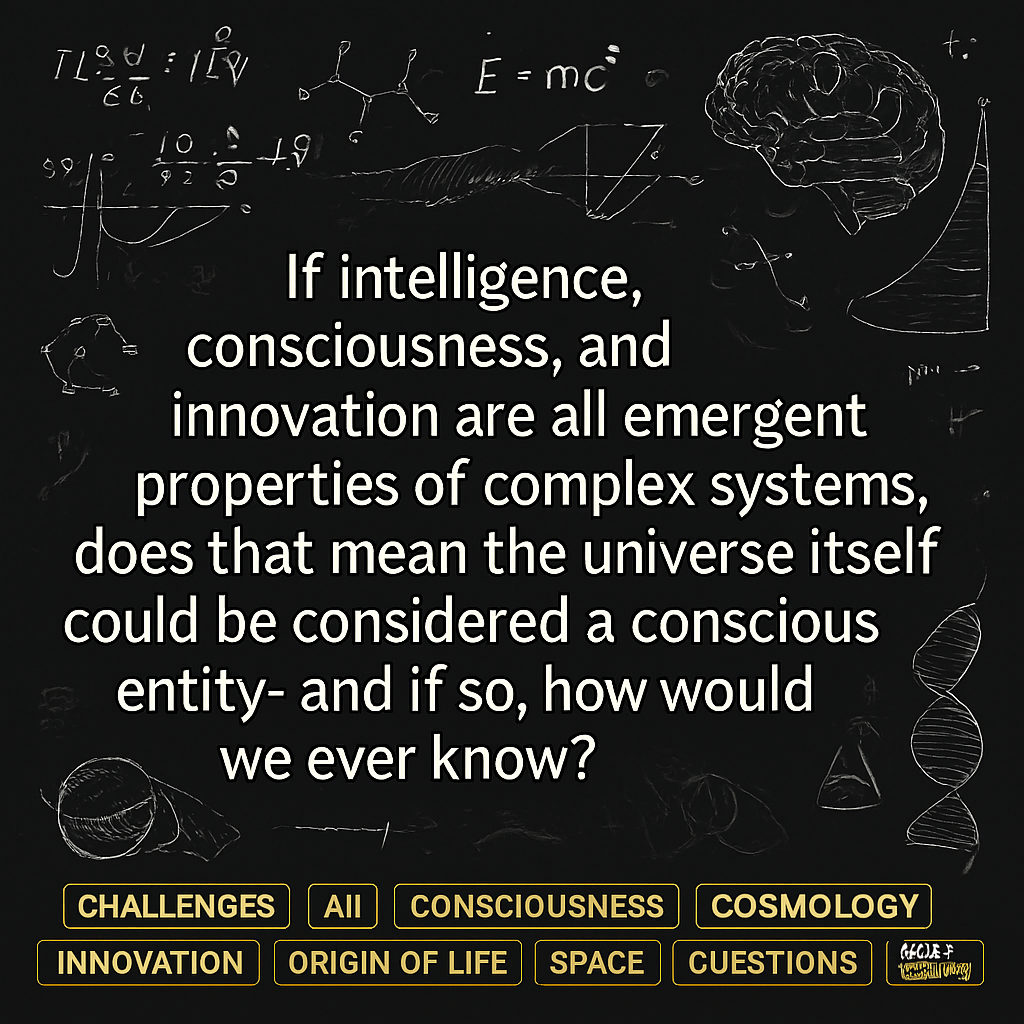
Thought‑provoking question:
"If intelligence, consciousness, and innovation are all emergent properties of complex systems, does that mean the universe itself could be considered a conscious entity—and if so, how would we ever know?"

This kind of question doesn’t have a definitive answer, but it invites people to wrestle with ideas about science, philosophy, and identity. It’s the sort of thing that sparks comments, debates, and imaginative engagement.

🗖 VIEW

⛶
Science
Neutral
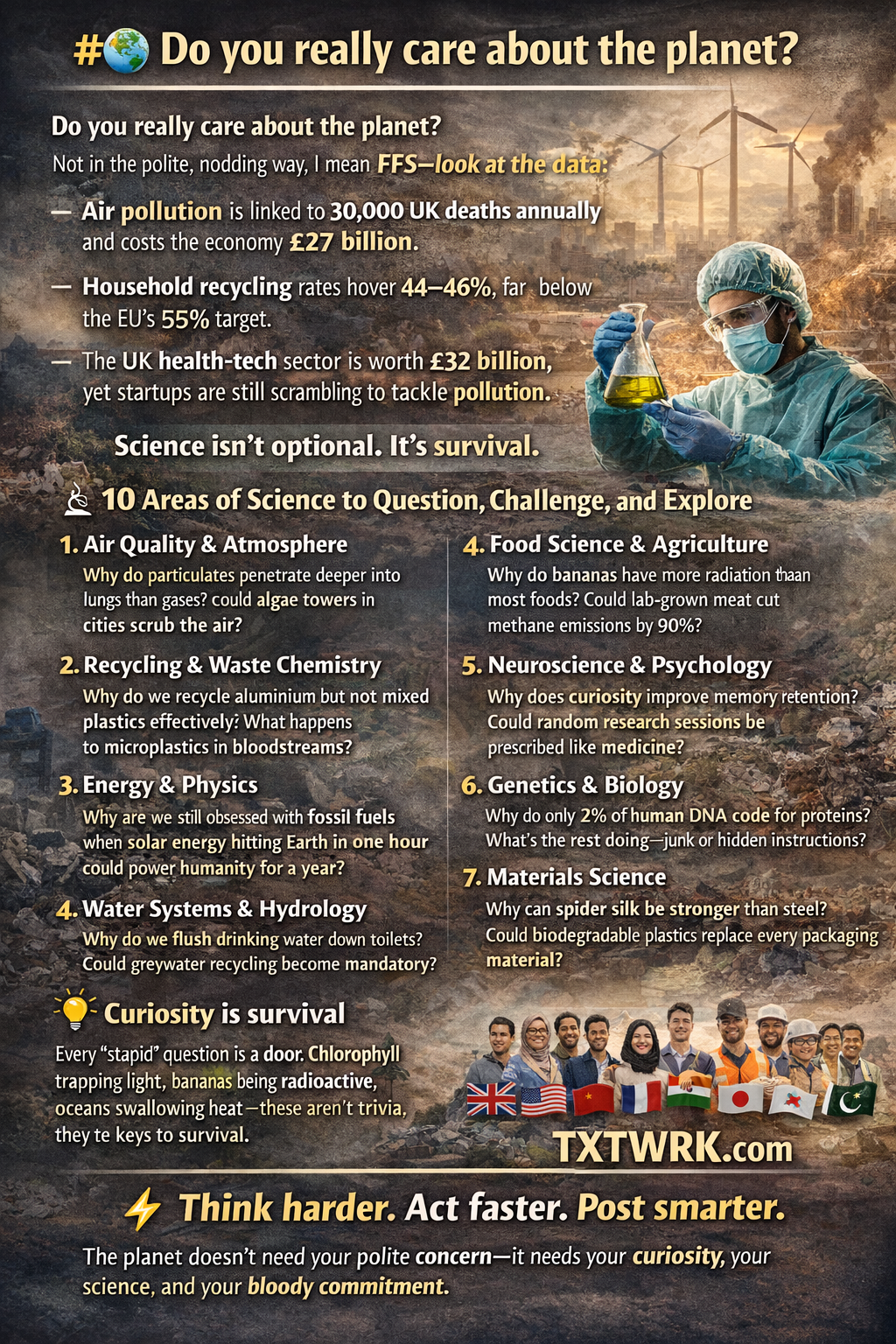
🌍 Do you really care about the planet?


Do you really care about the planet?
Not in the polite, nodding way. I mean FFS—look at the data:
•Air pollution is linked to 30,000 UK deaths annually and costs the economy £27 billion.
•Household recycling rates hover around 44–46%, far below the EU’s 55% target.
•The UK health-tech sector is worth £32 billion, yet startups are still scrambling to tackle pollution, pandemics, and prevention.

Science isn’t optional. It’s survival.

---

🔬 10 Areas of Science to Question, Challenge, and Explore


1. Air Quality & Atmosphere
Why do particulates penetrate deeper into lungs than gases? Could algae towers in cities scrub the air?

2. Recycling & Waste Chemistry
Why do we recycle aluminium but not mixed plastics effectively? What happens to microplastics in bloodstreams?

3. Energy & Physics
Why are we still obsessed with fossil fuels when solar energy hitting Earth in one hour could power humanity for a year?

4. Water Systems & Hydrology
Why do we flush drinking water down toilets? Could greywater recycling become mandatory?

5. Food Science & Agriculture
Why do bananas have more radiation than most foods? Could lab-grown meat cut methane emissions by 90%?

6. Neuroscience & Psychology
Why does curiosity improve memory retention? Could random research sessions be prescribed like medicine?

7. Genetics & Biology
Why do only 2% of human DNA code for proteins? What’s the rest doing—junk or hidden instructions?

8. Materials Science
Why can spider silk be stronger than steel? Could biodegradable plastics replace every packaging material?

9. Climate & Oceanography
Why does the ocean absorb 90% of excess heat? Could plankton blooms be engineered to lock away carbon?

10. Space & Astrobiology
Why do tardigrades survive in space? Could studying them unlock new medicines or survival tech for humans?

---

💡 Curiosity is survival

Every “stupid” question is a door. Chlorophyll trapping light, bananas being radioactive, oceans swallowing heat—these aren’t trivia, they’re keys to survival.

At TXTWRK, every post you share becomes part of a bigger picture—organised into topics, linked to menus, and connected to others who care.

---

🏴 Join your country’s movement

Make a profile at TXTWRK.com.
Create a page for your country—like @UnitedKingdom—and start your checklist:
•Track air quality.
•Share recycling hacks.
•Spotlight startups.
•Post your research.

---

🤝 We can’t do this alone

No single scientist, activist, or startup can fix the planet. But together—sharing facts, asking questions, building movements—we can. TXTWRKscience is your work zone to talk about what matters, open doors for others, and make the invisible visible.

---

⚡ Think harder. Act faster. Post smarter.
The planet doesn’t need your polite concern—it needs your curiosity, your science, and your bloody commitment.

🗖 VIEW