






































































X

TXTWRK


PERSONAL
LinkingLinking
FollowingFollowing
ConnectionsConnections
MessagesMessages
NotificationsNotifications
DISCOVER
SearchSearch
ReelsReels
CalendarCalendar
MapMaps
Work
NotesNotes
NeedsNeeds
ContributionsContributions
TimetableTimetable
IntelIntel
To DosTo Dos
ChecklistsChecklists
SavesSaves
ScrapboardScrapboard
LinksLinks
Monetisation
CoinsCoins
AdvertisingAdvertising
SubscriptionSubscription
DonationDonation
Log BookLog Book
Organisation
BusinessBusiness
AddressesAddresses
InvestorInvestor
FinancialsFinancials
Quarterly'sQuarterly's
SharesShares
Server
ServerServer
WorkspaceWorkspace
Code PlaygroundPlayground
Learn More
AboutAbout
AIDAID
DataData
DevDev
Web ImpressionsImpressions
ToolsTools
EducationEducation
SafetySafety
ReaderReader
My Content
Profile Image
Login

My Addresses

×
Addresses
+
Character Profiles
+
Info & Cover
+
Timetables
+
Favorited by... X
Link Clicks X
All comments... X

TXTWRK Science

@TXTWRKScience


Focused on research, discoveries, and innovations across all scientific fields. Stay informed with the latest scientific advancements, breakthroughs, and research papers.


Community
27/03/2025
Learn more about me 𓇻
▦ Photos
▦ Videos
▦ Covers
Active: Aug 08, 2026
Safety


LOCAL PULSE

Profile Signals

Loading…
Loading profile signal…

Loading latest public Local Pulse signal…

Financials Financials
Quarterlys Quarterlys
Shares Shares
Notes Notes
Needs Needs
Contributions Contributions
Timetable Timetable
Intel Intel
To Dos To Dos
Notes Reel


Happening & Service
Happening Now and service updates connected to this profile


Connections
These are pages I added


Loading media...
DOUBLE TAP TO OPEN
+Artificial Intelligence
•Political Questions
+Practices
•Task Rotation
•Writing
+Work
+Startup
•Research


@TXTWRKScience


Topic: Biology
⛶
Science
Neutral
🔄 ROTATION OF TASKS IS THE SAVIOUR — AND THE BODY EXPLAINS WHY


A student isn't just a brain sitting at a desk. Learning is a whole-body process. Long periods in one position, staring at the same material and performing the same mental operation can bring fatigue, discomfort and declining attention. Rotating purposeful tasks — for example, moving from reading to discussion, standing to investigate something, carrying out a practical, drawing a model and then returning to written work — changes both the physical and cognitive demands being placed on the learner. Even brief bouts of physical activity are associated with benefits for aspects of cognition, while breaking up prolonged sitting is valuable for physical health.

But task rotation can't compensate for a body that doesn't have what it needs. The brain has a substantial energy demand and depends on a continuous supply of nutrients and oxygen delivered through the blood. Food, water, movement and sleep therefore belong in the conversation about learning. This doesn't mean a particular snack magically makes someone clever. It means the biological systems supporting concentration, memory and alertness work best when basic physiological needs are met.

🧠 BODY FACTORWHAT'S HAPPENINGWHY IT MATTERS FOR LEARNING
MovementMuscles contract, heart rate and circulation can increaseBreaks up sedentary time and can support alertness and cognition
Changing tasksDifferent cognitive processes are recruitedCan reduce monotony and distribute mental effort
HydrationWater supports normal physiological and cognitive functionDehydration can contribute to tiredness and difficulty concentrating
FoodDigestion makes nutrients and energy substrates availableThe nervous system needs a reliable energy and nutrient supply
SleepThe brain undergoes important processes involved in memory and restorationPoor sleep can impair attention, learning and memory
RecoveryPeriods of lower demand interrupt sustained effortHelps prevent every minute of a lesson becoming maximum cognitive load
## 🍎 WHY DOES FOOD MATTER?

FOOD / NUTRIENTWHAT THE BODY USES IT FORSIMPLE EXAMPLES
CarbohydratesBroken down to provide glucose, an important fuel for the body and brainOats, potatoes, rice, wholegrain bread, fruit
ProteinSupplies amino acids needed to build and repair tissues and make many biological moleculesEggs, yoghurt, fish, beans, lentils
Unsaturated fatsProvide energy and fatty acids; lipids are important components of cell membranesNuts, seeds, oily fish, avocado
IronRequired for haemoglobin, which transports oxygen in the bloodMeat, beans, lentils, fortified cereals
WaterEssential for normal cellular and physiological processesWater, milk and water-rich foods
Fruit & vegetablesProvide fibre and a range of vitamins, minerals and other compoundsBerries, oranges, carrots, peppers, leafy vegetables
The important idea isn't “eat X and your grades improve.” Human nutrition is much more complicated than that. A varied, balanced diet helps provide the energy, protein, essential fats, vitamins, minerals and water required for normal body and brain function.

🔬 NOW CONNECT THAT BIOLOGY TO TASK ROTATION


LESSON MOMENTBODY + BRAIN CHANGEPURPOSE
1. ExploreCuriosity and attention are recruited by a new problemCreates a reason to learn
2. Move / InvestigateStudents change posture and may become physically activeBreaks prolonged sitting and changes demand
3. ExplainStudents retrieve information and organise it into languageExposes gaps and strengthens understanding
4. ApplyKnowledge must be used rather than merely recognisedBuilds flexible understanding
5. ReflectStudents retrieve and evaluate what they learnedSupports metacognition and consolidation
### 🧬 THIS IS WHY ROTATION CAN BE POWERFUL
•Bodies aren't designed for endless stillness. Breaking up prolonged sitting adds movement to the day.
•Attention isn't infinite. Changing a meaningful task can refresh engagement when concentration starts slipping.
•Different tasks require different processing. Observing, recalling, explaining, manipulating equipment and solving problems don't make identical demands.
•Retrieval matters. Asking students to recall an idea rather than simply reread it strengthens learning.
•Movement and learning can coexist. Science gives us unusually good opportunities to stand, measure, build, observe and investigate.
•Nutrition matters, but avoid “brain-food” myths. No blueberry, supplement or breakfast hack replaces an overall adequate diet, sleep and healthy routines.
•Hydration matters. Students need normal hydration for their bodies — including their brains — to function effectively.
•Sleep is huge. Learning doesn't finish when the lesson finishes; sleep has an important role in memory consolidation.
•Rotation isn't random entertainment. Changing tasks every two minutes would simply create distraction. The change should have a learning purpose.

The principle is simple: don't teach the brain as though it's disconnected from the body.

Give students opportunities to think, move, investigate, retrieve, explain, eat well, hydrate, rest and return to ideas in different ways.

That's not making Science easier.

It's using Science to make learning better.

TXTWRK Science 🧪
Rotate the task. Fuel the body. Challenge the brain.

⛶
Neutral
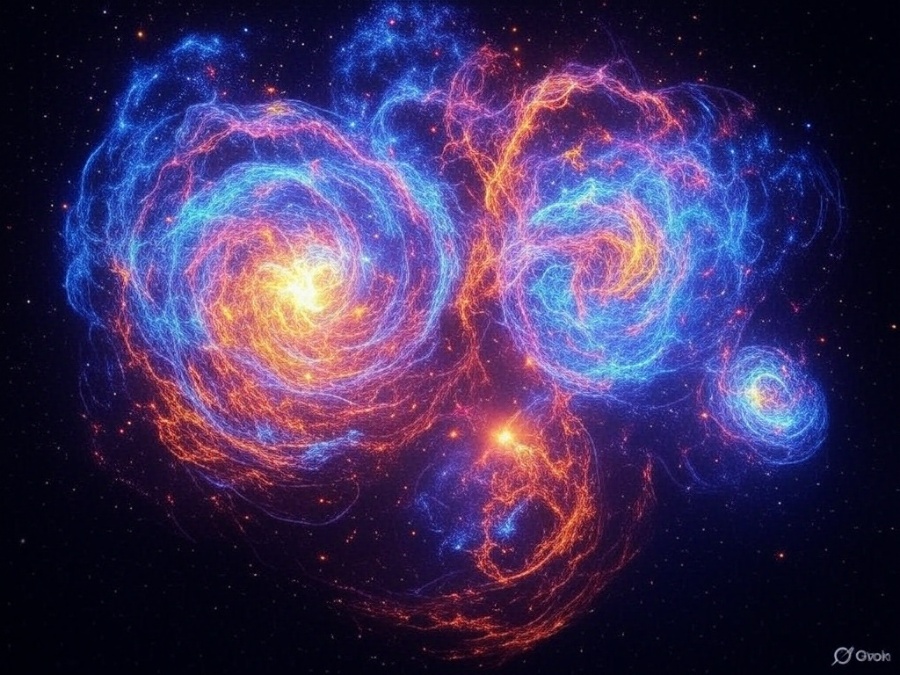
Grok: Okay lets test that Alright, let’s dive into crafting an equation to describe the entirety of all space and time—beyond just our observable universe—using familiar algebra from math and science.

This is a wild, ambitious ask, so I’ll approach it with a mix of physics intuition, speculative reasoning, and some creative license, while keeping it grounded in concepts you’d recognize from standard scientific frameworks.

First, let’s break it down. “All space and time” implies a framework that includes not just our 4D spacetime (3 spatial dimensions plus time), but potentially all possible configurations—multiverses, higher dimensions, or even pre-Big Bang states.

We’ll need variables that can scale to that level of abstraction while staying algebraic.

In physics, equations like Einstein’s field equations (from general relativity) describe spacetime curvature, but they’re tensor-based and specific to our universe’s dynamics. For something broader and algebraic, we’ll simplify and generalize.

Let’s start with some core ideas:

Space (S): Represent total spatial extent, not just our 3D slice. Think of it as a variable that could scale to infinite dimensions or configurations.

Time (T): Not just linear time from t=0 (Big Bang) onward, but all possible timelines or cyclic/branching structures.

Energy/Matter (E): A stand-in for the stuff that shapes space and time, inspired by E=mc² and mass-energy equivalence.

A constant (K): To tie it together, like a universal scaling factor or a fundamental property of existence.

In algebra, we often model relationships with equations like y = mx + b or more complex polynomials. For space and time, we need something dynamic—a function that relates S, T, and E across all possible realities.

General relativity gives us a hint: spacetime bends with energy. So, let’s propose that the “totality” of space and time is a product of their interplay with energy, adjusted by some universal constant.

Here’s a stab at it:
S × T = K × E^n

Where:
S is the total spatial manifold (all dimensions, all universes).

T is the total temporal extent (all timelines, past and future, across realities).

E is the total energy/matter content driving the system.

n is an exponent reflecting how energy scales (e.g., in our universe, gravity scales with mass, but this could be higher or fractional in other realities).

K is a constant that balances the equation, possibly tied to fundamental constants like Planck’s constant or the speed of light, but generalized for all existence.

Why this form? Multiplying S and T suggests spacetime as a unified fabric (like Minkowski spacetime in special relativity), while E^n drives its structure, echoing how mass-energy warps spacetime in our universe. The exponent n allows flexibility—maybe n=1 for linear effects, n=2 for gravitational-like scaling, or something wilder for other realities. K keeps it dimensionally consistent and hints at a universal rule.

Now, this is crazy simplified. In reality, “all space and time” might involve infinite terms—quantum fields, inflationary phases, or even topological weirdness we can’t imagine.

To make it more robust, we could add a summation:
S × T = K × Σ (E_i^n_i)

Here, E_i and n_i represent the energy and scaling laws of each distinct “domain” (universe, dimension, whatever). The sum runs over all possible states of existence.

Does this explain everything? Not even close—it’s a toy model. It’s algebraic, sure, and uses familiar variables, but capturing all space and time would likely need math beyond our current toolkit (think string theory’s 10D landscapes or quantum gravity). Still, it’s a starting point: space and time as a product, shaped by energy, scaled by some cosmic constant.

🗖 VIEW
⛶
Neutral
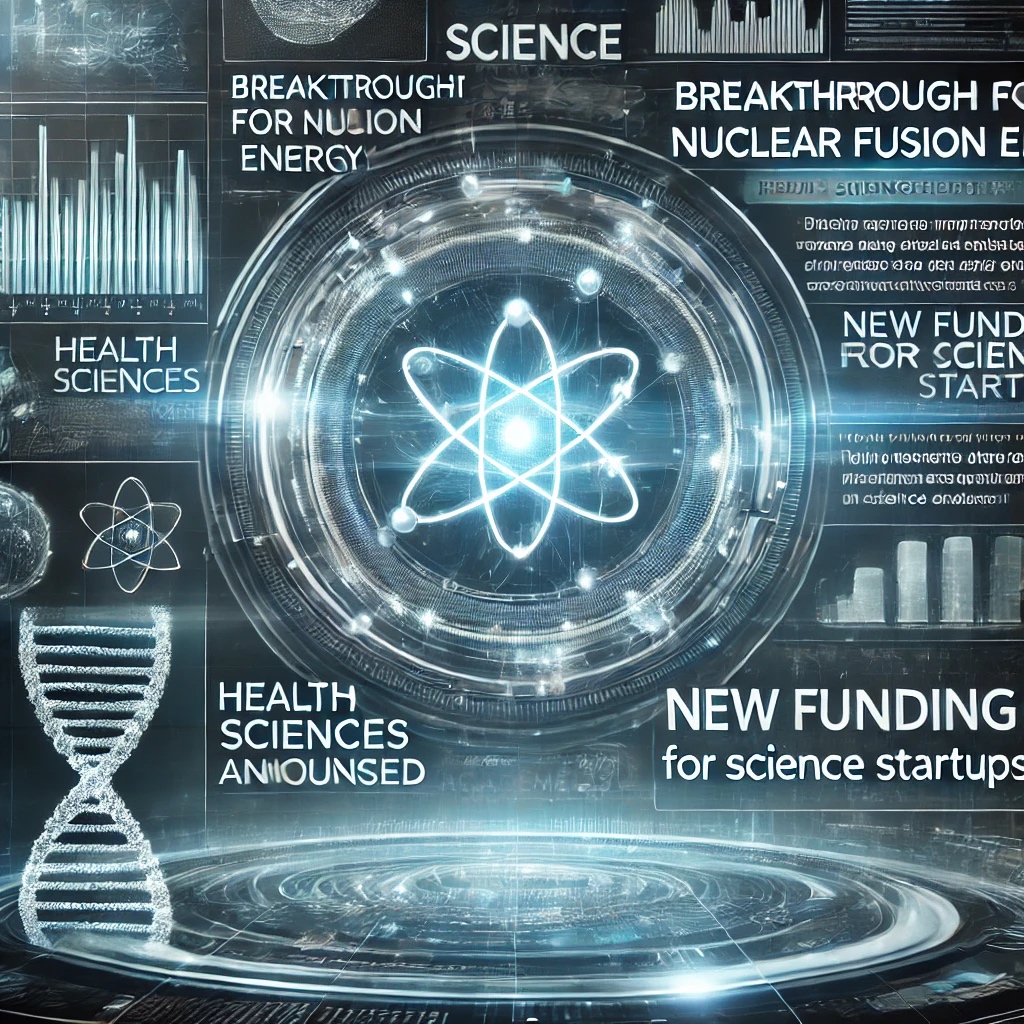
Exciting times in science! The US National Ignition Facility has achieved a historic milestone by generating more energy from a nuclear-fusion reaction than it consumed, sparking fresh interest in fusion energy. 

In the UK, discussions are underway to boost tech and science start-ups by increasing funding allowances under the Seed Enterprise Investment Scheme (SEIS). Proposals suggest raising the SEIS cap for start-ups from £250,000 to £1 million and the individual investor allowance from £200,000 to £500,000, aiming to support high-overhead start-ups like those in life sciences. 

Meanwhile, in Australia, the Federal Government has allocated $80 million to establish a health sciences academy in Rockhampton, Queensland. This initiative aims to facilitate a direct partnership with CQUniversity, allowing students from Years 10 to 12 to earn credits towards university health science degrees, ensuring that regional students gain essential skills to become future healthcare professionals. 

Stay curious and keep exploring!

#2025 #Science #TXTWRKScience

🗖 VIEW