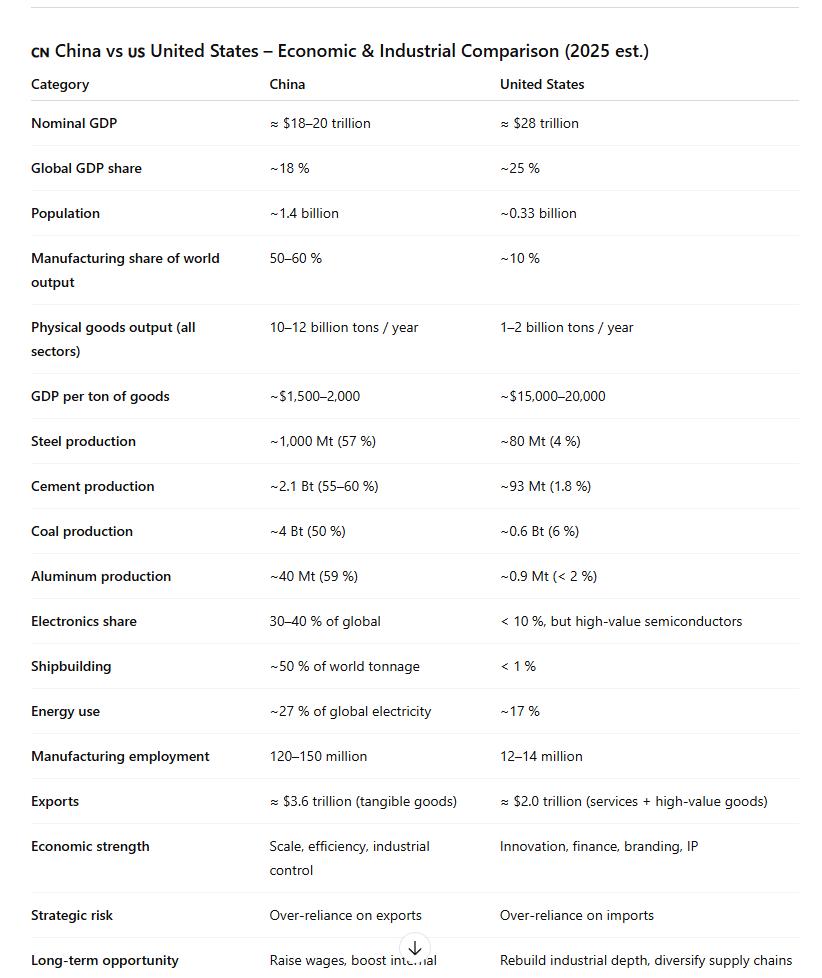
The United States and China both generate roughly $20–28 trillion in annual GDP, yet the substance of those economies is dramatically different. America’s wealth is built on services, finance, technology, and valuation, whereas China’s economy rests on manufacturing, construction, and physical output. While their monetary scales appear similar, America produces only about 10–15% of the world’s industrial mass, compared with China’s commanding 50–60% share.
This difference reflects a fundamental divide between value creation and material creation. The U.S. captures value through pricing, intellectual property, and market trust — essentially the symbolic economy. China, on the other hand, dominates the real economy, producing the steel, concrete, electronics, and textiles that make up most of the world’s tangible goods. America’s GDP per ton of output is 10× China’s because its goods are lighter but priced higher.
In geopolitical terms, this shapes the ongoing trade tension. The U.S. pushes to preserve its pricing power and dollar dominance, while China seeks to expand quality, wages, and internal demand. A true trade war pressures both — the U.S. risks inflation and loss of supply stability, while China risks demand disruption. The rational long-term path isn’t confrontation but co-development, where Western markets share innovation and branding, and China provides industrial capacity and scalability.























































































COMMUNITY
People