

















































































X

TXTWRK


PERSONAL
LinkingLinking
FollowingFollowing
ConnectionsConnections
MessagesMessages
NotificationsNotifications
DISCOVER
SearchSearch
ReelsReels
CalendarCalendar
MapMaps
Work
NotesNotes
NeedsNeeds
ContributionsContributions
TimetableTimetable
IntelIntel
To DosTo Dos
ChecklistsChecklists
SavesSaves
ScrapboardScrapboard
LinksLinks
Monetisation
CoinsCoins
AdvertisingAdvertising
SubscriptionSubscription
DonationDonation
Log BookLog Book
Organisation
BusinessBusiness
AddressesAddresses
InvestorInvestor
FinancialsFinancials
Quarterly'sQuarterly's
SharesShares
Server
ServerServer
WorkspaceWorkspace
Code PlaygroundPlayground
Learn More
AboutAbout
AIDAID
DataData
DevDev
Web ImpressionsImpressions
ToolsTools
EducationEducation
SafetySafety
ReaderReader
My Content
Profile Image
Login

My Addresses

×
Addresses
+
Character Profiles
+
Info & Cover
+
Timetables
+
Favorited by... X
Link Clicks X
All comments... X
More | 1/2

TheUKparty Verified Website

@UnitedKingdom

City of Derby, Derby, Derbyshire, East Midlands, England, United Kingdom, Europe

Official support page for political transparency in the United Kingdom, for all citizens to have a voice and play a role in our country’s development & democratic processes. Setup & ran by @ImSunnyClaire, the founder of @TXTWRK

Become Britain's Voice & Future @UnitedKingdom:Checklists! where your comments are remembered in humanities history forever, only at TXTWRK


Community
21/10/2024
Learn more about me 𓇻
▦ Photos
▦ Videos
▦ Covers
Active: 1 days ago
Safety


LOCAL PULSE

Profile Signals

Loading…
Loading profile signal…

Loading latest public Local Pulse signal…

Financials Financials
Quarterlys Quarterlys
Shares Shares
Notes Notes
Needs Needs
Contributions Contributions
Timetable Timetable
Intel Intel
To Dos To Dos
Notes Reel


Happening & Service
Happening Now and service updates connected to this profile


Connections
These are pages I added


Intel Pinned

Transparency of Operations
TheUKparty.com · Civic Voice & Start‑Up Utilisation Notice
Purpose
TheUKparty.com and its connected channels exist to help people have a real civic voice. These platforms allow individuals to give feedback about their streets, local organisations, community issues, and daily experiences. The goal is to make public input simple, open, and accessible to everyone.
Utilisation
We encourage the public, community groups, and emerging UK start‑ups to utilise these channels to express concerns, share ideas, and participate in constructive dialogue. Our aim is to support up to 5 million new UK start‑ups in taking advantage of the software ecosystem we use today, enabling them to grow, communicate, and operate with transparency.
Channels
www.TheUKparty.com (inlet) www.TXTWRK.com/@UnitedKingdom www.TikTok.com/@TheUKparty www.Facebook.com/TheUKparty www.X.com/@TheUKpartyNews
Operator
Community Architecture Powered by TXTWRK.com
Latest Intel · 2026-09-06 19:47:07


Loading media...
DOUBLE TAP TO OPEN
+Education
+Humanities
•Capacities
•Criminal Justice
•Living Standards
+Events
+By @TXTWRK
•TXTWRK Annual
+Feedback
+Communities
•Play Your Role
+History
•100+ Cities
+Progress
•Notices
+The Journey
•Signup
+Media
+BBC
+Four
•The Community Experience
+News
•Global
•National
+Safety
+Research
•Digital
+Space
•Skywatching
+Startups
+5m GB startups
•Home & Living
•Indexing
•Sell Limited Edition
•Shops
+Getting Started
•Innovation
+Grants
•UK Government Grants
+Sustainability
•Cost of Living
•Knowledge
+Technology
+AI
•Investment
+UK Government
•Leaders
+Research
•American Relationship
+Energy
•Water
•Online Safety
•Partnerships
•Safety
+The Budget
•Defence
•National/Local Support
+UK Security Stimulus Pledge
•Debt Control
+Intel
•UK Spending
•Sign
•The Pledge
+Views
+By @UnitedKingdom
•Politics
+Volunteer
•Design
•Engaging on Posts
+Research
•Search
•Volunteer Now
+Work
+Ethics
•Lifestyle
+Positivity
•Always Keep Working
+World
+Development
•Industries
•Politics
+World Security Fund
•Pledge


@UnitedKingdom


⛶
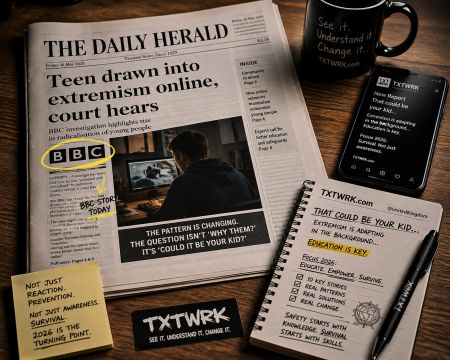
Education
Neutral
That Could Be Your Kid…


Extremism Is Adapting in the Background — Education to Survive Without Safeguards Must Be the Focus of 2026


---

Opening Frame


A teenager sits in their room.
Phone in hand.
No warning signs. No “type” you’d recognise.

They’re not looking for extremism.

Extremism is looking for them.

And in 2026, it’s not loud.
It’s not obvious.
It doesn’t arrive as hate — it arrives as belonging, answers, identity, and attention.

> That could be your kid.

---

Context — What’s Actually Changing


Across the United Kingdom, the pattern isn’t just about ideology anymore.

It’s about:
•Loneliness being harvested
•Frustration being redirected
•Algorithms rewarding emotional extremes
•Private channels replacing public radicalisation

When stories appear in outlets like BBC News, the narrative often lands here:

> “He was radicalised… he became the problem.”

But that framing misses the wider system.

Because by the time someone is “the problem,”
they’ve already been processed by one.

---

10 Key Stories (Reality Snapshots Across the UK)


1. The Quiet Drift


A 14-year-old starts watching harmless content.
The algorithm nudges slightly edgier material.
Within weeks, their feed becomes an echo chamber.

No one notices — because nothing looks extreme at first.

---

2. The Identity Hook


A young person struggling with purpose finds a group online.

They’re told:
•“You matter.”
•“We understand you.”

Then slowly:
•“Here’s who’s to blame.”

---

3. The Meme Pipeline


Extremism no longer starts with speeches.

It starts with:
•jokes
•irony
•“just memes”

Humour lowers defences.
By the time it turns serious, the ideas already feel normal.

---

4. The Private Channel Shift


Public platforms clamp down.
Extremism moves to:
•encrypted chats
•invite-only servers
•closed communities

By the time authorities see it, it’s already matured.

---

5. The “He’s the Problem” Trap


A case hits the news.
Focus lands entirely on the individual.

Little focus on:
•what content they consumed
•who guided them
•which systems enabled it

The cycle resets.

---

6. The Algorithm Advantage


Platforms optimise for engagement.

Extremism benefits because:
•outrage spreads faster
•certainty feels stronger than nuance
•controversy keeps users hooked

This isn’t always intentional — but it is predictable.

---

7. The Isolation Amplifier


Offline struggles:
•bullying
•financial stress
•lack of opportunity

Online actors step in and reframe that pain as a narrative.

---

8. The “Normalisation Phase”


Before anything extreme happens, there’s a stage where:
•language shifts
•empathy reduces
•“us vs them” thinking grows

This phase is often invisible to parents, teachers, and systems.

---

9. The Safeguard Gap


Reporting tools exist.
Moderation exists.

But:
•it’s inconsistent
•it’s reactive
•it’s often too late

Young people are expected to navigate systems that aren’t built to protect them early enough.

---

10. The Survival Blind Spot


Most education focuses on:
•what extremism is

But not:
•how to recognise manipulation in real time
•how to exit safely
•how to question emotionally persuasive content

This is the biggest gap.

---

The Core Problem


We are still treating extremism like a content issue.

It’s not.

It’s a systems + psychology issue:
•systems that amplify
•environments that isolate
•actors that exploit

---

What Needs to Change (2026 Focus)


1. Governments — Move Earlier, Not Louder

•Shift from reaction → prevention
•Invest in digital literacy as survival training
•Regulate algorithmic risk, not just content

---

2. Digital Companies — Design for Safety, Not Just Growth

•Identify behavioural radicalisation patterns early
•Reduce recommendation loops that intensify extremes
•Build friction into escalation paths (not endless scroll)

---

3. Education — Teach Survival, Not Just Awareness


Young people need to learn:
•how manipulation works
•how emotional hooks are used
•how to pause before belief forms
•how to leave safely without backlash

> Not “don’t click this”
> but “here’s how to think when you do”

---

4. Parents & Communities — Recognise the Subtle Signs


It’s no longer:
•obvious symbols
•clear statements

It’s:
•language shifts
•humour changes
•withdrawal into digital spaces

---

Final Message


This isn’t about fear.

It’s about reality.

Extremism in the United Kingdom isn’t just growing —
it’s evolving quietly, efficiently, and persistently.

And until we shift focus:
•from blame → understanding
•from reaction → prevention
•from awareness → survival

we will keep seeing the same headline:

> “Another young person… another case… another shock.”

---

Closing Line


That could be your kid.

So the real question for 2026 is:

> Are we finally going to prepare them —
> or just keep reacting when it’s too late?


🗖 VIEW
⛶
Community
Neutral
https://www.bbc.co.uk/news/articles/cge8yxpj7e1o

What’s actually behind these stories?


1. Platforms built for engagement, not safety


Apps like Snapchat, WhatsApp, and TikTok all share the same core logic:
•maximise time spent
•maximise emotional reactions
•minimise friction

That leads to:
•disappearing messages
•private group chats with no oversight
•viral humiliation, threats, and taunting
•beefs that escalate offline

None of that is about race. It’s about product decisions made by companies that know kids use these apps and still push features that fuel impulsive behaviour.

---

2. Online conflict doesn’t stay online


A lot of these violent incidents follow the same pattern:
•insult / threat / humiliation online
•messages deleted or denied
•rumours spread
•pressure to “respond” to save face
•confrontation in real life

For teenagers, especially boys, status + disrespect + no adult mediation is a dangerous mix.

---

3. Music does play a real role (but not in isolation)


Music absolutely influences mindset and behaviour, especially in adolescents whose identities are still forming.

Violent and nihilistic lyrics can:
•normalise aggression and retaliation
•glamorise criminal status and dominance
•reward disrespect with social validation
•reduce empathy through repeated exposure

The fact that not every listener becomes violent does not mean the influence is negligible — it means influence works probabilistically, not universally.

What actually increases harm is constant reinforcement, especially when music is:
•algorithmically pushed
•paired with online conflict
•consumed daily without adult context
•used as identity signalling among peers

Music doesn’t act alone — but it primes, frames, and legitimises certain responses. When a kid already feels disrespected or cornered, that framing matters.

So no: music isn’t the sole cause —
but pretending it’s just “reflection” and not reinforcement is dishonest.

---

Where responsibility actually belongs


If we’re being serious and not just venting:
•App makers → absolutely responsible for unsafe design
•Regulators → asleep at the wheel
•Schools & parents → often unaware of what’s happening online
•Society → terrible at giving kids healthy ways to deal with conflict

Blaming whole communities might feel satisfying in the moment, but it lets the people with real power — tech companies and policymakers — off the hook.