













































X

TXTWRK


PERSONAL
LinkingLinking
FollowingFollowing
ConnectionsConnections
MessagesMessages
NotificationsNotifications
DISCOVER
SearchSearch
ReelsReels
CalendarCalendar
MapMaps
Work
NotesNotes
NeedsNeeds
ContributionsContributions
TimetableTimetable
IntelIntel
To DosTo Dos
ChecklistsChecklists
SavesSaves
ScrapboardScrapboard
LinksLinks
Monetisation
CoinsCoins
AdvertisingAdvertising
SubscriptionSubscription
DonationDonation
Log BookLog Book
Organisation
BusinessBusiness
AddressesAddresses
InvestorInvestor
FinancialsFinancials
Quarterly'sQuarterly's
SharesShares
Server
ServerServer
WorkspaceWorkspace
Code PlaygroundPlayground
Learn More
AboutAbout
AIDAID
DataData
DevDev
Web ImpressionsImpressions
ToolsTools
EducationEducation
SafetySafety
ReaderReader
My Content
Profile Image
Login

My Addresses

×
Addresses
+
Character Profiles
+
Info & Cover
+
Timetables
+
Favorited by... X
Link Clicks X
All comments... X
TXTWRK.com | Home 🗓
Major rewrites until 19/10/26 0600HR
0
3
6
9
12
15
18
21
24

Loading local weather…
Today:
Web Impression

📝 Post

📰 Feed

⚡ Happening Now

📍 Local Pulse

🗺️ Maps

🎬 Reels

📈 Trending Topics

🚀 Getting started...

🌍 Apply My Vision

🤼 Get Volunteers

🚶 Stickman: Daily Activities

🛡️ Safety

💳 PayPal Services

💎 TXTWRK Premium

🔎 Transparency

+ Writers & Journalists
Add topics for e.g. 'Language; Semi-Colons; Systems'
Upload 15 Photos
Upload 100MB Video
Community Library
You must be 18 to select restricted options. Community curation improvements coming soon.


3D Model
2D Mapping
CSV Data File
Story Mode
Web Impression
Audio Room
Audio Rooms
Give your post a voice.
Open your post to audio and let people contribute with more than text.
What does the community think?
Discuss Share Audio Room
Go Live
Open the room.
When you're ready, turn Live Mode on and welcome people into the conversation.
Audio Room
Community conversation
Online
Community Audio
Listen. Then contribute.
Different voices can add context, personality, experience and reassurance.
Latest Audio
Alex 12 second recording
▶
Sam 24 second recording
▶
New Community response
▶
Your Voice
Not sure what to say?
Reassess before recording. Your next take can be calm, constructive or reassuring.
Record Audio
● REC
Take your time.
Record when you're ready.
Your Data
Create. Manage. Reclaim.
Recordings use your data balance. Delete your recording and its data is returned to you.
Audio data Yours
↻ Delete recording → data returned

Audio Rooms reduce the friction of joining a conversation. Instead of finding the perfect words to type, people can use their voice to contribute directly to your post and build a conversation together.

1. Harness community audio. Add context, personality and reassurance through your voice. Reduce friction and make conversations easier to join.

2. Record responsibly. Not sure what to say? Reassess before recording and keep your next take constructive or reassuring. Misuse may result in Audio Room access being limited or restricted.

3. Your data stays manageable. Recordings use your data balance. Delete your recording to get that data back. If the post is deleted, everyone gets their recording data back.

+ Checklist
+ Feedback
+ Product
+ Investment
Use ChatGPT, GROK or CoPilot to make a pitch...

1

Develop your pitch in a conversation over a number of messages, or write it from scratch in a notes app.

2

Click copy on the text response from AI, or paste your own text into AI and request it to format your pitch into a structured report, including tables where useful.

3

Copy your final text into the 'Funding Description' box.
Learn from our example

Note: Your text should usually include formatting such as #, ##, ** around words and sections.

Once you've made a campaign, you can only modify the Investment Amount Cap, the End Date, Category & Status.


  • E.g. Company - X% for £X (Funding Round 1)
  • E.g. F1 - X% for £X (@TXTWRK)
  • E.g. Series Round A for X (Org LTD)


Prepare Sections: (i.e 1.1.1)
  • 100 words...
  • 1. The Vision
  • 2. All Financial Requirements
  • 3. All Revenue Streams
  • 4. All Forecasts
  • 5. Share Types, Rights & Schemes
  • 6. Legal Jurisdiction Notice
  • 7. Additional T&C's

  • E.g. type '1000000' to raise £1m
  • In multiples of 10's

  • For e.g. £1m for '33.5' percent
  • '100' is the max figure of LTD

  • You may specify / update later

  • For e.g. type '10000' to cap user to £10k max

Funding Category
Search TXTWRK first. You can also add a missing Object.
Preset Options
Selected

How to get started with PayPal here at TXTWRK:

1. Setup a PayPal Developer Business Account

2. Create a Live App & give it a useful name (i.e. Shopping/Invest/etc)

3. Copy the Client ID & Make a Preset to select / Populate PayPal Client ID

Notice: Ensure that you, confirm your email, connect a bank to your account and enable your account for 'PayPal Payments' via the Permissions Tab if not already enabled via https://developer.paypal.com/dashboard/accountStatus (It can take 1-2 weeks for PayPal to approve your account - In the event you have issues, call/connect with PayPal Support Team)

PayPal charges ~2.9% + 30p for each investment transactedhttps://developer.paypal.com.

PayPal Setup


Additional Notes:

+ You can not delete an investment opportunity that has investors who have paid. You must request for deletion, which is subject to all investors approvals.

+ TXTWRK.com (TXTWRK) is not liable for the investment opportunity you make and you adhere to standard codes of conduct in your legal jurisdictions and those of your investors at all times.

+ TXTWRK's role is to help people create opportunities, guide people transparently, mediate when necessary and provide a safe way to get investments.

+ You will receive all of the funds as and when users invest instantly, except for approximately 5% which is used to process the transaction. For e.g. You have £100 for 10% opportunity, investor buys £10 for 1%, therefore user gets 1% and you will receive £10 - approximately 5% = ~£9.50 for the single investment. (exact fees are approximately 2.9% + 30p)

+ Investors have a legal right to claim against you/your investment opportunity, if you are suspected of illegal activities or using the funds for other/new projects without issuing a statement to the shareholders or request for their approval

+ The Investment opportunity will appear on your profile, in your business data £Username associator and also in dashboard & across our website.


Additional search filters (optional)

Funding Stage
Search TXTWRK first. You can also add a missing Object.
Preset Options
Selected

Usage of Funding
Search TXTWRK first. You can also add a missing Object.
Preset Options
Selected


Remember to update your Business details

+ Donate
+ Event
+ Questionnaire
+ Trending Topic
Turn on Pledge
Pay Per View
Private Access
Set Projection
Post Date


🌍 Global Feed
🌎 Home People
🌏 Existing People
📯 Mentions
👨‍👩‍👦 Following
👨 Followers
🖼 Photo
📽 Video
🎼 Audio
🎶 MP3
🌐 Web Impressions
🧊 3D Content
✅ Checklists
📈 Investments
📅 Upcoming
🛍 Shop
🔗 Links
Filter Category
⛶
Rugby League World Cup (RLWC 2026)
2026-10-15 10:05:00
2026-11-15 08:35:00
Location: Australia, New Zealand and Papua New Guinea

Attend
Sports
Neutral
RUGBY LEAGUE WORLD CUP 2026: THE WORLD IS WATCHING

TXTWRKsport | World Cup Special Report


Published: 16 October 2026
Category: Rugby League | International Sport
Tournament: 15 October – 15 November 2026
Host Nations: Australia, New Zealand and Papua New Guinea
Coverage: UK | USA | Australia | New Zealand | Pacific | Worldwide
By: TXTWRKsport Editorial Team

---

THE BIG STORY: A NEW CHAPTER FOR RUGBY LEAGUE


The Rugby League World Cup 2026 is underway.

From the stadiums of Australia to the rugby-loving communities
of New Zealand and Papua New Guinea, the international game
has entered another defining chapter.

For one month, the world's leading rugby league nations will
battle for international supremacy, national pride and the
right to be crowned world champions.

But the story goes beyond the scoreboard.

It is about the players carrying their nations' hopes,
the supporters bringing the streets alive, the growth of
women's rugby league, the visibility of wheelchair rugby
league and the future of a sport seeking a bigger global stage.

At TXTWRKsport, we believe these moments deserve to be
documented, discussed and remembered.

This is not simply a World Cup.

This is rugby league's opportunity to show the world
what comes next.

---

1. TOURNAMENT OVERVIEW


DetailInformation
CompetitionRugby League World Cup 2026
Opening dateThursday, 15 October 2026
Closing dateSunday, 15 November 2026
Duration32 calendar days
Host nationsAustralia, New Zealand, Papua New Guinea
CompetitionsMen's, Women's and Wheelchair
Defending men's championsAustralia
Defending women's championsAustralia
Defending wheelchair championsEngland
Men's final locationBrisbane, Australia
Women's final locationBrisbane, Australia
Main time zoneAustralian Eastern Time
UK coverage time zonesBST / GMT
TXTWRKsport coverageNews, results, features, analysis
### Important dates

EventDate
Men's tournament begins15 October 2026
Women's tournament begins16 October 2026
Wheelchair tournament begins30 October 2026
Women's World Cup final15 November 2026
Men's World Cup final15 November 2026
Tournament concludes15 November 2026
Time zone note: The United Kingdom switches from
British Summer Time (BST) to Greenwich Mean Time (GMT)
on 25 October 2026.

All broadcast times should be checked against the
official match schedule before publication.

---

2. OPENING NIGHT: AUSTRALIA VS NEW ZEALAND


Australia 24–22 New Zealand


Date: Thursday, 15 October 2026
Venue: Allianz Stadium, Sydney
Competition: Men's Rugby League World Cup
Status: Full time

Australia began their World Cup campaign with a dramatic
24–22 victory over New Zealand.

The opening fixture delivered the intensity expected
from two of rugby league's fiercest international rivals.

Australia entered the tournament carrying the pressure
of defending their world title.

New Zealand arrived determined to challenge the Kangaroos
and demonstrate their own championship credentials.

The result provided an early reminder that the road
to the final will not be straightforward.

Players in the spotlight


PlayerNationTalking point
Jack BostockAustraliaOpening-match hat-trick
Reece WalshAustraliaAttacking brilliance
Kalyn PongaNew ZealandTwo tries and injury concern
Mitchell MosesAustraliaInjury concern
Jamayne IsaakoNew ZealandImportant attacking involvement
### TXTWRKsport match verdict

Australia secured the result, but New Zealand showed
that the defending champions can be challenged.

The contest also highlighted the importance of squad
depth, physical resilience and individual brilliance.

In tournament rugby league, a single moment can
change everything.

---

3. THE TEAMS: WHO CAN WIN THE WORLD CUP?


Australia — The champions to beat


Australia remain one of the strongest forces in
international rugby league.

Their combination of elite NRL talent, attacking
speed, defensive organisation and championship
experience makes them a leading contender.

Key questions:
•Can Australia defend their title?
•Will their younger stars become tournament heroes?
•Can they maintain their intensity throughout the competition?

New Zealand — The serious challengers


New Zealand possess the talent and physicality
to compete with any nation.

The Kiwis have the ability to disrupt Australia's
dominance and produce major tournament moments.

Key questions:
•Can New Zealand recover from the opening defeat?
•Will injuries affect their campaign?
•Can their attacking stars deliver consistently?

England — A nation with something to prove


England carry the expectations of a passionate
rugby league community.

From traditional heartlands in Yorkshire and
Lancashire to supporters across the country,
England's campaign will attract considerable interest.

Key questions:
•Can England challenge the southern hemisphere powers?
•Will the squad perform under knockout pressure?
•Can the tournament inspire the next generation?

Samoa — The Pacific powerhouse


Samoa's international rise has changed perceptions
of what Pacific rugby league nations can achieve.

Their performances have helped demonstrate the
importance of heritage, identity and national pride.

Tonga — Passion, power and identity


Tonga continue to represent one of international
rugby league's most compelling stories.

Their passionate support and commitment to national
representation have made them an important force
in the sport's international development.

Papua New Guinea — Rugby league is culture


In Papua New Guinea, rugby league is deeply embedded
in national sporting culture.

The World Cup provides another opportunity for
PNG's players and supporters to showcase their
identity to an international audience.

---

4. PLAYERS TO WATCH


PlayerNationPosition / RoleStoryline
Reece WalshAustraliaFullbackSpeed and creativity
Jack BostockAustraliaWingBreakout World Cup performer
Kalyn PongaNew ZealandFullbackAttacking talent and fitness
Nathan ClearyAustraliaHalfbackGame management
Harry GrantAustraliaHookerTempo and distribution
James Fisher-HarrisNew ZealandPropForward leadership
Editorial note: Player participation, injury status
and selection must be checked against official squad
and team announcements.

---

5. TEAM LINEUPS AND SELECTIONS


Official starting lineups should be published only
after confirmation by the respective national teams.

Australia


JerseyPositionConfirmed starter
1FullbackAwaiting official team sheet
2WingAwaiting official team sheet
3CentreAwaiting official team sheet
4CentreAwaiting official team sheet
5WingAwaiting official team sheet
6Five-eighthAwaiting official team sheet
7HalfbackAwaiting official team sheet
8PropAwaiting official team sheet
9HookerAwaiting official team sheet
10PropAwaiting official team sheet
11Second rowAwaiting official team sheet
12Second rowAwaiting official team sheet
13LockAwaiting official team sheet
### New Zealand

The same 13-position format will be used for New Zealand
and all other competing nations.

TXTWRKsport will distinguish between:
•Confirmed starting lineups
•Predicted lineups
•Replacement benches
•Late withdrawals
•Injury updates
•Matchday changes

---

6. TALK ON THE STREET: WHAT RUGBY FANS ARE DISCUSSING


The World Cup is not only being contested inside
stadiums.

It is also being discussed in pubs, workplaces,
sports clubs, homes and online communities.

Across the rugby league world, several conversations
are likely to shape the coming weeks.

Can anyone stop Australia?


Australia's dominance remains one of international
rugby league's biggest talking points.

But the growing strength of Pacific nations has
made the international game more competitive.

Is this England's opportunity?


England supporters will be watching closely to see
whether their side can deliver against the leading
southern hemisphere teams.

Are Pacific nations changing the sport?


Samoa, Tonga and Papua New Guinea represent an
important part of rugby league's future.

Their growing influence reflects the connection
between sport, community and cultural identity.

Is international rugby league finally growing?


The long-term challenge is turning World Cup
excitement into sustainable international competition.

TXTWRKsport community question:

> Which nation will lift the World Cup, and who will
> emerge as the tournament's biggest star?

*These are editorial discussion themes, not attributed
fan quotations or verified polling results.*

---

7. THE FUTURE OF RUGBY LEAGUE


The 2026 World Cup arrives at an important moment
for international rugby league.

The competition has the potential to influence
the sport far beyond November.

Women's rugby league


The women's competition provides an opportunity
to celebrate elite female athletes and encourage
greater investment in the women's game.

Future progress will depend on stronger domestic
competitions, player development and wider media coverage.

Wheelchair rugby league


Wheelchair rugby league deserves recognition
as a major international sporting competition.

Its inclusion alongside the men's and women's
tournaments creates opportunities for greater
visibility and participation.

Youth development


Young players need pathways from grassroots
participation to professional and international rugby.

World Cup stars can become role models for the
next generation.

Pacific rugby league


Pacific nations are central to the future of the game.

Their international performances and community support
demonstrate rugby league's potential for continued
growth across the region.

Technology and broadcasting


Streaming platforms, digital journalism, social
media and data analysis are changing how supporters
experience rugby league.

The opportunity is to make international rugby
league easier to discover, follow and understand.

---

8. HOW TXTWRKSPORT WILL DOCUMENT THE WORLD CUP


TXTWRKsport aims to build a record of the tournament
that goes beyond final scores.

Our editorial coverage


CoverageWhat TXTWRKsport will document
Breaking newsMajor tournament developments
Match previewsForm, tactics and key players
Team lineupsConfirmed starters and replacements
Live match coverageKey incidents and score updates
Match reportsResults, tries and turning points
Player profilesCareers, backgrounds and performances
Fan cultureSupporter stories and community reactions
Women's rugbyMatches, players and milestones
Wheelchair rugbyCompetition reports and athlete stories
Video highlightsLicensed or officially embedded footage
PhotographyLicensed imagery and credited contributors
Tournament archiveHistoric results and memorable moments
Future of rugbyDevelopment, participation and investment
### Key moments worth preserving

1. The opening ceremony and opening match.
2. The first major tournament upset.
3. Record-breaking individual performances.
4. Breakthrough performances from emerging nations.
5. Historic achievements in women's rugby league.
6. Major wheelchair rugby league milestones.
7. The semifinal battles.
8. The World Cup finals.
9. The champions' celebrations.
10. The tournament's long-term sporting legacy.

TXTWRKsport's ambition is to connect match reporting
with the wider human stories behind international sport.

---

9. THE ROAD TO THE FINAL


The tournament will progress through its scheduled
group-stage fixtures and knockout rounds.

Each phase brings different challenges.

Group stage


Teams must establish momentum, manage injuries
and secure the results needed to advance.

Knockout stage


Every match becomes decisive.

A single error, brilliant try or defensive effort
can determine a nation's fate.

The finals


The men's and women's finals are scheduled for
15 November 2026 in Brisbane.

The final day will bring the tournament's biggest
championship moments and provide a platform for
celebrating the sport's international talent.

---

10. THE TXTWRKSPORT VERDICT


The Rugby League World Cup 2026 represents more
than a battle between established international powers.

It is an opportunity to build a stronger global game.

Australia may begin as the benchmark, but New Zealand,
England and the Pacific nations have the ambition
to challenge the traditional order.

The women's and wheelchair competitions also have
the opportunity to introduce new audiences to
outstanding athletes and compelling sporting stories.

For the players, this is about national pride.

For the fans, it is about belonging.

For rugby league, it is about the future.

And for TXTWRKsport, it is about documenting
the moments that deserve to be remembered.

The World Cup has begun. The story is still being written.

---

11. FOLLOW TXTWRKSPORT


Stay connected with TXTWRKsport for:
•Rugby League World Cup news
•International match reports
•Player and team profiles
•Fixture and results updates
•Women's and wheelchair rugby league coverage
•Rugby culture and community stories
•The future of international sport

TXTWRKsport — Documenting the game. Capturing the
culture. Telling the stories that matter.


---

12. OPENING-WEEK FIXTURES AND KICKOFF TIMES


All times below are UK local time (BST).
US times are Eastern Daylight Time (EDT).

DateFixtureUK KickoffUS EasternVenue
15 OctAustralia 24–22 New Zealand10:05 AM5:05 AMAllianz Stadium, Sydney
16 OctSamoa vs France6:45 AM1:45 AMCommBank Stadium, Sydney
17 OctPapua New Guinea vs Lebanon4:25 AM11:25 PM, 16 OctNational Football Stadium, Port Moresby
17 OctEngland vs Tonga9:05 AM4:05 AMHBF Park, Perth
18 OctFiji vs Cook Islands5:05 AM12:05 AMMcDonald Jones Stadium, Newcastle
Note: These are men's tournament fixtures.
Women's and wheelchair competitions have separate schedules.

For the complete tournament schedule:
https://www.nrl.com/draw/?competition=170

---

13. HOW TO WATCH THE 2026 RUGBY LEAGUE WORLD CUP


International supporters can follow the tournament
through regional television and streaming services.

International broadcast guide


CountryBroadcaster / PlatformCoverage
United KingdomPremier SportsAll 53 matches live
United StatesPremier SportsSubscription streaming
CanadaPremier SportsSubscription streaming
AustraliaSeven Network / 7plus SportAll 53 matches, free
New ZealandThreeNowSelected free matches
Other countriesRegional rights holdersCheck local listings
### United Kingdom

Premier Sports holds exclusive UK broadcast rights
across the men's, women's and wheelchair competitions.

UK viewers can access coverage through:
•Premier Sports channels 1 and 2
•Sky Q channels 419 and 420
•Virgin Media
•Amazon-supported subscription options
•Premier Sports streaming services

Website:
https://www.premiersports.com/

United States


US supporters can watch through Premier Sports'
regional streaming offering.

Check the service for subscriptions, match availability
and US Eastern or Pacific kickoff times.

Australia


Australian viewers can follow the World Cup live
and free through the Seven Network and 7plus Sport.

Website:
https://7plus.com.au/

New Zealand


Selected matches are available through ThreeNow.

Check local television listings for additional coverage.

Website:
https://www.threenow.co.nz/

International viewing advice


Broadcast rights, subscription prices and match
availability can vary by country.

Always confirm the regional broadcaster and
current programme listings before kickoff.

---

14. TXTWRKSPORT MATCH TRACKER


DateEventResult / Status
15 OctoberAustralia vs New ZealandAustralia won 24–22
16 OctoberSamoa vs FranceScheduled
17 OctoberPNG vs LebanonScheduled
17 OctoberEngland vs TongaScheduled
18 OctoberFiji vs Cook IslandsScheduled
15 NovemberWomen's finalUpcoming
15 NovemberMen's finalUpcoming
### Editorial update policy

TXTWRKsport will record results only after official
confirmation.

Starting lineups, injury news and broadcast information
will be updated as reliable information becomes available.

---

15. THE FINAL WORD


The 2026 Rugby League World Cup has opened with a
thriller, and the message is already clear:

The champions can be challenged.

Australia may have taken the opening victory,
but New Zealand's performance has raised
questions about how close this tournament could become.

England, Samoa, Tonga, Papua New Guinea and the
other competing nations now have their opportunity
to make their own history.

Across the men's, women's and wheelchair tournaments,
new heroes will emerge, rivalries will intensify
and communities will celebrate their national teams.

TXTWRKsport will follow the stories behind the scores,
the people behind the players and the moments
that define the tournament.

One World Cup. Three competitions. Millions of
supporters. A month of rugby league history.


TXTWRKsport — Where sport becomes a story.

---

SOURCES AND FURTHER READING

•Official Rugby League World Cup:
https://www.rlwc2026.com/
•Official NRL fixtures and results:
https://www.nrl.com/draw/?competition=170
•Official NRL match reports:
https://www.nrl.com/news/
•Rugby Football League:
https://www.rugby-league.com/
•Premier Sports:
https://www.premiersports.com/

---

TXTWRKsport | Rugby League World Cup 2026
Published: 16 October 2026
Editorial status: Opening-week report

ARTICLE TAGS


#RLWC2026 #RugbyLeagueWorldCup #RugbyLeague
#TXTWRKsport #Australia #NewZealand #EnglandRugbyLeague
#Samoa #Tonga #PapuaNewGuinea #WomensRugbyLeague
#WheelchairRugbyLeague #WorldCup2026 #SportsJournalism

🗖 VIEW
⛶
Technology
Neutral
TXTWRK Servers

Infrastructure Development & Feasibility Report

October 2026 | Concept & Research Edition
TXTWRK — https://txtwrk.com

> Imagine a TXTWRK Server switched on by someone in your family today. A hundred years from now, that same server is still running, still connected and still contributing to the network. It may have needed maintenance, upgrades and periods of downtime, but the network kept working while it rested.

Built to outlast generations. Designed to evolve.

Executive Summary


TXTWRK proposes a new approach to digital infrastructure, combining accessible home servers, simplified software, partner integrations and an optional distributed computing network.

The initiative has two principal products:

ProductProposed Starting PricePurpose
TXTWRK Server OneFrom £1,000Home hosting for businesses and communities
TXTWRK Servers: Local Open ComputeFrom £3,000Server One capabilities plus distributed computing participation
Prices are preliminary development targets, not confirmed retail commitments.

The network begins as a hybrid of residential nodes, traditional data centers, cloud infrastructure and content delivery partners. Over time, more workloads may be distributed when technically and commercially feasible.

---

Part One — TXTWRK Servers


1. Product Vision


TXTWRK Servers are plug-and-play devices designed to help people establish and operate businesses, websites and communities from home.

The product prioritizes user experience. Customers should be able to connect their hardware, complete a guided setup and begin using their server without specialist systems administration knowledge.

Core Principles

•Plug-and-play installation.
•Locally controlled infrastructure.
•Preinstalled server software.
•A simple local management interface.
•Optional integration with txtwrk.com.
•Access to partner applications and services.
•Security, updates and backup support.
•Long-term maintainability and repairability.

2. User Experience


The intended setup journey is:

1. Unbox the TXTWRK Server.
2. Connect power and networking.
3. Open the local setup interface.
4. Configure administrator access and security.
5. Optionally connect a TXTWRK account.
6. Configure domains, applications and services.
7. Launch a website, community or business platform.

The local interface should remain useful even when TXTWRK's central platform is temporarily unavailable.

3. Software Architecture


LayerFunction
Local interfaceDevice management, storage, applications and networking
TXTWRK platformAccounts, domains, licensing, support and partner integrations
Partner servicesWebsite builders, management panels, security and backup
Server operating environmentHosting, containerization, updates and monitoring
Network servicesOptional connectivity to the wider TXTWRK ecosystem
TXTWRK can investigate integrations with established software such as cPanel, open-source management tools and future applications created by independent developers.

4. Hardware Requirements


ComponentProposed Requirement
CPUEfficient multicore processor
RAMExpandable memory
StorageSSD-based system and application storage
NetworkingReliable Ethernet connectivity
SecuritySecure boot, encryption and authenticated identity
CoolingEfficient, maintainable cooling
PowerLow idle consumption and safe shutdown
ConstructionRepairable and replaceable components
SoftwarePreinstalled TXTWRK environment
Final specifications must be established through workload testing and manufacturing research.

5. Commercial Positioning


Proposed starting price: £1,000.

The objective is to provide accessible infrastructure for individuals, startups and communities.

The price is an initial target. Manufacturing costs, taxes, support, warranties and commercial viability remain to be validated.

---

Part Two — TXTWRK Servers: Local Open Compute


6. Concept


Local Open Compute extends TXTWRK Server One by providing additional resources for participation in a coordinated distributed computing network.

The enhanced product includes the capabilities of Server One and additional storage, processing and networking capacity.

Customers can operate their own services while optionally contributing agreed resources to the wider network.

7. Resource Allocation


The initial concept proposes 1 TB of dedicated Local Open Compute storage per participating device, separate from personal or business storage.

ResourceInitial AllocationPurpose
Total dedicated network storage1 TBDistributed network participation
CDN-style cache100 GBFrequently requested content
Remaining storage900 GBOther approved network storage workloads
CPUTo be specifiedIndependent processing tasks
GPUModel-dependentSupported accelerated workloads
BandwidthManaged allocationNetwork delivery and resource sharing
Allocations may change according to demand, contractual agreements and the resource limits accepted by participants.

Actual usable storage will be lower after operational overhead.

8. Network Architecture


TXTWRK proposes a hybrid infrastructure combining:
•Independently owned home servers.
•TXTWRK network coordination services.
•Partner cloud infrastructure.
•Traditional data centers.
•CDN providers.
•Regional storage and processing nodes.

The coordination system would allocate workloads according to location, availability, performance, security and cost.

The network should initially focus on workloads that do not require extremely low-latency communication between distributed machines.

9. Local Content Distribution


Popular files could be replicated across approved nodes in relevant geographic regions.

For example, a UK business could have suitable static assets cached on several participating servers serving different locations.

The network would need to account for:
•Content popularity and geographic demand.
•Node availability and upload capacity.
•Network routing and latency.
•Storage replication and consistency.
•Security and encryption.
•Bandwidth usage and partner agreements.

Residential nodes would complement conventional CDNs where measurements show an advantage.

Geographic proximity alone does not guarantee improved performance.

10. Distributed Compute


Potential workloads include:
•Independent CPU processing.
•Batch processing.
•AI inference requests.
•Selected GPU workloads.
•Media processing.
•Distributed storage and caching.
•Background application jobs.

Large-scale AI training may remain better suited to specialized data centers because of the high-speed communication requirements between GPUs.

TXTWRK should investigate compute workloads through research and controlled benchmarks before making performance commitments.

11. Bandwidth and Network Coordination


TXTWRK and participating partners would establish mutually agreed network policies.

These would govern:
•Resource allocation.
•Bandwidth commitments.
•Workload scheduling.
•Service quality.
•Node eligibility.
•Network monitoring.
•Security and compliance.

Participants should have clear visibility into resource commitments and the ability to manage participation within agreed terms.

12. Credits and Compensation


Participating owners could earn TXTWRK credits for verified resource contributions.

MechanismProposed Approach
Storage contributionsReward verified useful capacity and availability
Compute contributionsReward successfully completed workloads
Bandwidth contributionsReward approved data delivery
CompensationTXTWRK credits
RedemptionOptional periodic cash settlement
Settlement frequencyQuarterly, six-monthly or another agreed interval
The commercial model must account for electricity, connectivity, operating costs, taxes, fraud prevention and service reliability.

No financial return is guaranteed.

13. Security


The network should use defense-in-depth security.

Proposed measures include:
•Secure boot and signed updates.
•Encrypted storage and network traffic.
•Authenticated node identities.
•Workload isolation.
•Remote attestation where supported.
•Tamper detection.
•Compromise monitoring.
•Automated quarantine and service migration.

A physical tamper event could generate a report to trusted infrastructure or nearby nodes, but this must not be treated as proof that a compromised device can reliably report its own condition.

14. Reliability and Failover


The network should tolerate individual devices going offline for maintenance, cooling, hardware failure or connectivity interruptions.

Potential techniques include:
•Replicated storage.
•Erasure coding.
•Redundant service execution.
•Health monitoring.
•Automated failover.
•Planned workload migration.
•Backup and recovery.

A node may temporarily stop operating while another eligible node handles its supported workload.

Availability guarantees will depend on redundancy and tested recovery procedures.

15. Hybrid Infrastructure


TXTWRK will initially depend on a combination of residential infrastructure and conventional providers.

Traditional data centers remain important for:
•Central coordination.
•High-bandwidth workloads.
•Critical services.
•Large GPU clusters.
•Disaster recovery.
•Regional connectivity.

Long-term research may investigate greater network independence, but independence is not required for the initial commercial model.

---

Part Three — Sustainability and Product Longevity


16. Long-Term Device Support


TXTWRK proposes a development culture based on durability rather than frequent hardware replacement.

New product editions may be introduced approximately every three to five years.

Older devices should remain compatible with supported network functions wherever feasible.

The ambition is to maintain useful participation for decades through updates, repairs and changing workload assignments.

17. Hardware Repurposing


Older nodes may transition to less demanding responsibilities.

Device ConditionPotential Role
New high-performance deviceAdvanced applications and compute
Mature deviceGeneral hosting and distributed storage
Older compatible deviceCaching and lightweight processing
Limited-capacity deviceMonitoring or other low-demand services
Unsupported or unsafe deviceRetirement, refurbishment or recycling
A century-long service life is an aspiration for continuity and maintainability, not a guarantee that original components will operate indefinitely.

18. Buyback and Recycling


TXTWRK may develop a buyback program to support upgrades and responsible reuse.

Returned devices could be:
•Inspected and refurbished.
•Reassigned to educational projects.
•Redeployed for lighter workloads.
•Used for spare parts.
•Recycled when continued operation is no longer viable.

Energy consumption, repair costs and cybersecurity support must determine whether continued operation is practical.

---

Part Four — Research and Partnerships


19. Collaborative Development


TXTWRK intends to develop the initiative with industry specialists, technology partners, independent researchers and volunteers.

Research areas include:
•Server hardware and manufacturing.
•Networking and connectivity.
•Distributed storage.
•GPU and CPU scheduling.
•Cybersecurity.
•Energy efficiency.
•Application integration.
•Customer experience.
•Resource accounting.

Volunteer research should have clear expectations, appropriate recognition and genuine educational value. Commercial operational responsibilities require appropriate resourcing.

20. Partner Opportunities


Partner CategoryPotential Contribution
Hardware manufacturersComponents and modular server designs
Hosting companiesDomain services and management tools
Network operatorsConnectivity and routing expertise
Cloud providersHybrid compute and storage
CDN operatorsContent delivery integration
Security companiesDevice trust and threat protection
UniversitiesResearch and independent testing
Software developersApplications and platform integrations
These represent potential collaborations rather than confirmed partnerships.

---

Part Five — Network Capacity and Economics


21. Illustrative Storage Growth


Assuming each participating Local Open Compute server contributes 1 TB of raw dedicated storage:

Participating ServersRaw Network StorageCDN Cache Allocation
100100 TB10 TB
1,0001 PB100 TB
10,00010 PB1 PB
100,000100 PB10 PB
1,000,0001 EB100 PB
These figures are theoretical and exclude replication, redundancy, offline devices, metadata and operational reserves.

They are not customer acquisition or deployment forecasts.

22. Economic Requirements


The commercial feasibility model must evaluate:
•Hardware manufacturing costs.
•Product distribution and warranty costs.
•Electricity consumption.
•Residential internet limitations.
•Network coordination expenses.
•Customer support.
•Security operations.
•Partner revenue sharing.
•Resource compensation.
•Real customer demand.

Network participation must create sufficient value to justify its operating costs.

23. Principal Technical Challenges


ChallengeResearch Response
Residential upload limitationsBenchmarking and workload selection
Dynamic IP addresses and NATSecure tunnels and connectivity services
Unreliable nodesRedundancy and automated recovery
Hardware differencesStandardized compatibility profiles
Data securityEncryption and isolation
Network economicsUsage metering and resource accounting
Electricity costsEnergy-efficient scheduling
Long-term supportModular design and compatibility policies
Legal complianceData protection and regulatory assessment
---

Part Six — Development Roadmap


24. Proposed Development Phases


PhaseObjectivePrincipal Deliverable
1Product definitionUser experience and hardware requirements
2Standalone prototypeWorking TXTWRK Server
3Platform integrationTXTWRK account and partner connectivity
4Distributed researchSmall Local Open Compute test network
5Pilot deploymentReliability and performance measurements
6Commercial validationManufacturing and economic assessment
7Controlled expansionAdditional models and network growth
No fixed launch dates are established in this report.

25. Research Milestones


Before a wider launch, TXTWRK should demonstrate:

1. A working plug-and-play standalone server.
2. Reliable local hosting and management.
3. Secure TXTWRK platform integration.
4. A small distributed storage network.
5. Tested failover and node recovery.
6. Verified bandwidth and compute accounting.
7. Measurable energy and operating costs.
8. A commercially viable support and compensation model.

---

Part Seven — Industry Opportunity


26. Reusing Established Technologies Differently


TXTWRK is not claiming to invent distributed computing, edge hosting, failover or CDN technology.

The proposal is to combine established technologies into a more accessible, integrated product ecosystem.

The innovation opportunity lies in:
•Making home infrastructure approachable.
•Connecting owned servers to useful services.
•Enabling optional distributed participation.
•Creating an accessible partner ecosystem.
•Supporting long-term hardware use.
•Developing sustainable resource compensation.
•Making infrastructure education part of the product experience.

The objective is to revisit barriers that have historically limited adoption and test whether new hardware, software and network approaches can overcome them.

27. Supporting UK Startups


TXTWRK aims to make infrastructure ownership a practical option for UK entrepreneurs and community organizations.

The long-term ambition includes reaching a potential market of millions of new and existing businesses.

This represents a strategic aspiration rather than a verified market forecast.

28. Criteria for Success


TXTWRK should measure success through:
•Customer ease of use.
•Service reliability.
•Hardware longevity.
•Security.
•Economic sustainability.
•Partner participation.
•Network utilization.
•Environmental performance.
•Accessibility to small organizations.

The project should progress from working prototypes and measured evidence rather than assuming that theoretical capacity automatically produces commercial value.

---

Conclusion


TXTWRK Servers and TXTWRK Servers: Local Open Compute represent two interconnected initiatives.

Part One enables individuals, communities and businesses to operate their own digital infrastructure through accessible home server hardware and integrated software.

Part Two investigates how independently owned devices can contribute to a wider distributed computing network.

The network begins as a hybrid system, combining home infrastructure with established hosting, cloud and data center services.

Its long-term direction emphasizes sustainability, maintainability, local ownership and collaborative innovation.

The technical and commercial challenges are significant. Success will require partnerships, prototypes, research and measured validation.

TXTWRK's objective is to make digital infrastructure accessible today while developing a network capable of evolving for generations.

---

Founding Principle


> Build locally. Connect globally. Last for generations.

A server should not be defined only by the day it was manufactured, but by the value it can continue providing to the people and networks that depend on it.

---

Document Status: Initial Concept and Feasibility Report

Organization: TXTWRK

Website: https://txtwrk.com

Date: October 2026

Commercial Status: Proposed product concepts, indicative starting prices and research objectives. Specifications, performance, partnerships and release plans remain subject to validation.

Let’s work together @Meta & @XAI


⛶
Technology
Neutral
TXTWRK — FULL DEVELOPMENT & API CONSOLIDATION REPORT


Report Date: 13 October 2026
Project: TXTWRK
Subject: Original Directory API Kit, Server API Kit and Messaging API Kit compared with the consolidated Workspace, Checklist and Messaging platform.

---

1. EXECUTIVE SUMMARY


TXTWRK began with three principal API kits:

1. Directory API Kit
2. Server API Kit
3. Messaging API Kit

The objective was to consolidate these technologies into one connected infrastructure that would allow users to manage files, communicate, collaborate and use their own Connected Servers for storage.

The project has progressed from individual API capabilities into a broader platform consisting of:
•Connected Server infrastructure
•Workspace file management
•Checklist collaboration
•Messaging and private media
•Shared filesystem operations
•Centralised access control
•Attachment reference synchronisation
•Media processing and thumbnails
•Integrated directory viewers
•Mobile-responsive overlays

The most important achievement is the separation of storage, identity, permissions and collaboration records while allowing these systems to operate together.

The remaining development concerns primarily involve file-reference integrity, deletion handling, thumbnail synchronisation and complete cross-kit verification.

---

2. ORIGINAL DIRECTORY API KIT


Original Purpose


The Directory API Kit provided the foundation for managing files and folders through TXTWRK.

Its responsibilities included:
•Browsing directories
•Listing files and folders
•Creating files
•Creating folders
•Uploading files
•Downloading files
•Renaming files and folders
•Moving files and folders
•Deleting files and folders
•Accessing authorised server directories

Development Progress


The Directory API functionality has been integrated into both Workspace and Checklist.

Workspace provides general-purpose file management.

Checklist provides a more restricted directory experience associated with a particular Checklist, its selected Connected Server and its participants.

Current Architecture


The Directory API is no longer best understood as a completely independent user-facing feature.

It provides reusable filesystem functionality that other TXTWRK kits consume.

Assessment


Status: Implemented and integrated.

Additional work remains to ensure deletion and reference synchronisation behave consistently across every consuming feature.

---

3. ORIGINAL SERVER API KIT


Original Purpose


The Server API Kit established the connection between TXTWRK Central and a user's Connected Server.

Its responsibilities included:
•Server registration
•Server verification
•Remote agent installation
•Server identification
•Secret-based authentication
•Signed API requests
•Remote filesystem operations
•Server ownership and permissions

Server Verification


The original verification process was designed to confirm that:

1. /TXTWRK.php was installed.
2. The server executed PHP correctly.
3. The remote agent possessed the expected secret.
4. The server identified itself correctly.
5. The server supported the required TXTWRK protocol.

Server URLs and secrets were resolved centrally rather than accepted directly from browser input.

Consolidated Architecture


The Connected Server model now supports multiple application features.

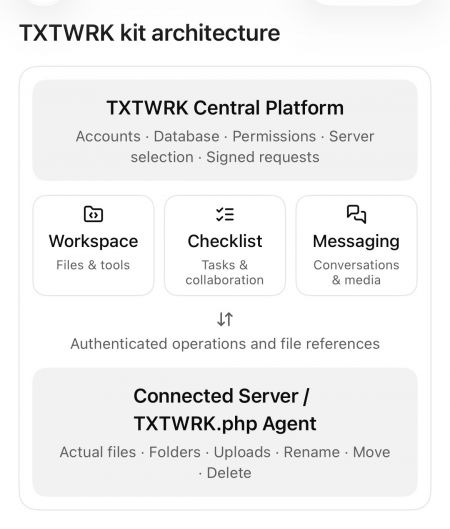
The general request flow is:

TXTWRK Interface
↓
TXTWRK Central API
↓
Session and Permission Validation
↓
Connected Server Selection
↓
Signed API Request
↓
Customer's /TXTWRK.php Agent
↓
Filesystem Operation
↓
Operation Result
↓
TXTWRK Central

The central API uses signed requests incorporating a timestamp, nonce and HMAC-SHA256 authentication.

Development Achievement


The Server API provides a common infrastructure for:
•Workspace operations
•Checklist directories
•Messaging media storage
•Authorised file access
•Remote uploads and downloads

Assessment


Status: Core architecture implemented.

Complete security and production-readiness verification still requires end-to-end testing.

---

4. ORIGINAL MESSAGING API KIT


Original Purpose


The Messaging API Kit was designed to provide private communication while allowing users to store media through Connected Servers.

The original concept included:
•Personal conversations
•Group conversations
•Private file sharing
•Server-backed media uploads
•Multimedia previews
•Downloadable attachments
•User-controlled storage capacity

Consolidated Messaging Architecture


Messaging now participates in the common Connected Server model.

The reviewed central gateway supports:
•Personal Messaging identity
•Delegated @MessagingAccess identity
•Accepted Messaging Access grants
•Group upload authorisation
•Direct-message upload authorisation
•Server-backed media storage

Important Architectural Separation


Messaging identity and storage entitlement are not the same thing.

A user may be authorised to store files on a particular Connected Server without representing that server owner's Messaging identity.

This allows TXTWRK to distinguish:

Who is communicating?

from:

Which Connected Server may store the files?

Assessment


Status: Shared storage authorisation implemented.

The complete Messaging attachment lifecycle still requires verification, particularly Rename, Move, Delete and database-reference consistency.

---

5. WORKSPACE KIT


Purpose


Workspace is TXTWRK's general-purpose file-management and working environment.

It uses the Connected Server infrastructure to perform authenticated filesystem operations.

Implemented Functionality

•Directory browsing
•File and folder listing
•File creation
•Folder creation
•Uploads
•Downloads
•Rename
•Move
•Delete
•File editing
•File versions
•Edit locks
•File ownership checks
•Edit requests
•ZIP compression
•ZIP extraction
•Delegated File Access
•Checklist integration

Original Compatibility


The early Workspace implementation preserved the existing manage.php action contract.

This allowed the original browser interface to continue functioning while filesystem operations were routed through the Connected Server agent.

Checklist Integration


Workspace became aware of Checklist file relationships.

When supported Checklist files or directories are moved, the Workspace implementation can invoke central reference synchronisation.

This is important because files are no longer treated solely as independent filesystem objects.

They may also be attachments belonging to Checklist comments, replies or Threadlets.

Assessment


Status: Implemented with substantial integration.

Remaining work concerns consistency after deletion, partial failures and cross-feature reference updates.

---

6. CHECKLIST KIT


Purpose


Checklist provides task-oriented collaboration connected to files, participants and discussions.

Core Functionality

•Checklist creation and organisation
•Checklist items
•Grouped items
•Item navigation
•Checklist overlays
•Applications
•Apply Now
•Active participants
•Comments
•Replies
•Threadlets
•Connected files
•Member directories
•File viewers
•Activity information

Connected Server Integration


Each Checklist can be associated with a selected Connected Server.

The directory system operates within the Checklist's authorised context.

The later gateway implementation checks the relationship between:
•Checklist ID
•Server ID
•Checklist owner
•Active participant
•Requested member directory

This helps prevent Checklist directory access from becoming unrestricted Workspace access.

Comments and Replies


The discussion system supports attached files and richer content.

The reviewed work includes:
•Comment attachments
•Reply attachments
•File listings
•Image previews
•Video previews
•Thumbnail handling
•Formatting controls
•Comment sorting
•Reply interactions
•Web Impression content

Threadlets


Threadlets extend Checklist conversations with nested discussion.

Development work included:
•Nested Threadlet presentation
•New Threadlet controls
•Connected file lists
•Image and video attachments
•Primary media previews
•Thumbnail handling
•Pagination
•Mobile indentation
•Visual discussion boundaries

Threadlet attachments use an independent database structure, including threadlet_media_files.

Mobile Development


Recent work addressed:
•Safari overlay scrolling
•Background-page scroll interference
•Checklist scroll-container targeting
•Apply Now navigation
•Dynamic comment viewers
•Web Impression display
•Threadlet presentation

The revised Apply Now behaviour was reported working after testing.

Assessment


Status: Broad functionality implemented and actively refined.

Some attachment lifecycle and interface interactions still require comprehensive regression testing.

---

7. API CONSOLIDATION ARCHITECTURE


The consolidated architecture can be represented as:

TXTWRK CENTRAL
│
├── Server Management
│ ├── Server registration
│ ├── Verification
│ ├── Stored credentials
│ └── Signed communication
│
├── Workspace Kit
│ ├── File management
│ ├── File editing
│ ├── File permissions
│ └── Checklist integration
│
├── Checklist Kit
│ ├── Items and groups
│ ├── Applications
│ ├── Comments and replies
│ ├── Threadlets
│ ├── Connected files
│ └── Member directories
│
├── Messaging Kit
│ ├── Personal identity
│ ├── Delegated identity
│ ├── Group/direct messaging
│ └── Server-backed media
│
├── Shared Authorisation
│ ├── Server ownership
│ ├── File Access
│ ├── Checklist membership
│ └── Messaging Access
│
└── Shared File Reference Management
├── Comment references
├── Reply references
└── Threadlet references
│
▼
CONNECTED SERVER
│
└── /TXTWRK.php
├── Files
├── Folders
├── Uploads
├── Downloads
├── Rename
├── Move
└── Delete

This represents the logical architecture visible in the reviewed code. It does not imply that every component has been consolidated into one physical PHP file.

---

8. FILE REFERENCE SYNCHRONISATION


One of the most important later developments was central attachment-reference synchronisation.

Purpose


When a file or directory changes location, TXTWRK must preserve the relationship between that file and the content referencing it.

Current Implementation


The reviewed function is:

txtwrkSyncConfirmedMoves()

It is designed to run after the Connected Server confirms a Rename or Move operation.

Database Tables


Checklist Comments


Table:

post_c_comment

Fields:
•file_connected_array
•thumbnail

Checklist Replies


Table:

checklist_reply_uploads

Field:
•file_location_name

Threadlets


Table:

threadlet_media_files

Fields:
•relative_path
•original_name

Server Isolation


Reference updates are scoped to the selected Connected Server.

This prevents an operation on one server from indiscriminately updating matching paths belonging to another server.

Example


Original attachment:

/opensource/system/checklists/user_i/files/photo.jpg

Renamed attachment:

/opensource/system/checklists/user_i/files/new-photo.jpg

After a confirmed Rename operation, the synchronisation function can update the relevant stored references.

Current Limitations


The reviewed implementation does not fully establish:
•Reference cleanup after Delete
•Synchronisation of Threadlet thumbnail_path
•Complete Messaging attachment synchronisation
•Automatic recovery from partial failures

Assessment


Status: Rename/Move synchronisation implemented for reviewed Checklist attachment structures.

Deletion and broader lifecycle consistency remain unfinished or unverified.

---

9. ORIGINAL CODE VERSUS CURRENT DEVELOPMENT


CapabilityOriginal FoundationDeveloped System
Directory APIGeneral filesystem operationsIntegrated Workspace and Checklist file management
Server APIConnect and verify serversShared Connected Server infrastructure
Messaging APIPrivate communication and mediaIntegrated storage authorisation
WorkspaceExisting file-management actionsConnected Server routing and Checklist integration
ChecklistItems, comments and repliesDirectories, richer media and Threadlets
AuthenticationSigned server requestsAdditional feature-specific permission checks
AttachmentsFeature-specific stored pathsCentral Rename/Move synchronisation
MediaExisting uploads and previewsExpanded thumbnail and video handling
Mobile UIExisting responsive controlsTargeted overlay and scrolling corrections
The original system already contained substantial functionality.

Later work should therefore be described primarily as consolidation, integration, extension and refinement rather than the creation of every capability from nothing.

---

10. SECURITY AND ACCESS CONTROL


The reviewed architecture includes several protection layers.

Connected Server Security

•Server verification
•Server ID checks
•Stored server secrets
•Signed requests
•Timestamp and nonce handling

Workspace Security

•Server ownership checks
•File Access permissions
•Allowed folders
•Allowed files
•Path validation

Checklist Security

•Checklist ID validation
•Server association
•Owner/participant checks
•Member directory restrictions

Messaging Security

•Messaging Access grants
•Delegated identity handling
•Group upload authorisation
•Direct-message upload authorisation
•Separation of identity and storage entitlement

Remaining Security Work

•End-to-end authorisation testing
•Cross-server isolation tests
•Path traversal testing
•Partial-operation recovery
•Destructive-operation permission checks
•Consistent error handling

Assessment


Status: Multiple security layers implemented.

A complete production security audit has not been established from the available files.

---

11. DEVELOPMENT PROGRESSION


Phase 1 — Original API Foundation


Established:
•Directory API
•Server API
•Messaging API
•Connected Server verification
•Remote filesystem communication

Phase 2 — Backend Consolidation


Developed:
•Shared Connected Server communication
•Signed operations
•Central server selection
•Permission routing
•Workspace compatibility

Phase 3 — Workspace Integration


Expanded:
•Remote file management
•File editing
•File locks
•Versions
•Archive operations
•Delegated File Access

Phase 4 — Checklist Integration


Developed:
•Checklist-selected Connected Servers
•Participant directories
•Connected file management
•Comment and reply attachments
•Directory viewers

Phase 5 — Collaboration Expansion


Refined:
•Threadlets
•Connected media
•Video thumbnails
•Web Impressions
•Nested discussion presentation

Phase 6 — Reference Synchronisation


Implemented:
•Comment attachment path updates
•Reply attachment path updates
•Threadlet attachment path updates
•Server-scoped Rename/Move synchronisation

Phase 7 — Interface Refinement


Addressed:
•Mobile Safari scrolling
•Overlay behaviour
•Apply Now navigation
•Dynamic viewers
•Threadlet layout
•Pagination interactions

Phase 8 — Current Consolidation Completion


Outstanding priorities:
•Safe deletion handling
•Thumbnail-path synchronisation
•Messaging reference verification
•Consistent operation results
•Cross-kit regression testing
•Security and failure-recovery testing

---

12. CURRENT DEVELOPMENT STATUS


SystemAssessment
Connected Server infrastructureImplemented
Server verificationImplemented
Signed API requestsImplemented
Directory API integrationImplemented
Workspace file operationsImplemented
Checklist directoriesImplemented
Checklist comments/repliesImplemented
ThreadletsImplemented
Media and thumbnailsImplemented with remaining path-consistency work
Messaging storage authorisationImplemented in gateway
Checklist Rename/Move reference syncImplemented
Delete reference protectionIncomplete or unverified
Threadlet thumbnail-path syncIncomplete
Complete Messaging attachment lifecycleNot fully verified
Cross-kit integration testingNot established
Production security auditNot established
These assessments refer to reviewed source code and reported testing, not measured percentages of completion.

---

13. REMAINING DEVELOPMENT PRIORITIES


Priority 1 — Attachment Deletion


Establish a consistent policy for deleting files still attached to comments, replies or Threadlets.

Recommended approach:

Block deletion while active references exist, unless an explicit attachment-removal workflow is used.

Priority 2 — Threadlet Thumbnails


Synchronise or invalidate thumbnail_path when the corresponding media is renamed or moved.

Priority 3 — Messaging Integration


Verify Messaging file-reference behaviour against the same lifecycle standards used for Checklist attachments.

Priority 4 — Shared API Responses


Standardise operation responses across controllers and the Connected Server.

Avoid forcing success = true when the remote operation has failed.

Priority 5 — Cross-Kit Testing


Test complete workflows involving multiple kits.

Example:

1. Upload a file through Checklist.
2. Attach it to a comment.
3. Open it through Workspace.
4. Rename it.
5. Confirm the comment still opens it.
6. Move its parent directory.
7. Confirm the reference updates.
8. Attempt deletion.
9. Verify the selected deletion policy is enforced.

Priority 6 — Stability


Preserve existing user interfaces and controls while strengthening the shared backend.

Avoid creating additional parallel APIs for operations already supported by the consolidated infrastructure.

---

14. FINAL ASSESSMENT


The original TXTWRK architecture began with:

DIRECTORY API KIT

The developed architecture now consists of:

TXTWRK CENTRAL

The central architectural achievement is that file storage, user identity, authorisation and collaboration records can remain separate while operating through common infrastructure.

Workspace manages files.

Checklist organises work and associates files with collaborative discussions.

Messaging provides private communication and authorised media storage.

The Server API establishes trusted communication with Connected Servers.

The Directory API supplies reusable filesystem operations.

The consolidation layer connects these responsibilities.

Overall Conclusion


TXTWRK has progressed substantially beyond its original three-kit foundation.

It now represents an integrated platform for connected storage, file management, collaborative Checklist work and Messaging.

The next development milestone is not another independent API Kit.

It is completing the consistency of the existing consolidated architecture across every file operation, permission boundary and attachment relationship.

The foundation is implemented. The remaining challenge is complete cross-kit reliability and verification.

---

REPORT SCOPE


This report is based on:
•Original API source files shared in the conversation
•Subsequent Workspace and Checklist implementations
•Connected Server gateway and runtime code
•Messaging-related gateway code
•Reference synchronisation functions
•Threadlet and media-related development
•Interface changes and reported testing

It does not constitute a live production audit, a complete line-by-line diff of every revision or confirmation that every generated replacement file has been deployed.

1/6
🗖 VIEW
⛶
Technology
Neutral
📢 TXTWRK Update: Introducing the Post Draft Upgrade with Library 💾


Create now. Save locally. Publish when you're ready.

At @TXTWRK, we're continuing to improve how people create, manage and publish content.

Our new Post Draft Library gives members greater control over unfinished posts, including posts containing text, images, videos, audio, checklists and other interactive content.

Instead of requiring every unfinished post to be uploaded to our servers, TXTWRK now supports browser-based draft storage.

You decide when to save, what to keep and when to publish.

---

💾 1. How the New Draft Library Works


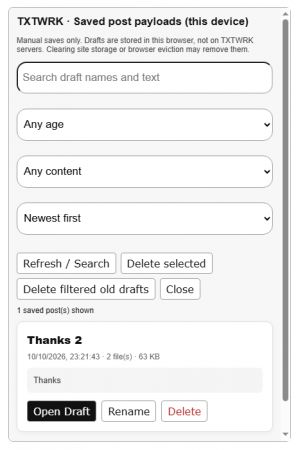
TXTWRK uses your browser's IndexedDB storage system to save unfinished post payloads on your device.

A post payload is the collection of information you have entered or attached to a post before publication.

This can include your written content, selected options, attachments and other post settings.

FeatureWhat it does
💾 Save DraftManually save the post you're creating
📄 Manage DraftsBrowse previously saved post payloads
✏️ Update DraftMake changes and save over an existing draft
📑 Save New CopyKeep another version of your post
📂 Open DraftReturn saved content to the post composer
🔎 Search & FilterFind drafts by name, age or media content
🏷️ RenameGive saved drafts meaningful names
🗑️ DeleteRemove individual or multiple saved drafts
↺ Reset PostClear your current post without deleting saved drafts
There is no automatic draft saving.

When you press Save Draft, TXTWRK saves your current work locally. Changes made after that save must be saved again if you want to preserve them.

Your saved drafts remain available for later use, provided your browser retains its site storage.

---

🎬 2. More Than Just Saving Text


TXTWRK posts can contain considerably more than a message and a photograph.

Our draft system is designed to preserve the information entered across the post composer.

Supported content and settings


Post featureDraft support
📝 Text, topics and assetsSaved form content
📸 PhotosSelected files and preview restoration
🎥 VideosSelected video files and related fields
🎙️ Voice and MP3Audio files and form settings
🎚️ Audio StudioProject arrangements and recorded takes
📖 StoriesScenes, media and narration fields
ChecklistsItems, groups and selected settings
🖥️ Checklist ServersSelected server information
🛍️ ProductsProduct form values
📈 InvestmentsFunding details and settings
EventsEvent details and dates
❓ QuestionnairesSaved input values
📍 LocationsLocation IDs and form selections
🔒 PrivacyAudience and visibility choices
💰 Paid ContentPricing and subscription settings
📊 CSV and 3DSupported files and related form values
🌐 Web ImpressionsSaved fields and HTML content
Important: Basic form values are broadly supported. Some advanced interactive editors may require additional review or adjustment after reopening a draft. Not every generated preview or editor state is guaranteed to be restored perfectly.

Our aim is to make returning to complex unfinished posts much easier.

---

👥 3. What Happens When Multiple Members Use the Same Device?


TXTWRK links each local draft library to the signed-in member's unique memberID.

For example, imagine two TXTWRK members using the same computer and browser profile.

ActionMember AMember B
Signs into TXTWRKMember A active—
Saves three drafts3 local drafts—
Signs outDrafts remain stored—
Member B signs inA's drafts not listedB's library opens
Member B saves two drafts3 drafts remain2 local drafts
Member A signs back inOriginal 3 drafts appearB's drafts remain separate
### What does that mean?
•Each member gets their own draft list within the TXTWRK interface.
•Signing out does not automatically erase saved drafts.
•Returning to the same account, browser and device allows that member to reopen their drafts.
•Another member signing in is not shown the previous member's draft library.

A privacy reminder: Member-specific draft lists provide application-level separation, not encryption or complete protection from someone who has access to the device's browser storage. Avoid storing sensitive drafts on shared or public computers.

---

📱 4. What Happens If You Change Devices?


Because TXTWRK's new draft system is browser-based, the location of your drafts matters.

SituationWill your saved drafts be available?
Close and reopen the same browserUsually yes
Restart your phone or computerUsually yes
Return after switching between appsUsually yes
Sign out and back into the same accountYes, if local storage remains
Another member signs in on the same browserOnly their own drafts are listed
Use a different browserNo automatic transfer
Sign in on another phoneNo automatic transfer
Clear TXTWRK browser site storageDrafts may be permanently lost
Uninstall a browser or clear its app dataDrafts may be lost
Your TXTWRK account identifies which local draft library to display, but the files themselves are not synchronised between your devices.

Save Draft is not a cloud-backup service. Browser storage may be cleared or evicted, and large media files are subject to available storage capacity.

---

🌍 5. How Does TXTWRK Compare with Other Social Networks?


Different networks take different approaches to unfinished content.

PlatformDraft approachKey distinction
TXTWRKManual, browser-based Draft LibraryMultiple named post payloads with supported files and settings
InstagramDrafts for posts and ReelsPrimarily device-based editing and content drafts
TikTokVideo draft collectionDrafts are device-dependent and may be lost after app removal
XPost and thread draftsDraft behaviour varies by application and device
LinkedInPost and article draftsSome drafts can be continued across devices
FacebookPersonal and Page draft workflowsDraft management differs between personal posting and Pages
TXTWRK's focus is on preserving more of the post creation process, rather than treating a draft as written text alone.

We also recognise that other platforms offer features such as cross-device drafts that TXTWRK's local-only library does not currently provide.

This is a different approach, designed around user-controlled local saving and the wide range of content TXTWRK supports.

---

💽 6. Why Use Browser Storage Instead of Uploading Every Draft?


There are several benefits to keeping unfinished post payloads locally.

For members

•More control: Decide exactly when to save.
•Less unnecessary uploading: Saving a draft does not submit the post payload to TXTWRK's draft servers.
•Multiple projects: Keep several unfinished posts and return to them individually.
•Media recovery: Selected files can be stored locally when browser storage permits.
•Draft management: Organise older work without publishing or deleting everything.

For the platform

•Fewer unnecessary draft-storage requests.
•Less server storage consumed by unfinished post uploads.
•Reduced dependence on repeated server-side draft saving.
•Separation between preparing content and publishing content.

The distinction matters: saving locally prepares your work for later, while pressing Post sends your finished content through TXTWRK's normal publishing process.

---

🚀 7. How to Save and Reopen a Post


Using the Draft Library is straightforward.

1. Start creating a post. Add your text, media and other content.
2. Press 💾 Save Draft. Give your draft a name.
3. Continue working or leave TXTWRK. Your saved version remains in browser storage.
4. Return to TXTWRK. Sign into the same account using the same browser profile.
5. Press 📄 Manage Drafts. Browse or search your saved posts.
6. Select Open. TXTWRK loads the saved payload back into the composer.
7. Review and publish. Check restored media and settings, make any final changes, then press Post.

You can also use Save New Copy to preserve an earlier version while continuing to develop another.

What about old drafts?


The manager supports searching, sorting, filtering by age or media, and deleting individual or multiple saved records.

Saved drafts are not automatically removed simply because you reset the composer or publish a post. You can manage or delete those saved copies yourself.

---

⚠️ 8. Important Things to Remember


We want members to understand both the capabilities and limitations of this feature.

1. Browser storage is not unlimited. Large videos and other attachments may reach browser storage limits.

2. Save important work regularly. TXTWRK does not automatically save changes between manual saves.

3. Do not clear your site storage if you need your drafts. Clearing browser data can permanently remove locally saved content.

4. Use the same browser profile. Signing into TXTWRK on another browser or device will not automatically retrieve these drafts.

5. Review complex posts before publishing. Advanced media editors and interactive components may need adjustment after reopening.

6. Wait for a successful save confirmation. If saving fails because storage is full or unavailable, your latest changes have not been safely preserved.

---

🌱 9. What's Next for TXTWRK?


The Draft Library is another step towards making TXTWRK a more flexible environment for creating content.

We're building beyond the idea that a social post must be completed and published in one session.

Our longer-term goal is a creative environment where members can prepare detailed posts, work with different media formats, return to unfinished projects and manage their content before it goes public.

That means continuing to improve advanced editor restoration, media handling and the reliability of local draft recovery.

---

💬 Your Work. Your Timing. Your TXTWRK.


Not every idea needs to be published immediately.

Sometimes you want to write today, add media tomorrow, review your settings later and publish when everything is ready.

TXTWRK's Post Draft Library gives you that flexibility — with manual saving, local storage and multiple draft management tools.

Sign into TXTWRK, open your post composer and explore 💾 Save Draft and 📄 Manage Drafts.

What other draft-management features would you like us to introduce?

@TXTWRK — Helping the world make text work in daily life.

#TXTWRK #TXTWRKUpdate #SocialMedia #Drafts #ContentCreation #DigitalCreativity #CreatorTools #BrowserStorage #WebDevelopment

🗖 VIEW
⛶
Reviews
Neutral

Derby City: Rape, Sexual Violence and Public Safety

Ten-Year Statistical Review and Autumn 2026 Preparedness Report


Report date: 10 October 2026
Location: Derby City, England
Reporting period: April 2016 – March 2026
Sources: Home Office, Office for National Statistics (ONS), Derbyshire Constabulary and Derby City Council

---

1. Executive Summary


This report examines the increase in police-recorded rape offenses in Derby City over ten years, the potential causes of that increase, and the measures undertaken by Derbyshire Constabulary and Derby City Council.

It also examines concerns about poor street lighting and public safety during autumn and winter 2026.

Key Findings

•Police-recorded rape offenses increased from 211 in 2016–17 to 448 in 2025–26, according to the working figures previously extracted.
•This represents an increase of approximately 112%.
•The ten-year working total is 3,708 recorded offenses.
•The annual average is approximately 371 recorded offenses.
•Derbyshire Constabulary has introduced specialist investigative and victim-support initiatives.
•Derby City Council has participated in public safety, CCTV and environmental improvement initiatives.
•The effectiveness of these interventions in preventing rape specifically within Derby City has not been established by the evidence reviewed.
•Current evidence is insufficient to determine whether Derby's street-lighting infrastructure is adequately prepared for autumn and winter 2026.

Important qualification: The crime figures are working totals from the previously discussed Home Office spreadsheets and require final independent verification.

---

2. Derby City Rape Statistics: 2016–2026


The following table presents the ten-year working dataset.

Financial YearRecorded Rape OffensesAnnual Change
2016–17211—
2017–18254+20.4%
2018–19325+28.0%
2019–20362+11.4%
2020–21357−1.4%
2021–22474+32.8%
2022–23473−0.2%
2023–24410−13.3%
2024–25394−3.9%
2025–26448+13.7%
Total3,708
Annual Average371
### Statistical Observations

Lowest year: 2016–17, with 211 recorded offenses.

Highest year: 2021–22, with 474 recorded offenses.

Latest year: 2025–26, with 448 recorded offenses.

Overall recorded increase: Approximately 112%.

The data suggests three periods:

1. 2016–2020: A substantial increase in recorded offenses.
2. 2020–2023: A further rise, reaching a peak in 2021–22.
3. 2023–2026: A decline followed by an increase in the latest financial year.

The trend is not a continuous annual increase.

Police-recorded offenses should not be interpreted as a direct measurement of all rapes committed during each financial year.

---

3. Why Are Recorded Rape Offenses Increasing?


There is no established single explanation for Derby's recorded increase.

3.1 Increased Reporting


Greater public awareness of sexual violence and increased confidence in reporting may contribute to higher police-recorded figures.

Some victims report offenses many years after they occurred.

An increase in reporting can therefore occur without an equivalent increase in recent offending.

3.2 Changes in Police Recording Practices


Improvements in police recording standards can increase the number of offenses officially recorded.

This makes historical comparisons more complicated.

3.3 Changes in Actual Offending


Increased actual offending may also contribute.

However, the Derby figures alone cannot establish how much of the recorded increase reflects a change in actual victimization.

3.4 Repeat Offending


Repeat perpetrators may present continuing risks.

Effective prevention requires:
•Identifying high-risk offenders.
•Investigating allegations thoroughly.
•Managing repeat offending.
•Providing safeguarding for victims.
•Intervening before further harm occurs.

3.5 Environmental Safety


Poor lighting, isolated pedestrian routes and inadequately maintained public spaces may increase vulnerability and fear of crime.

However, rape frequently occurs in private settings and may involve perpetrators known to victims.

Conclusion: Environmental improvements are important, but they cannot independently explain or prevent all sexual violence.

---

4. Derbyshire Constabulary: Actions Taken


4.1 Operation Soteria Bluestone


Derbyshire Constabulary has reported implementing the national Operation Soteria approach to improving rape and serious sexual offense investigations.

The approach includes:
•Suspect-focused investigations.
•Specialist investigative training.
•Improved treatment of victims.
•Better investigative processes.
•Greater attention to perpetrator behavior.

4.2 Victim Engagement Officers


Specialist victim engagement arrangements have been introduced to improve communication and support during investigations.

4.3 High Harm Offender Management


Derbyshire Constabulary reports using specialist teams and protective orders to manage individuals presenting serious risks.

4.4 Call It Out Campaign


The force has undertaken educational and prevention activity addressing misogyny, harassment and harmful behavior.

4.5 Public Scrutiny


The Derbyshire Police and Crime Commissioner has undertaken assurance work concerning serious violence and violence against women and girls.

Assessment


These initiatives demonstrate identifiable policing activity.

However, further evidence is needed to determine their effectiveness in reducing rape in Derby City.

Relevant indicators include:
•Charge rates.
•Prosecution outcomes.
•Investigation times.
•Repeat victimization.
•Victim experiences.
•Repeat offender management.
•Demonstrable prevention outcomes.

---

5. Derby City Council: Actions Taken


5.1 Safe Derby


Safe Derby is a partnership initiative addressing gender-based violence, harassment and public safety.

Its areas of activity include consideration of:
•Improved street lighting.
•CCTV.
•Environmental improvements.
•Awareness campaigns.
•Community engagement.

5.2 CCTV Infrastructure


Derby City Council reports operating 196 public-area CCTV cameras across the city center and selected surrounding locations.

CCTV may support detection and investigations.

However, camera coverage alone does not demonstrate that sexual violence has been prevented.

5.3 Project Flex


Project Flex is a joint initiative involving Derbyshire Constabulary and Derby City Council.

It addresses serious and organized crime in parts of Derby city center, including Green Lane and surrounding areas.

The council reported more than 50 arrests during its initial enforcement phase.

These arrests concern multiple offense categories and should not be interpreted as rape-specific outcomes.

5.4 Domestic Abuse and Sexual Abuse Strategy


The Derby and Derbyshire Domestic Abuse and Sexual Abuse Strategy 2026–2029 establishes a multiagency approach to prevention and victim support.

Assessment


The council has participated in documented public safety initiatives.

Further evidence is needed to establish:
•Implementation progress.
•Actual expenditure.
•Locations improved.
•Public feedback.
•Measurable prevention outcomes.

---

6. Street Lighting and Autumn 2026 Preparedness


Poor street lighting is a legitimate public safety concern.

As daylight hours shorten, inadequately illuminated routes may become less attractive or feel less safe to pedestrians.

6.1 Derby City Council Lighting Standards


IssuePublished Response Standard
Ordinary faulty streetlightVisit within five working days and attempt repair
Electricity supply faultMay take up to 25 working days
Dangerous electrical or structural faultAim to attend within one hour
These standards do not establish how quickly every repair is completed.

6.2 Outstanding Questions


The evidence reviewed does not establish:

1. The current number of defective streetlights.
2. The total repair backlog.
3. The number of faults exceeding response standards.
4. Whether high-priority pedestrian routes have been inspected.
5. Whether additional lighting improvements have been completed before autumn 2026.
6. Whether lighting maintenance has been evaluated alongside sexual violence prevention.

6.3 Suggested Audit Locations


The following areas should be considered for pedestrian safety assessments:
•Derby city center and St Peter's Street.
•Green Lane and surrounding connections.
•Arboretum Park approaches.
•Normanton Road and nearby pedestrian routes.
•Bus stops and public transport connections.
•Routes connecting nightlife venues, car parks and residential areas.

Important: These are suggested locations for assessment, not verified locations of defective lighting or rape hotspots.

Autumn 2026 Conclusion


The available information does not establish whether Derby is adequately prepared for autumn and winter 2026.

A published lighting fault inventory and independent route assessment would provide a stronger evidence base.

---

7. Recommended Action Plan


TimescaleRecommended ActionIntended Outcome
14 daysPublish lighting fault backlogPublic transparency
30 daysAddress priority lighting defectsSafer pedestrian routes
60 daysConduct joint police–council public safety reviewIdentify environmental risks
90 daysPublish Derby-specific rape investigation indicatorsAccountability
6 monthsEvaluate prevention initiativesEvidence of effectiveness
12 monthsIndependent progress reviewAssess outcomes
These are proposed actions and deadlines, not existing commitments.

7.1 Immediate Priorities


Street lighting: Identify and prioritize defective lighting on pedestrian routes.

Safeguarding: Strengthen support for victims and people at risk of repeat harm.

Investigations: Improve investigative quality and monitor delays.

Prevention: Evaluate education, offender management and public-space interventions.

Transparency: Publish progress in a form residents can understand.

---

8. Questions for Derbyshire Constabulary and Derby City Council


Street Lighting


1. How many streetlights are currently defective in Derby City?
2. How many faults have remained unresolved for more than five working days?
3. Which pedestrian routes have been inspected ahead of autumn 2026?
4. What funding is available for lighting improvements?

Sexual Violence


5. How many rape offenses recorded during 2025–26 relate to incidents occurring in earlier years?
6. What proportion of recorded rape offenses result in charges?
7. How have investigation times changed?
8. What evidence demonstrates the effectiveness of Operation Soteria in Derby?
9. What measurable outcomes have resulted from Safe Derby?

Public Accountability


10. When will a joint police–council public safety progress report be published?
11. Who is responsible for overseeing outstanding actions?
12. How will residents and survivors be involved in evaluating improvements?

---

9. Overall Conclusions


The ten-year working dataset indicates a substantial increase in police-recorded rape offenses in Derby City.

This raises important questions about actual victimization, reporting behavior, prevention, safeguarding and investigation outcomes.

Derbyshire Constabulary and Derby City Council have undertaken documented initiatives addressing sexual violence and community safety.

However, the evidence reviewed does not establish the extent to which those initiatives have reduced rape in Derby City.

Street lighting deserves specific attention during autumn and winter.

The council's published maintenance standards provide a basis for accountability, but current evidence is insufficient to determine whether the city's lighting network is adequately maintained.

Final Assessment


The most important next steps are to:

1. Verify the historical crime statistics.
2. Investigate the factors behind changes in recorded offenses.
3. Obtain current street-lighting fault and repair data.
4. Assess pedestrian safety on priority routes.
5. Publish Derby-specific investigative and prevention outcomes.
6. Establish measurable public safety objectives.
7. Independently evaluate progress.

The long-term objective should be zero sexual violence.

Progress toward that objective must be assessed using more than police-recorded crime totals.

Actual victimization, victim safety, reporting confidence, repeat harm, investigative quality and effective prevention must all be considered.

---

10. Sources


1. Home Office: Police Recorded Crime Community Safety Partnership Open Data, 2016–2026.
https://www.gov.uk/government/statistical-data-sets/police-recorded-crime-and-outcomes-open-data-tables

2. Office for National Statistics: Crime in England and Wales.
https://www.ons.gov.uk

3. Derbyshire Constabulary: Sexual violence investigations, safeguarding and prevention.
https://www.derbyshire.police.uk

4. Derbyshire Police and Crime Commissioner: Serious violence and violence against women and girls assurance work.
https://www.derbyshire-pcc.gov.uk

5. Derby City Council: Street lighting, Safe Derby and Project Flex.
https://www.derby.gov.uk

Evidence Limitations


The annual rape figures are working totals previously reported from the two uploaded Home Office spreadsheets. They have not undergone final independent row-by-row verification.

The institutional measures described are drawn from the public information reviewed earlier in this conversation.

The report does not establish a causal connection between street-lighting conditions and the ten-year rape trend.

It is a desk-based evidence review, not a physical safety inspection or independent performance audit.

---

End of Report
Derby City — 10 October 2026

🗖 VIEW


SPONSORED AD
⛶
Neutral
A progress update after 17 months of developing TXTWRK, the world’s best network in the making!

We’ve made a bunch of new updates lately for our notification and checklist technology. You can now query a member’s engagements, you can also query a members directory to see their files, you can also format a message to switch between raw code and link code, you can copy raw code and you can copy the link of a comment too. — You will also be able to do all of these things on replies and threadlets in the next 24 hours, alongside doing some of these things when viewing applicants. We’ve tried to make the process a lot more easier and organised when things get busy.

Notification updates recently includes being able to hide individual notifications or hide notifications from a member, to help you manage your notifications better. You can still view notifications from them, if you choose to do so via the visibility filter. We will also introduce the ability to set rules and to be able to make labels/groups to segregate your notifications to the highest of levels for network delivery.

In other news, it’s super interesting how we have managed to link our API Directory kit to members directories for checklist owners servers, so now you can click on “Query Member Directory” to see a members files with ease for a checklist they are working on. We also made changes to primarily uploading files versus adding files to comments, which enables businesses & charities to own & manage their own data.

There’s lots more news coming up over the next two weeks, from seeing our advertising system in action, right up to taking a lead in the leaders innovation fund for the United Kingdom government programme is 2025.

You will see us develop in the live space over the next 48 hours, talking about this new fund being offered by the UK government which we will be encouraging UK entrepreneurs to apply to this leaders fund as well. We understand that we are eligible for this fund and with our recent progress @DerbyCollege, we’re looking forward to being a pioneer in work based technology for many years to come, where Derby College has expressed their interest in continuing our work & expanding upon our partnerships via Derby Community Hub & TXTWRK, alongside other ventures of our founder, such as UIA The Game & The ImFashion Group. We started on our journey to help people volunteer and now we’re achieving this goal, alongside inspiring the next generation of students, who most needed our opportunities.

Nearly 6 months complete in 2025, there’s no better time than now to reflect on the developments we’ve made across our life & work.

🗖 VIEW