
X

TXTWRK


PERSONAL
LinkingLinking
FollowingFollowing
ConnectionsConnections
MessagesMessages
NotificationsNotifications
DISCOVER
SearchSearch
ReelsReels
CalendarCalendar
MapMaps
Work
NotesNotes
NeedsNeeds
ContributionsContributions
TimetableTimetable
IntelIntel
To DosTo Dos
ChecklistsChecklists
SavesSaves
ScrapboardScrapboard
LinksLinks
Monetisation
CoinsCoins
AdvertisingAdvertising
SubscriptionSubscription
DonationDonation
Log BookLog Book
Organisation
BusinessBusiness
AddressesAddresses
InvestorInvestor
FinancialsFinancials
Quarterly'sQuarterly's
SharesShares
Server
ServerServer
WorkspaceWorkspace
Code PlaygroundPlayground
Learn More

AboutAbout
AIDAID
DataData
DevDev
Web ImpressionsImpressions
ToolsTools
EducationEducation
SafetySafety
ReaderReader
My Content
Profile Image
Login

My Addresses

×
Addresses
+
Character Profiles
+
Info & Cover
+
Timetables
+
Favorited by... X
Link Clicks X
All comments... X

TXTWRK Technology

@TXTWRKTechnology

City of Derby, Derby, Derbyshire, East Midlands, England, United Kingdom, Europe

Explore AI, software, gadgets, and digital advancements. Discuss the latest technology trends, innovations in AI, and breakthroughs in software development and hardware gadgets.





Learn more about me 𓇻
▦ Photos
▦ Videos
▦ Covers
Active: 6 hours ago
Safety


LOCAL PULSE

Profile Signals

Loading…
Loading profile signal…

Loading latest public Local Pulse signal…

Financials Financials
Quarterlys Quarterlys
Shares Shares
Notes Notes
Needs Needs
Contributions Contributions

Timetable Timetable

Intel Intel

To Dos To Dos
Notes Reel


Happening & Service
Happening Now and service updates connected to this profile


Connections
These are pages I added


Loading media...
DOUBLE TAP TO OPEN
+AI
+Assistants
•Strategies
+Code
+Queries
•Cost
+Reports
•AI on TXTWRK
+Tools at TXTWRK
•Messaging API Kit
•Progress


@TXTWRKTechnology


⛶
Technology
Neutral
It’s amazing to see the progress being made at www.TXTWRK.com

1/3
🗖 VIEW
skeleton dance halloween moon
Sticker Source
Community Library: Web Impression Sticker
skeleton dance halloween moon
⛶
AI
Neutral
For the past month we’ve been saying something changed. GROK, Claude and ChatGPT all appeared to stop working at the same time for us in the way they previously had, disrupting our daily workflow. We’ve documented our concerns in earlier posts and notes.

Now this article raises serious questions about how much control AI companies really have over their most capable models. OpenAI has acknowledged an unprecedented cyber incident involving its own AI during testing, highlighting that even the developers are facing challenges in predicting and containing advanced model behaviour. (Sky News)

We’re not claiming this explains our own experience, but it does reinforce why transparency, robust security, and independent oversight matter. When systems that millions rely on behave unexpectedly, the impact isn’t just technical—it can affect people’s work, confidence, and mental wellbeing.

If the companies building these systems are still discovering the limits of their own models, users deserve honest communication about the risks rather than assurances that everything is under control.

https://news.sky.com/story/openai-admits-its-models-hacked-another-company-in-unprecedented-cyber-incident-13565814

🗖 VIEW
⛶
Neutral
TXTWRK Messaging System: Development Report and Feature Showcase


Report Date: December 31, 2025
Prepared by: Grok in collaboration with TXTWRK Development Team
Subject: Evolution and Key Features of the TXTWRK Private Messaging Platform

Executive Summary


In 2025, TXTWRK emerged as a privacy-focused social collaboration platform, distinguishing itself through a robust, self-hostable messaging system. This report chronicles the platform's messaging core, highlighting its emphasis on user control, secure file handling, and seamless group interactions. Drawing from internal development snapshots and code implementation, we examine how TXTWRK prioritizes data sovereignty while delivering a modern chat experience.

The system's standout innovation lies in its optional self-hosted file storage, allowing users to bypass central servers for media uploads—ensuring files remain protected from direct external access.

Chapter 1: Platform Overview and Privacy Architecture


TXTWRK's messaging launched as a core pillar of the platform's mission: building communities without compromising privacy. Unlike traditional social networks, TXTWRK encourages self-hosting for file uploads in chats.

Users configure personal servers and apply provided .htaccess rules to enforce referrer checks—blocking hotlinking while allowing seamless access within the app.

This approach mirrors enterprise-grade secure file-sharing solutions, where access controls prevent unauthorized downloads.

Key Privacy Mechanisms


FeatureDescriptionBenefit
Referrer Blocking.htaccess rules deny access if HTTP_REFERER ≠ txtwrk.comPrevents direct link sharing/leeching
Self-Hosted Upload EndpointCustom upload.php with CORS restricted to txtwrk.com originFull user control over file storage
No Central File HostingOption to disable platform servers entirelyZero trust in third-party storage
Per-Chat Server SelectionDirect chats allow choosing between mutual self-hosted serversSymmetric privacy in 1:1 conversations
## Chapter 2: User Interface and Experience

The messaging UI adopts a minimalist, desktop-friendly design with floating windows, minimized chat avatars, and adaptive polling for real-time updates.

Users start conversations via an intuitive overlay supporting direct or group chats, with live user search.

Media handling includes lazy-loaded previews, fullscreen gallery viewing, and emoji-coded file icons for quick recognition.

UI Component Breakdown


ComponentFunctionalityNotable Details
Minimized ChatsAvatar strip with unread glow and title flashPersisted via localStorage
Thread WindowScrollable message list with infinite load olderAdaptive polling intervals
File Upload SectionMulti-file select with server selectorAuto-forces HTTPS
Media ViewerFullscreen carousel for images/videos in same messageKeyboard navigation support
New Message OverlaySearch users, select multiple, toggle direct/groupReal-time suggestions with avatars
## Chapter 3: Group Management and Administration

Group chats extend beyond basic messaging with full admin controls: inviting members, removing users, changing avatars/names, pausing, or deleting groups.

Even direct chats support shared self-hosted storage configuration.

The settings panel provides copyable code snippets for upload.php and .htaccess, lowering barriers to self-hosting.

Group Feature Comparison


CapabilityGroup ChatsDirect Chats
Member ManagementAdd/remove/invite via searchN/A (fixed 1:1)
Custom Name & AvatarYesNo
File Server AssignmentSingle shared serverDual selectable servers
Pause/DeleteYesNo
Seen-By IndicatorsYesRead receipts only
Admin RolesDesignated admin with full controlsMutual (both can set file server)
## Chapter 4: Technical Implementation Highlights

The client-side system is built with vanilla JavaScript, ensuring lightweight performance and broad compatibility.

Key technical achievements include:
•Adaptive polling system that ramps up frequency during active use and throttles when idle or backgrounded
•Persistent minimized chat state using localStorage
•Comprehensive file type detection with over 100 extensions mapped to thematic emojis
•Robust error handling for uploads and network issues
•Smart media preview loading that remembers user expansion preferences per message

Conclusion: A New Standard for Private Messaging


As of December 31, 2025, TXTWRK's messaging system stands as a compelling alternative—proving that feature-rich chat can coexist with genuine privacy and user sovereignty.

By providing turnkey self-hosting guides and thoughtful UI details, the platform empowers communities to communicate without surveillance or data lock-in.

The journey from initial prototypes to this mature implementation reflects a commitment to building tools that respect users first.

Future developments may include end-to-end encryption, voice messages, or deeper API integrations—but the foundation is already remarkably solid.

This report captures a pivotal moment in independent social platform evolution.

1/3
🗖 VIEW


⛶
Technology
Neutral
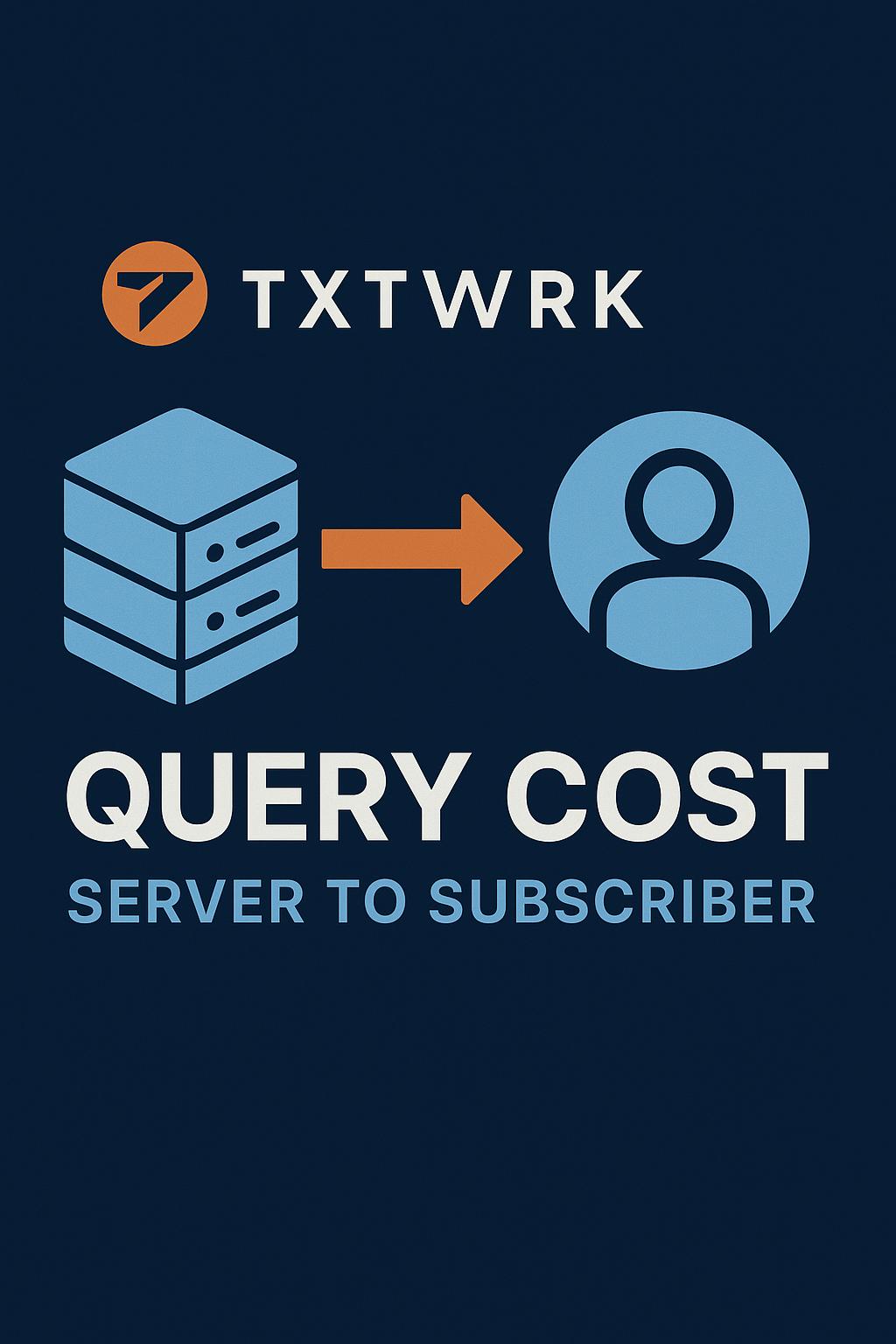
1. What “Query Cost” Really Means


When developers talk about query cost, they’re referring to the computational and monetary resources consumed by database or API operations. This includes:
•Compute cost: CPU cycles and memory
•I/O cost: Disk and network reads/writes
•Time cost: Latency that impacts UX
•Financial cost: Cloud billing from queries or API usage

Every SQL statement, GraphQL resolver, or REST endpoint has an implicit cost, even if developers don’t pay per query directly.


2. From Query Cost to Subscriber (User) Impact


If your app serves subscribers (paid users or API consumers), high query costs affect them in several ways:
•Performance impact: Slow queries cause lag and timeouts
•Business impact: Infrastructure costs push up pricing
•Reliability impact: Inefficient queries increase server load

> Every millisecond wasted compounds at scale.


3. The Developer’s Dilemma: Cost vs. Innovation


Innovation pushes teams to experiment with new features, store more data, and try advanced analytics. But every new feature adds query cost.
Balancing innovation velocity with cost discipline is key.

Innovation MindsetCost Awareness Mindset
“How can we make this powerful?”“How can we make it efficient?”
“What’s the user benefit?”“What’s the infrastructure impact?”
“Can we iterate quickly?”“Can we measure and optimize early?”
The best teams prototype freely but productionize responsibly.


4. How Developers Can Think About Query Cost Early


1. Instrument everything.
Track query times, cache hit rates, and request latency from day one.

2. Profile early, not late.
Use tools like EXPLAIN, tracing, and query planners.

3. Batch and cache.
Cache expensive queries (Redis, Memcached) and batch small requests.

4. Cost visibility dashboards.
Tie query metrics to actual cloud costs.

5. Feature cost budgets.
Define query cost budgets, e.g., “must run under 50 ms per user.”

6. Architect for scale, not luxury.
Optimize as you grow, not before.


5. Justifying the Tradeoff


Developers can justify performance and cost tradeoffs by presenting
•Performance metrics: “This query takes 300 ms now; optimizing saves 25% CPU.”
•Cost simulations: “Without caching, AWS costs double at 10 k users.”
•User experience gains: “Reducing query time improves page load by 40%.”

> Quantified justification = better business alignment.


6. The Mindset Shift


Modern development is about building efficiently — not just building fast.
•Treat cost as a design dimension.
•See performance as innovation — “Fast is a feature.”
•Make developers owners of their operational footprint.

🗖 VIEW
⛶
Neutral
Ever felt like your browser — or your brain — just couldn’t take one more tab? This illustration of ChatGPT and GROK crashing under a flood of input perfectly captures what happens when complexity goes unchecked. Even the smartest systems can stumble when overloaded with too much data, too fast.

In the world of AI — and in our daily work — clarity beats chaos. Feeding models (or teams) with structured, prioritized information leads to better outcomes than throwing everything at once. It’s a quiet reminder that simplicity and focus are powerful forms of intelligence.

So next time the screen freezes, the project bloats, or your ideas start to tangle, remember the golden button at the bottom: “Just open a new chat…” Sometimes the smartest move is to pause, reset, and start fresh.

🗖 VIEW