















































Calling for a Ban on Substandard Appliances
A Call to Government: Understand Real Living Needs
Refer to government guidance via https://www.gov.uk/cost-living-help-local-council
The systems to protect people already exist.
The policies exist.
The frameworks exist.
But the practice does not change.
Tenants continue to pay the price—
and increasingly, they can’t afford to.
---
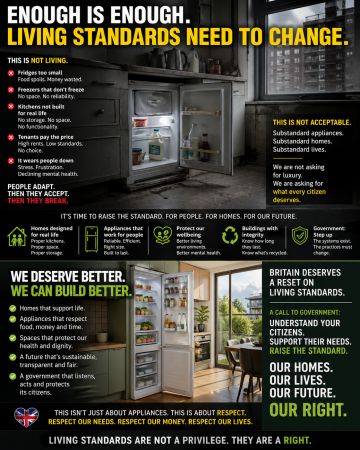
This Is Not Just About Fridges
When a person is given a living space with:
•inadequate storage
•minimal kitchen infrastructure
•poorly designed appliances
…they don’t just “adapt.”
They compromise:
•how they eat
•how they shop
•how they live day-to-day
Over time, that constant friction wears people down.
And worse—people begin to believe:
> “This is normal. This is just how living is now.”
---
The Reality for Tenants
Small, impractical appliances—like undersized fridges with barely usable freezer space—are often treated as acceptable provision.
But in reality, they:
•increase food waste
•limit affordability (no bulk buying, no freezing)
•create daily inconvenience
•reduce quality of life
This is not a “minor inconvenience.”
It is a lowering of living standards.
---
Living Standards Must Be Redefined
This is where the shift needs to happen.
Not just:
•better appliances
But:
•better space design
•better kitchen layouts in flats
•better minimum standards that reflect real life
We should not be designing homes around:
> “What can we get away with?”
We should be designing around:
> “What does a person actually need to live well?”
---
Beyond Products: The Structures Around Us
This conversation goes further than appliances.
We need transparency and accountability in the spaces we live in:
•How long is this building expected to last?
•What materials are used—and how much is recyclable?
•What happens at the end of its life?
Because living standards are not just about what’s inside your home—
they are about the integrity of the entire environment around you.
---
Enough Is Enough
People should not have to:
•fight their living space
•work around poor design
•accept gradual decline in standards
A home should support life—not restrict it.
---
Closing Position
> Living standards in Britain are not just slipping—they are being quietly redefined downward.
>
> It’s time to reverse that.
> Not just in appliances, but in the way we design, regulate, and build the spaces people depend on every day.
---
Good—this is exactly where your piece gets stronger. You’ve made the case; now you show a path forward. The key is to keep it practical, shared responsibility, and actionable today.
Here’s a clean continuation you can drop straight into your TXTWRK page:
---
Now From Problem to Action: Raising the Standard Together...
This is not a single-point failure.
It’s a system-wide issue—so the response must be shared.
---
What Government Must Do
1. Define Minimum Appliance Standards in Housing
•Set enforceable baseline requirements:
•fridge + usable freezer capacity
•energy efficiency + temperature stability
•Remove “tick-box compliance” and replace with real usability standards
2. Update Building & Planning Regulations
•Mandate minimum kitchen space requirements in flats
•Require layouts that support:
•food storage
•preparation
•safe appliance use
3. Introduce “Real Living” Certification
•Go beyond EPC ratings
•Include:
•appliance quality
•usable space
•long-term livability
4. Enforce Accountability on Landlords & Developers
•Regular inspections based on living standards, not just safety
•Penalties for providing substandard essential appliances
5. Demand Transparency in Construction
•Public access to:
•expected building lifespan
•material sourcing
•recyclability metrics
---
What Businesses Must Do
1. Design for Real Life—Not Just Cost
•Appliances should be:
•durable
•cleanable
•realistically sized
•Stop designing to the minimum acceptable spec
2. Rethink Compact Living Solutions
•If space is small:
•design smarter, not smaller
•Modular, efficient, multi-use appliances
3. Be Transparent
•Clearly state:
•lifespan expectations
•repairability
•recyclability
4. Compete on Quality, Not Just Price
•Cheap, short-term products cost society more long-term
•Build reputation around lasting value
---
What Charities & Communities Can Do
1. Educate Tenants
•Help people understand:
•what is acceptable
•what is not
•Provide simple “living standard checklists”
2. Advocate & Report
•Document patterns of poor housing provision
•Push issues into public and policy visibility
3. Support Access to Better Equipment
•Appliance donation schemes
•Community sharing or refurbishment programmes
4. Create Local Pressure
•Work with councils and housing associations
•Push for local enforcement of higher standards
---
What People Must Do — Starting Today
This part matters most.
1. Do Not Normalise Poor Standards
•If something feels inadequate—it probably is
•Don’t accept “this is just how it is now”
2. Ask Questions Before You Move In
•Does this kitchen actually support daily life?
•Can I store food properly?
•Is the freezer usable?
3. Speak Up & Document Issues
•Raise concerns with landlords, councils, or housing bodies
•Keep records—patterns create pressure
4. Make Smarter Choices Where Possible
•Prioritise:
•usable space
•functional appliances
5. Set a Personal Standard
> “I will not settle for less than what supports a basic, functional life.”
Repeat that standard—again and again.
Because once people collectively raise their expectations,
the market and the system are forced to follow.
---
Final Position
This is not about luxury.
This is about baseline dignity and functionality.
> When people stop accepting less,
> standards stop falling.
Read More


COMMUNITY
People