














































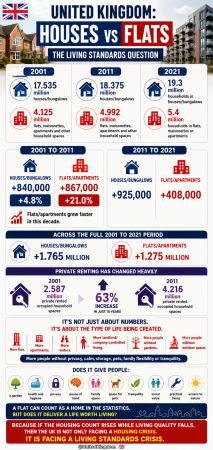
🇬🇧 United Kingdom: Houses vs Flats — The Living Standards Question
In 2001, England & Wales had:
17.535 million houses/bungalows
4.125 million flats, maisonettes, apartments and other household spaces
By 2011, that became:
18.375 million houses/bungalows
4.992 million flats, maisonettes, apartments and other household spaces
That means from 2001 to 2011:
Houses/bungalows increased by 840,000
Flats/apartments increased by 867,000
So flats/apartments grew faster:
Houses: +4.8%
Flats/apartments: +21.0%
By 2021, England & Wales had:
19.3 million households in houses/bungalows
5.4 million households in flats, maisonettes or apartments
That means from 2011 to 2021:
Houses/bungalows increased by about 925,000
Flats/apartments increased by about 408,000
Across the full 2001 to 2021 period:
Houses/bungalows increased by about 1.765 million
Flats/apartments increased by about 1.275 million
But the living standards issue is not only the number.
It is the type of life being created.
More flats.
More apartments.
More renters.
More landlord/company-controlled living.
More people without gardens.
More people without outdoor space.
More people without privacy, calm, storage, pets, family flexibility or tranquility.
At the same time, private renting changed heavily.
In 2001, England & Wales had 2.587 million private rented occupied household spaces.
By 2011, that had risen to 4.216 million.
That is a 63% increase in private renting in just ten years.
So the real question is not only:
How many homes are being built?
The real question is:
Are we building proper living standards, or just more housing units?
A flat can count as a home in the statistics.
But does it give people:
🌳 a garden
🧼 health and hygiene
🔒 privacy
🧠 peace of mind
👨👩👧 family space
🐕 space for pets
🌿 tranquility
🤝 social value
🛠 practical living
🌤 access to nature
Because if the housing count rises while living quality falls, then the UK is not only facing a housing crisis.
It is facing a living standards crisis.
@UnitedKingdom
Read More

COMMUNITY
People